The things people make time for
The Second Bell Rooms occupy two former offices above a Stavenbruck tram workshop. On ordinary evenings they offer recorded music and tea; twice in a good week the movable partition opens for live performers or dancing. Bela Noren, sound technician and occasional singer, runs the tape deck with a pencil list of cue points. She has to rewind between selections unless another machine is available. Her audiences know that pause: conversation rises, glasses move and somebody calls for a song she has already declined twice.
Bela dreams of recording a regional programme with musicians from ferry and foundry towns. She also wants one evening each week when she can visit her sister without being told the programme will fail without her. The room is a business, a social place and a technical undertaking. Performers argue about microphone placement, payment, which songs count as old standards and whether a imperfect live performance is better than a carefully duplicated recording.
Music and the ownership of a copy
Recordings travel through lending, sale, copied cassettes and gifts. A clean early copy can carry prestige; an unreliable handwritten label can be part of a joke between friends. The Reading Exchange lends designated listening copies. A performer may permit a household copy but object to somebody charging admission to play it. The city has neither effortless enforcement nor one universally accepted view of ownership. These disagreements provide ordinary artistic politics without requiring a modern global entertainment industry.
Foundry bands use brass, drums and durable instruments that compete with an outdoor crowd. Ferry songs favour refrains several tired people can hold together. Students at the Institute experiment with tape loops and controlled mechanical sounds; older listeners may call the result a workshop malfunction. Some elders love it. Music preferences do not divide neatly by age or class, though owning equipment makes experimentation easier.
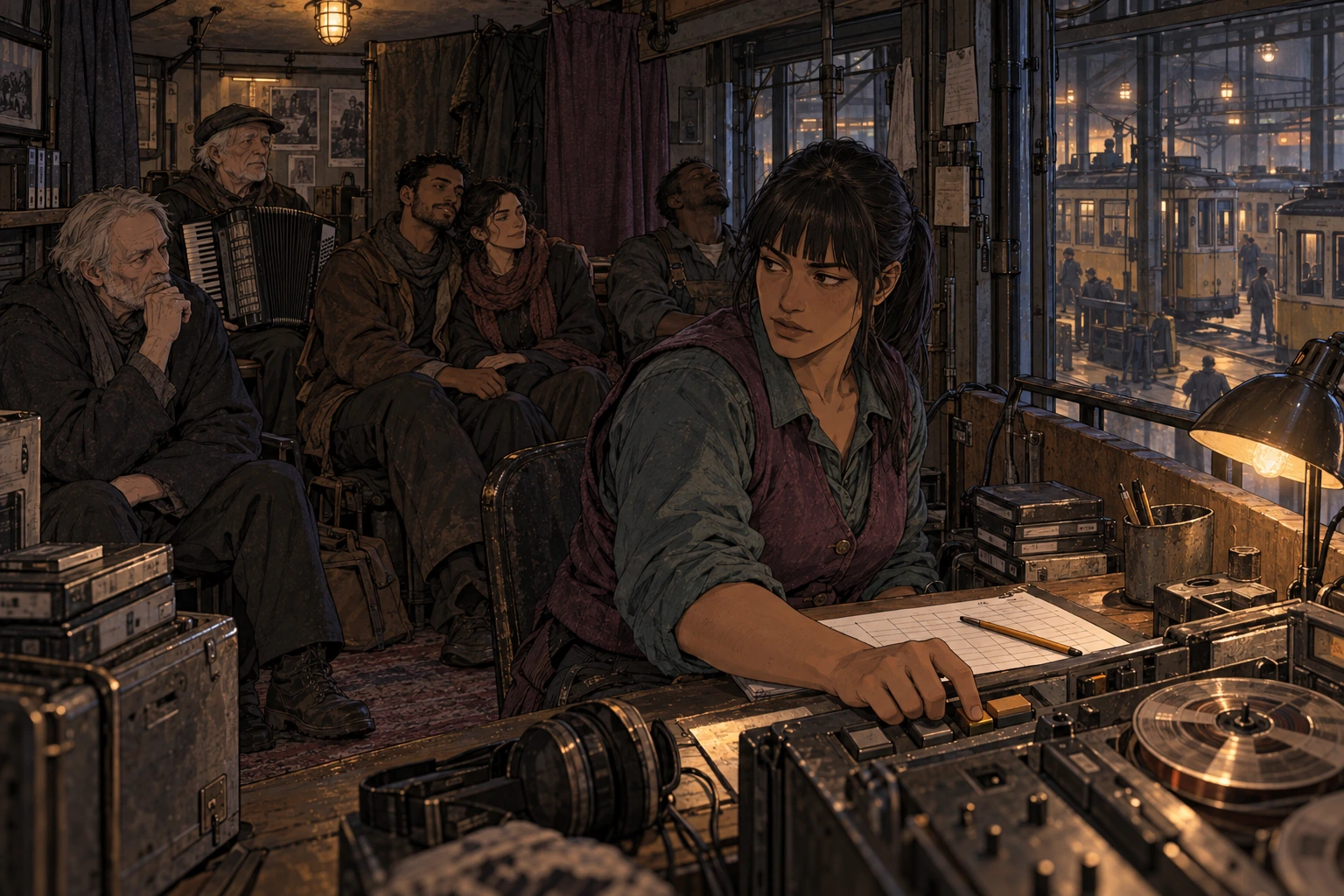
Bela Noren cues a physical recording while listeners make room for an evening together.
Open full-size illustration ↗People in this picture · 1
Bela Noren
foreground, at the tape transport · Goes by Bela
Residence: rooms near the Second Bell Rooms, Stavenbruck. Bela tends recordings and equipment at the Second Bell Rooms. She likes an evening to sound welcoming without drowning out conversation. She is cueing the recording for the waiting musician and listeners in her usual working role.
Festivals without compulsory happiness
Lantern Repair Day is a proposed Northbank custom tied to the return of longer working light rather than a fixed new calendar date. Households bring lamps to a courtyard bench, repairers demonstrate simple maintenance, and children carry paper silhouettes around the yard at dusk. The event began as useful work and acquired songs, food stalls and a competition for the cleverest repaired lamp. It may be held, postponed or skipped. A person who dislikes crowds is not thereby rejecting community.
Roven Ferry's First Open Crossing marks the resumption of a dependable seasonal service. Pilots decorate the ferryhouse rail, names of lost boat workers are read, and a public meal follows when organisers can supply it. The ceremony is neither a safety certification nor a universal religious observance. Tarnfeld's Press Supper celebrates the completion of a major production run, with disputes over who deserves thanks often surviving the speeches. Brackenzell's workshop procession displays beautifully finished ordinary objects as well as music; a stove door can be a work of pride.
These celebrations coexist with household remembrance meals. Mourning can be public, private, secular or religious. Some families set an absent person's cup beside the table; others find that gesture unbearable. No single custom claims every household. The official announcement of a transport loss may arrive long after neighbours began fearing it, complicating when people feel entitled to mourn.
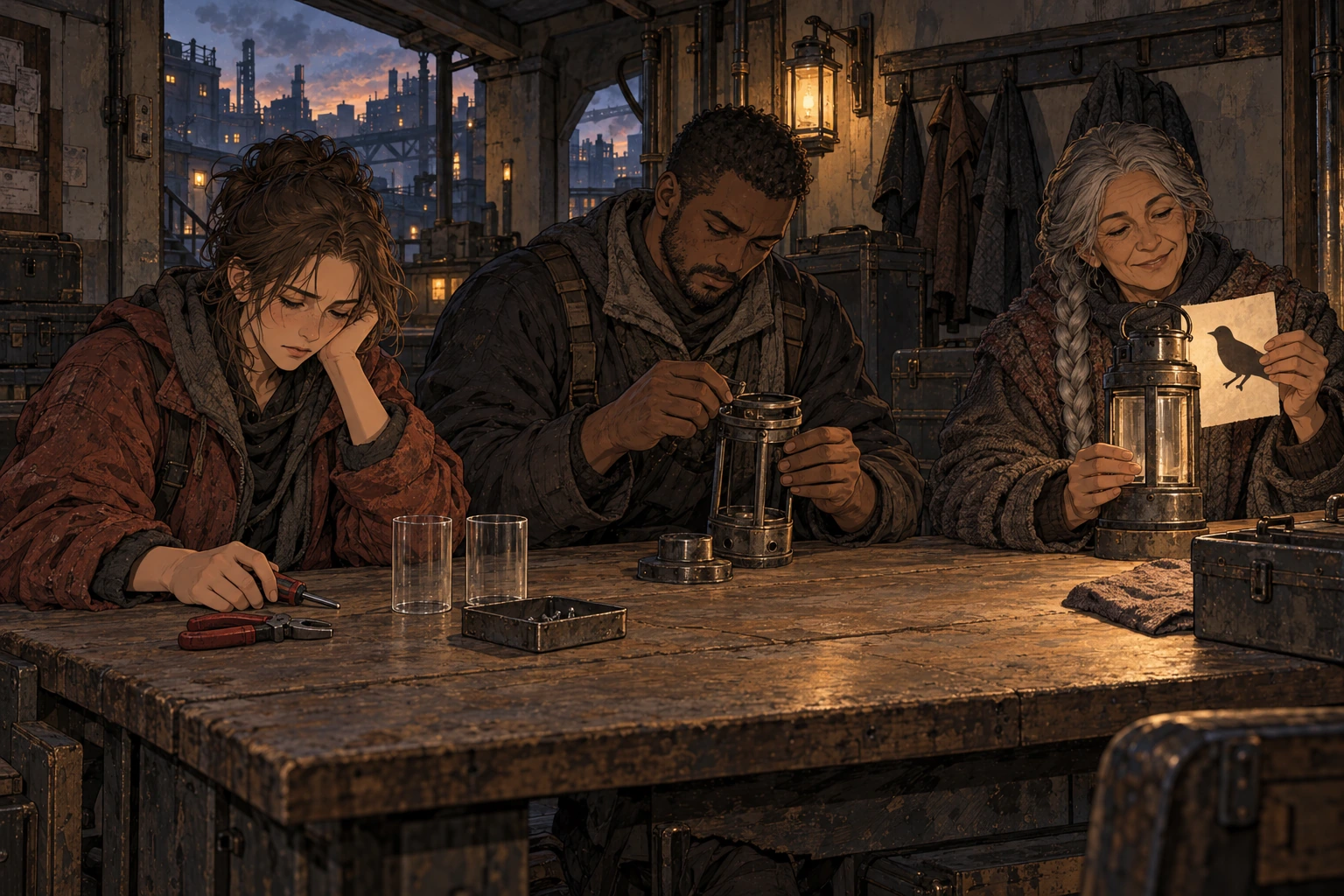
A proposed Northbank custom makes shared repair and modest celebration possible when circumstances permit.
Open full-size illustration ↗People in this picture · 3
Alina Draven
left, fitting the small lantern part · Goes by Lina
Residence: Northbank, Stavenbruck. Lina repairs household switches and wants the festival lanterns to be repairable next year as well. Malik is her workshop colleague; Ruth has brought the glass sleeves.
Malik Vrenn
centre, working on the lantern frame · Goes by Mal
Residence: Northbank, Stavenbruck. Mal repairs hand tools and enjoys making a careful job of an object with no official production target. Lina is a colleague; Ruth is their neighbour.
Ruth Korven
right, holding the lantern and paper bird · Goes by Ruth
Residence: Northbank, Stavenbruck. Ruth is a retired glazier who still sorts serviceable glass from damaged stock. She likes a celebration she can help make. Lina and Mal are neighbours sharing her repair bench.
Weddings, fashion and being seen
Stavenbruck partnerships can be marked at the registry, in a congregation, through a household gathering or through several occasions. The proposed registry records a recognised partnership and nominated contacts without prescribing one family model. It does not erase the established coercive reproductive regime or decide every legal consequence of marriage. A wedding's pleasures can be an borrowed dress, a live accordion, polished boots and a meal assembled by friends. Wealth buys private rooms, elaborate food and freedom from borrowed schedules.
Outer clothing must work in the weather. Fashion appears in lining colours, cuffs, scarf knots, repaired embroidery and the shape of a cap worn off duty. Maren Ilt, an alterations worker at Canvas Square, adds contrasting seams that make repairs deliberate rather than apologetic. People with money sometimes imitate that look using undamaged cloth, which irritates customers whose worn elbows are not a choice. A carefully patched coat can still be beautiful.
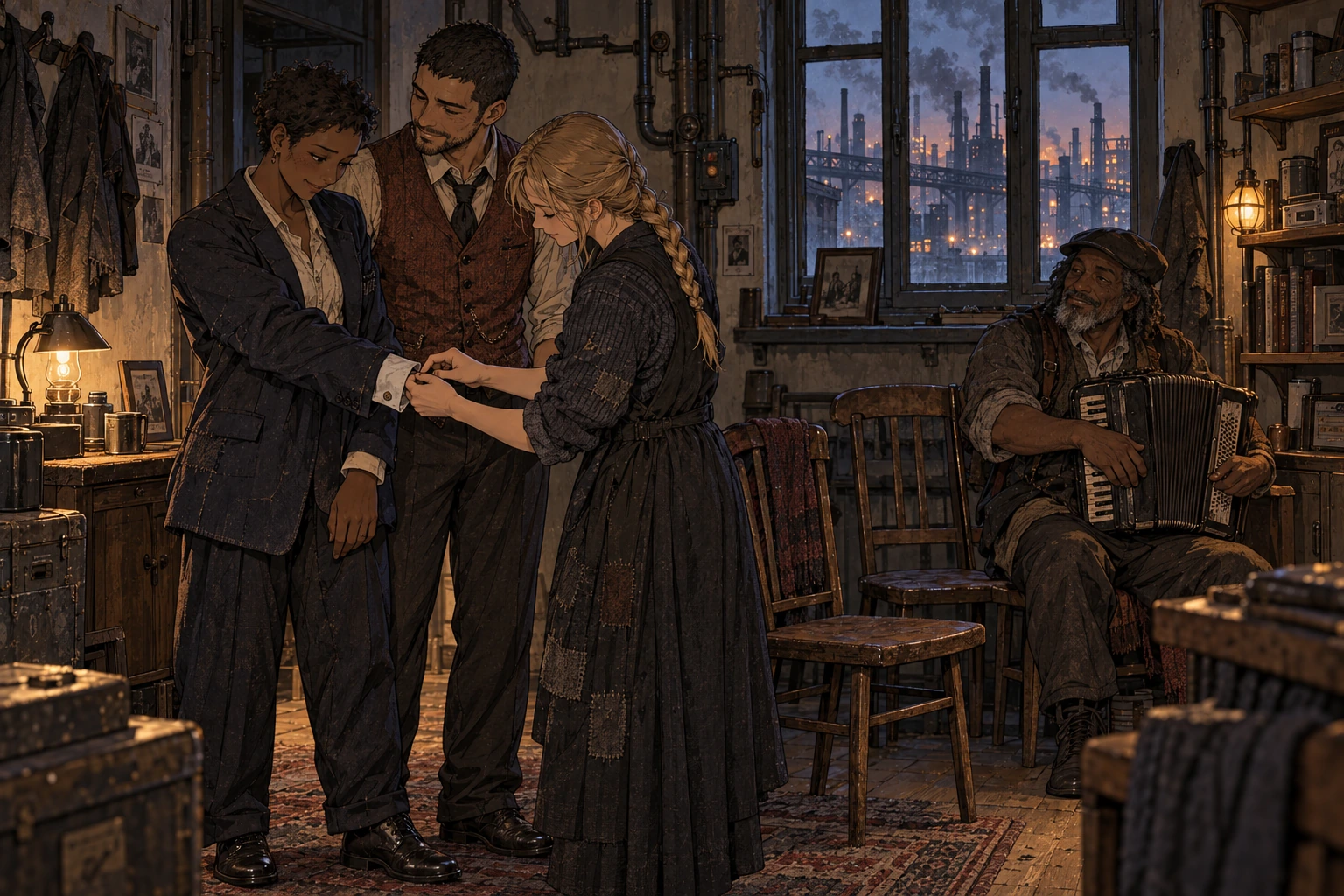
A modest partnership celebration can matter without an extravagant table.
Open full-size illustration ↗People in this picture · 4
Amira Kes
left, having her cuff adjusted · Goes by Mira
Residence: Pump Ward, Stavenbruck. Mira is a relay operator who has borrowed a good jacket for this small celebration. She wants to remember the company more than the clothes. Jon is her partner; Katya is their friend helping with the fit.
Jonas Varek
centre, standing beside Mira · Goes by Jon
Residence: Pump Ward, Stavenbruck. Jon is a machine-shop bookkeeper who has arranged a short evening around both partners’ shifts. Mira is his partner; they are celebrating their partnership.
Katya Hollen
right of the couple, adjusting the cuff · Goes by Kat
Residence: the streets beside Canvas Square, Stavenbruck. Kat is a seamstress who makes borrowed clothing sit comfortably without cutting away what its owner will need later. She is a friend of Mira and Jon.
Oskar Pell
seated at the right with the accordion · Goes by Oz
Residence: Freight Ward, Stavenbruck. Oz earns part of his living playing small gatherings and part repairing instrument straps. He knows when to let a conversation finish. He is the couple’s hired musician, introduced by Kat.
Games, jokes and disagreement
Nine Posts is a proposed tabletop alignment game played with nine small counters per side on a marked board. Tables carry house variants, and arguments over the remembered rules can last longer than the match. Winter courtyards host short throwing and balance games on cleared ground; organised teams use safer maintained spaces when they can obtain them. Not every sport requires a militarised contest or a lethal wager.
Children play at being inspectors, stamping scrap paper with potato-cut seals. Adults laugh until a visiting official hears the imitation. A common proposed joke concerns a delayed form: “It arrived tomorrow, so we sent it yesterday.” Gossip offers practical news, affection and cruelty in different proportions. A familiar neighbourhood is not entitled to somebody's private life simply because its people helped mend their roof.
An illustrative story might follow Bela negotiating ownership of a regional recording, Maren preparing clothes for two estranged siblings' reunion, or a village band trying to keep its performance date through a service change. Joy can be the objective and a lasting outcome. It need not be bait for the next catastrophe.
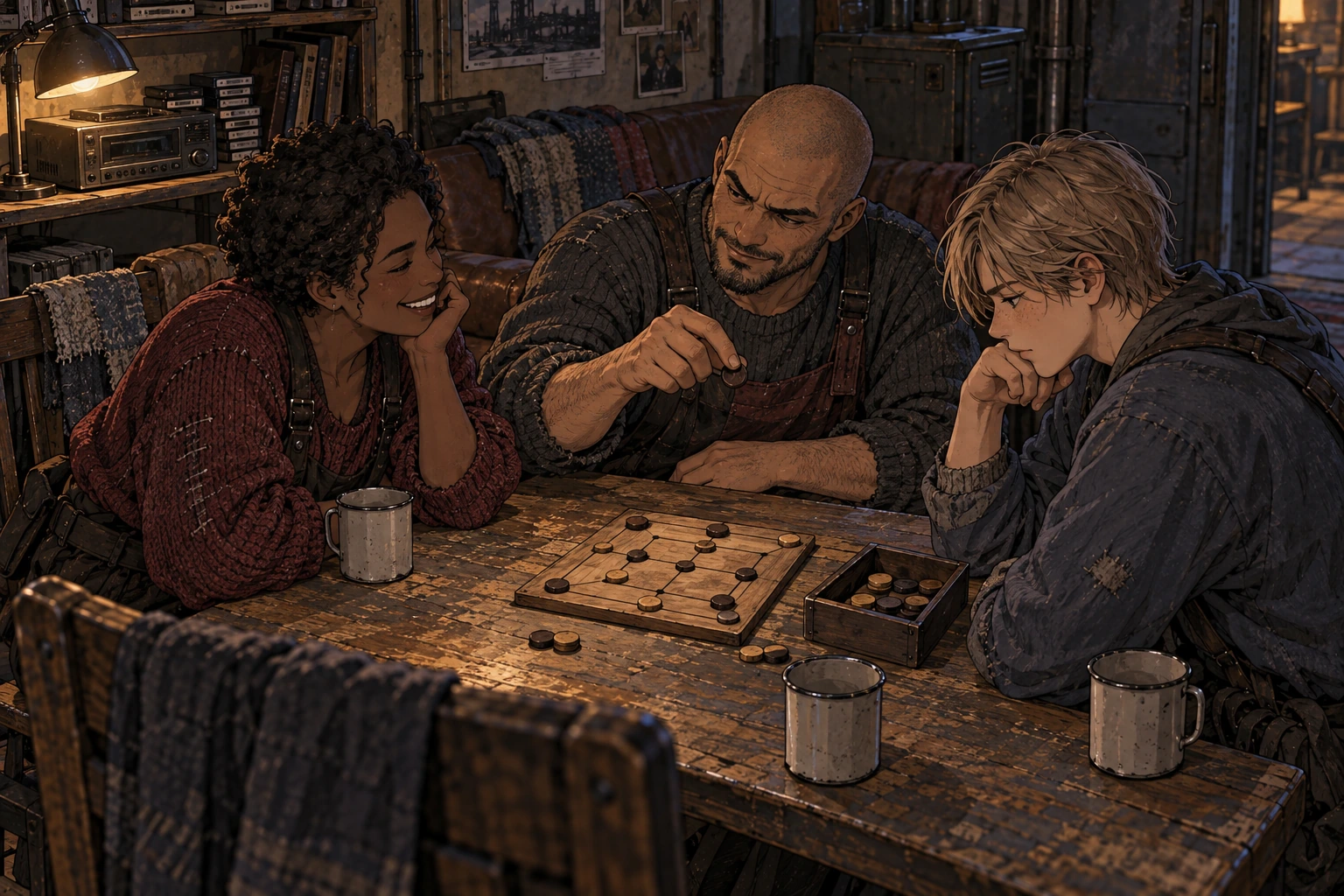
Play leaves room for humour, arguments and different local rules.
Open full-size illustration ↗People in this picture · 3
Sana Brevik
left, watching the game · Goes by Sana
Residence: Pump Ward, Stavenbruck. Sana works in a lamp shop and likes games in which patience matters more than quick arithmetic. Marten is her partner and Eren their teenage son.
Marten Brevik
centre, moving a counter · Goes by Mart
Residence: Pump Ward, Stavenbruck. Mart is a boiler-shop fitter who enjoys explaining a clever move even when the explanation gives it away. Sana is his partner; Eren has heard his favourite strategies before.
Eren Brevik
right, blond teenager studying the board · Goes by Eren
Residence: Pump Ward, Stavenbruck. Eren is a school pupil without a paid job. He is learning to lose an argument about rules without abandoning the game. Sana and Mart are his parents.
Cultural dominance and human diversity
The dominant public culture grew from Valkrisch-speaking river ports and charter towns. Trade advantages became political privileges after the ancient War of the Crossings; industrial finance, technical education and inherited offices sustained them. The establishment has historically drawn disproportionately from lighter-skinned northern and central communities, but its culture and institutions also include people of other ancestries. A shared coat, language or custom does not establish a shared ethnicity.