The first developed building type is a municipal worker tenement: lockable household rooms around a shared heated courtyard, common kitchens and washrooms, a bathhouse and a works-maintained boiler. Some rooms have small cooking appliances whose usefulness is limited by fuel and wiring. This does not describe every city home.
Housing offices allocate tenancies. Rent and heating charges are separate from food claims. Employers can sponsor applications without owning all tenancies. Job loss produces arrears and reassignment pressure, not automatic overnight loss of a room. Lodgers and informal overcrowding occur.
Households may comprise partners, relatives, friends sharing costs, single residents, lodgers or chosen family. Municipal records track residence and nominated dependants or carers. They do not impose one family form. Neighbour care, workplace collections, school meals and overstretched clinics provide uneven support.
Irena Koss is the tenement kitchen organiser. Marta's waterworks connection makes the neighbourhood's water supply part of her work.
A household collector arranges the day's collection while another resident prepares for work. Kitchen use, washing and shared heat bring separate households into contact. An evening may include mending, a table game or a traded music cassette. If supplies permit, people eat together. These activities need not conceal an adventure or end in disaster.
Rooms, thresholds and people who share them
Northbank's representative tenement becomes Rook Court, three residential ranges around a heated inner yard. Forty household rooms vary from a narrow single with a window above the passage to two connected rooms occupied by an extended family. The number describes this representative building, not a city housing standard or an engineered capacity. A household tenancy can cover one or several rooms; lodgers commonly share rent without appearing on the oldest tenancy papers.
The courtyard's pipe benches provide useful heat rather than luxurious warmth. Laundry occupies overhead rails on assigned washing days, with a courteous chaos of negotiated exchanges. Irena Koss keeps the common kitchen usable and a chalk list of people who have offered to collect food for neighbours. She does not control their ration entitlement. The boiler belongs to municipal works; a resident cannot settle a heating bill by taking fuel from its store. Toma Vesk, the resident caretaker, records damage and changes bulbs, but serious boiler work needs a qualified crew and a work order.
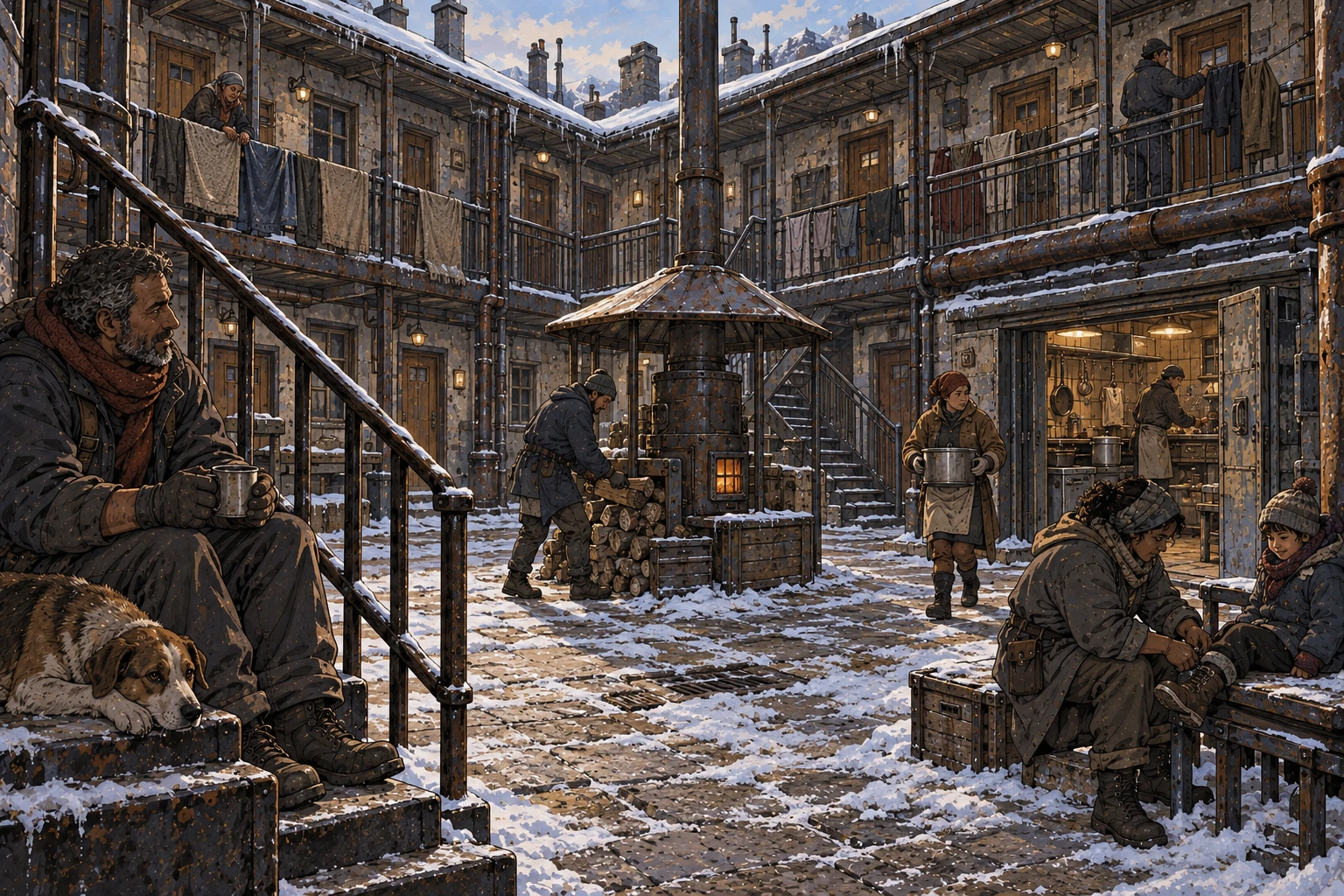
Lockable household rooms, pipe benches and common facilities surround a municipal worker courtyard. This is a proposed representative building, not a surveyed plan.
Open full-size illustration ↗People in this picture · 3
Milen Oskel
foreground left, resting on the steps · Goes by Mil
Residence: Rook Court, Northbank, Stavenbruck. Mil is a furnace cleaner off shift. He likes sitting in the yard with the resident dog before the shared rooms become busy. The other residents are neighbours; he is not supervising the child across the yard.
Anton Selvik
right foreground, beside the seated child · Goes by Ant
Residence: Rook Court, Northbank, Stavenbruck. Ant repairs work bags and tries to finish household mending before the evening kitchen queue. The child beside him is his daughter, Nelli.
Nelli Selvik
right, child seated by Anton · Goes by Nel
Residence: Rook Court, Northbank, Stavenbruck. Nel is a school pupil with no paid job. She likes the yard’s shared company but wants a quiet corner for drawing. Ant is her father; Mil lives across the courtyard.
The domestic day
An early worker can wash before the kitchen crowd forms, collect food at the alternate window and leave a pot with someone who will be home later. A household collector may handle several people's registered claims, but neighbours still ask which meal is wanted warm and which can wait. Mending and preparing additions to paste take place on kitchen tables also used for lessons. A cooking appliance in a private room offers privacy only if the circuit and fuel can support it; Irena will not pretend the common stove makes every improvised heater sensible.
Working households negotiate quiet rather than achieving it. A night-shift driver hangs a blue cloth inside the door to request undisturbed sleep. Children learn which stair squeaks and use it to announce visitors deliberately. The cloth is a Rook Court custom, not an official city signal. Privacy is maintained through habits—knocking, lowering voices, keeping another household's mail folded—as much as through locks.
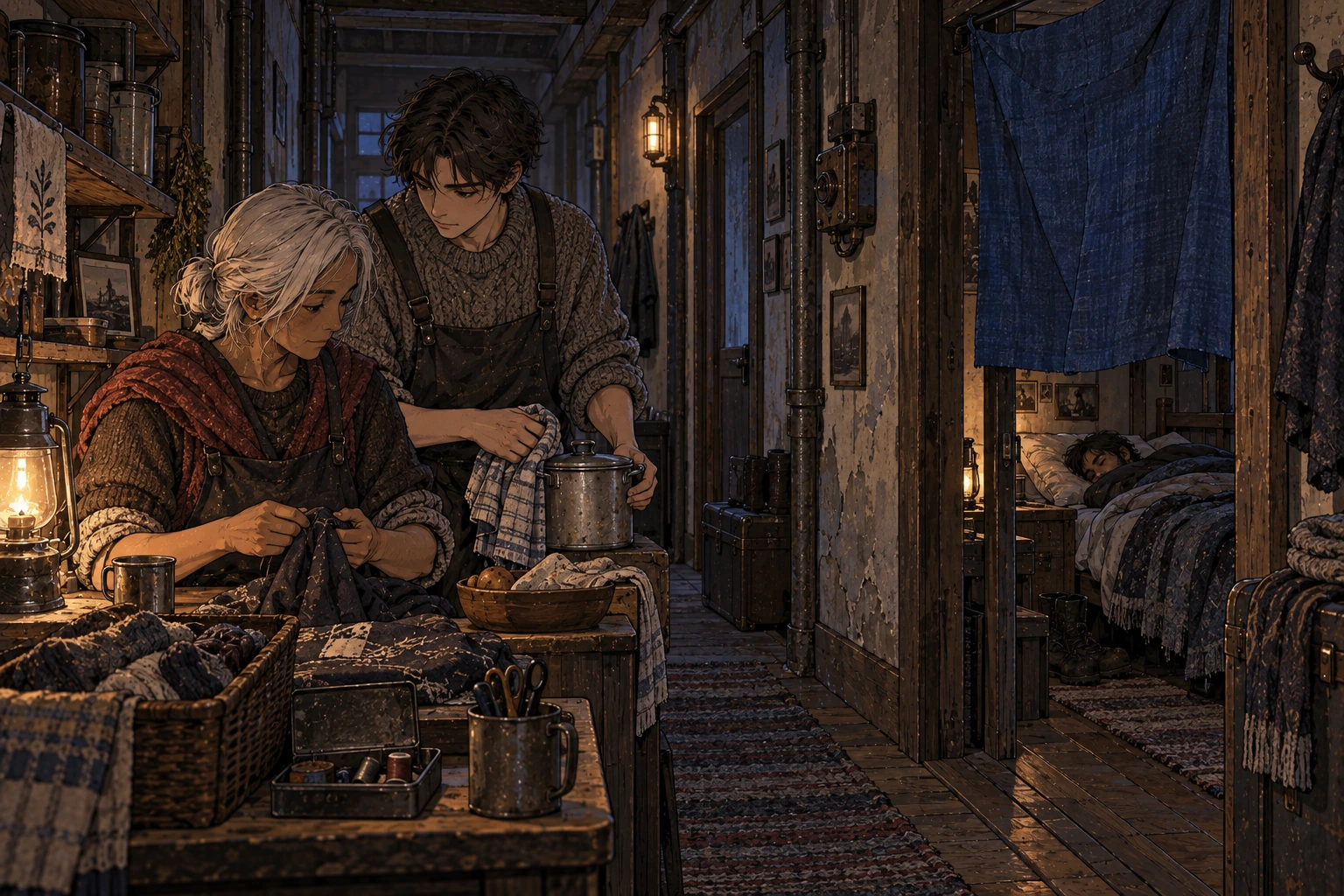
A blue cloth inside a Rook Court doorway asks for quiet while domestic work continues. The cloth is a proposed local custom, not an official city signal.
Open full-size illustration ↗People in this picture · 3
Roza Velnik
left, mending clothes at the table · Goes by Roza
Residence: Rook Court, Northbank, Stavenbruck. Roza is a retired seamstress who still takes occasional paid repairs. She keeps the stitching quiet beside a night worker’s room. Dana is her neighbour and their sleeping neighbour is Eren.
Dana Vesnik
centre, standing beside the cooking pot · Goes by Dana
Residence: Rook Court, Northbank, Stavenbruck. Dana cleans office rooms and shares household errands with neighbours when shifts collide. Roza is helping her keep the corridor quiet for Eren.
Eren Halvek
asleep through the right-hand doorway · Goes by Eren
Residence: Rook Court, Northbank, Stavenbruck. Eren is a night-shift pump attendant. His blue doorway cloth asks neighbours to let him sleep before the next shift. Roza and Dana live nearby and are respecting his rest.
Different homes, different burdens
Old Exchange clerks rent converted rooms above shops, often with better windows but expensive coal deliveries. A senior signals engineer may have a whole floor and a domestic cassette deck, yet still lose sleep when the exchange calls. Freight Ward lodging houses sell beds by the week; residents gain flexibility while losing storage and the certainty that a room will be theirs after a journey. Riverside boat households store bedding in dry chests and treat a dependable shore address as a valuable favour. Tarnfeld houses combine dwelling, seed storage, fully enclosed transparent polyurethane or plastic garden greenhouses, and work yard, giving families space but entangling private life with farm ownership.
In Brackenzell, terraced houses may share walls with kin while drawing heat from an employer-owned line. A worker's household therefore has stronger reasons to resist both the employer and an immediate shutdown. Wealth purchases distance from noise, clean upholstery, spare filters and the ability to refuse a lodger. It does not abolish regional storm closures. The most admired city luxury is often a room whose owner can leave a table set overnight.
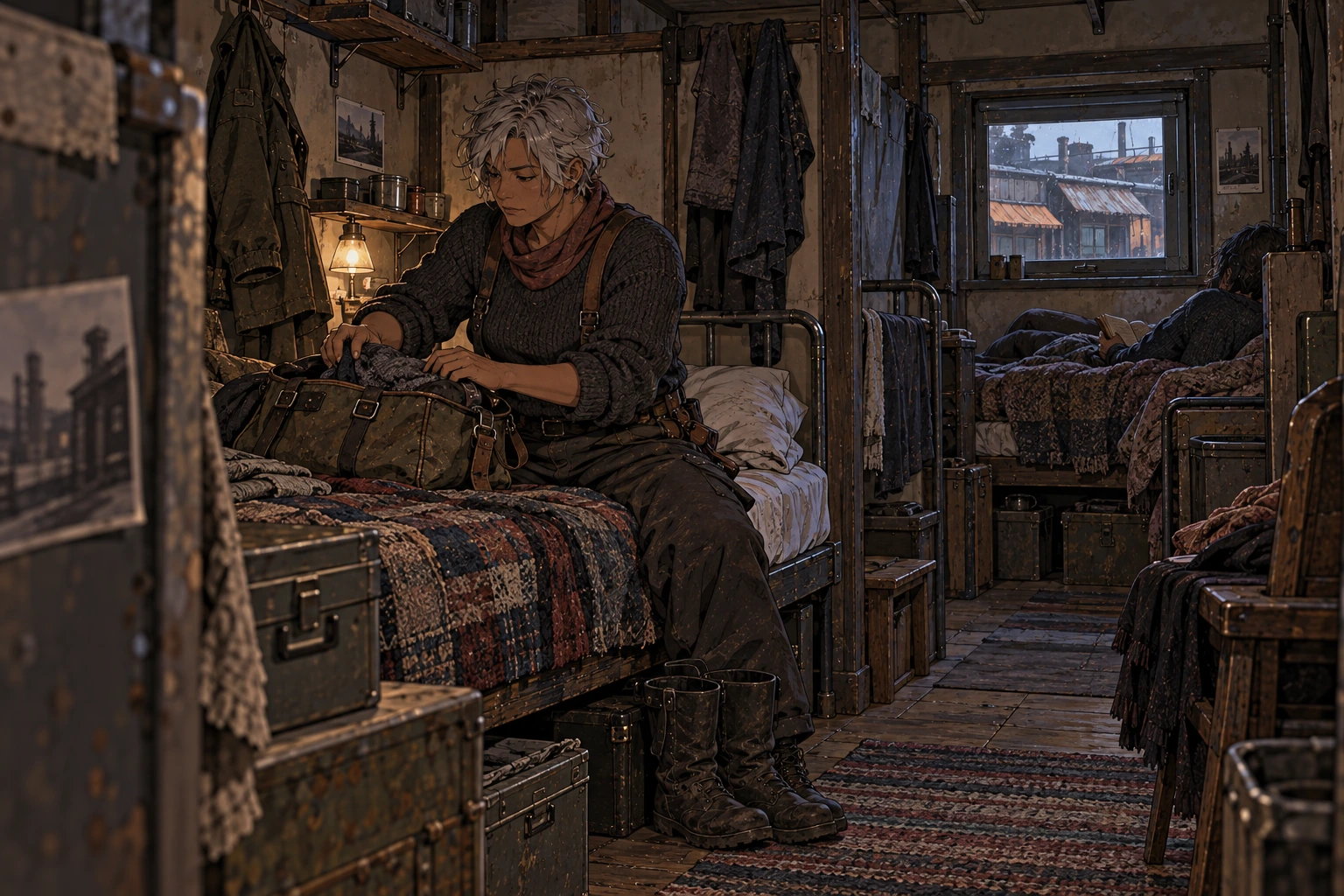
A temporary bed, packed belongings and little storage show one kind of housing burden. Other households can buy space and privacy without escaping regional closures.
Open full-size illustration ↗People in this picture · 1
Rosa Kelven
seated alone, unpacking the bag · Goes by Rosa
Residence: a weekly lodging house in Freight Ward, Stavenbruck. Rosa takes temporary linen-room jobs and keeps her belongings packed for another move. She wants an address that lasts longer than the next vacancy. No companion is foregrounded; the other beds belong to fellow lodgers.
Partnership, childhood and ageing
Courtship commonly involves time and practical attention: reserving a seat at a listening room, finding a compatible needle for somebody's player, offering a walk without insisting on escorting them. Repair gifts can be affectionate, presumptuous or a means of claiming a debt. A person is entitled to refuse them. Friends sharing a tenancy may remain friends, become partners or separate without the municipal housing office acquiring authority to define their emotional lives.
Children move among households by actual arrangement rather than communal ownership. One neighbour supervises schoolwork while another works late; an older sibling may resent being repeatedly treated as free care. Elders contribute histories, skills, money or company without having to justify their place through usefulness. Some dislike the young exchanging family recipes; others are the first to bring home an unfamiliar recording. Care can be tender and exhausting at once.
Rook Court's Thursday Pot is an occasional shared meal, held when residents agree they can contribute. Attendance is not a test of loyalty, and an empty seat does not imply a feud. In a quiet scene, Irena may spend the evening negotiating table space between a repair demonstration and a child's puppet performance. In a harder story, a municipal reassignment notice could threaten a household split by shift work. Neither example activates an event.
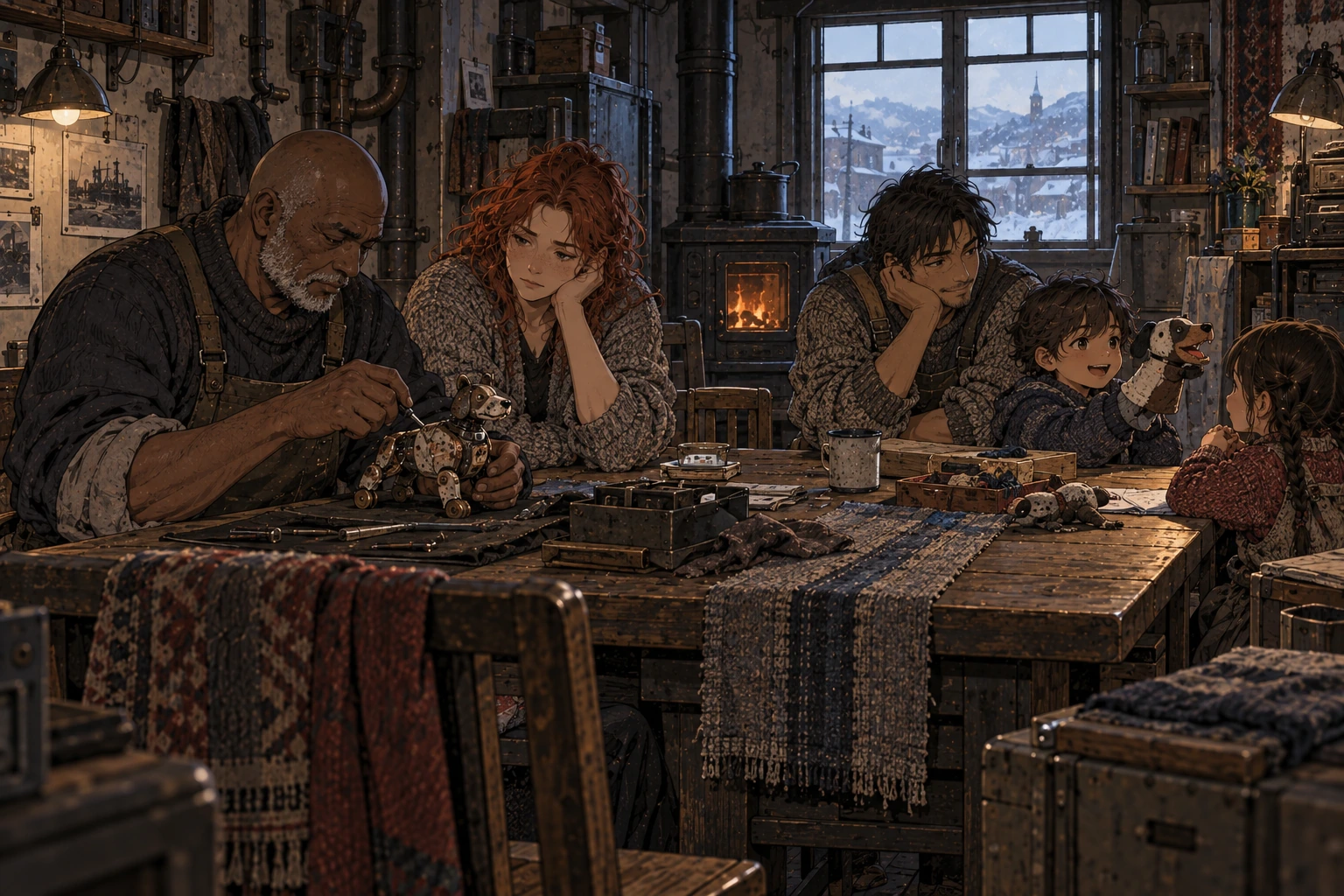
Lessons, repair and care bring generations and chosen household ties together. Affection and exhaustion can occupy the same room.
Open full-size illustration ↗People in this picture · 5
Oton Karev
left, repairing the mechanical toy · Goes by Oton
Residence: Rook Court, Northbank, Stavenbruck. Oton is a retired instrument fitter who repairs small household objects at his own pace. He likes a child to watch before helping. Ena and Navir are his adult children; the younger two are Navir’s children.
Ena Karev
red-haired adult beside Oton · Goes by Ena
Residence: Rook Court, Northbank, Stavenbruck. Ena earns wages in a canteen and shares care with her brother. She knows her father’s concentration should not be mistaken for unlimited energy. Oton is her father, Navir her brother, and the children her niece and nephew.
Navir Karev
dark-haired adult beside the children · Goes by Nav
Residence: Rook Court, Northbank, Stavenbruck. Nav works in a packing room and makes puppet voices better than he admits outside the household. Ena is his sister and Oton his father; Dima and Fina are his children.
Dima Karev
child holding the dog puppet · Goes by Dim
Residence: Rook Court, Northbank, Stavenbruck. Dim is a school pupil without paid employment. He prefers giving the puppet lines to allowing it a silent audience. Fina is his sister; Nav is their father, Ena their aunt and Oton their grandfather.
Fina Karev
child at the far right facing the puppet · Goes by Fin
Residence: Rook Court, Northbank, Stavenbruck. Fin is a young child with no job. She likes deciding what the puppet wants before its owner speaks for it. Dim is her brother and Nav her father; Oton and Ena share their household.
When a household changes
The housing office accepts a nominated contact for a hospitalised tenant and gives an initial arrears hearing before reassignment. In this proposed practice, evidence can be a work record, a care certificate or testimony from a household collector; records may be incomplete, and hearings uneven. Using that hearing is difficult in practice. Notices can reach a shift worker late, work and care records may be held by different offices, and obtaining supporting testimony takes time away from paid work. A returned or incomplete file can delay consideration while arrears continue. Neighbours or an advocate may help assemble the evidence, but neither is always available. A sufficiently supported case can still secure a revised payment arrangement or a workable tenancy decision without extending that remedy into Kaltbruch. The central distinction remains: job loss can threaten a home, but it does not automatically make the tenancy disappear that night.
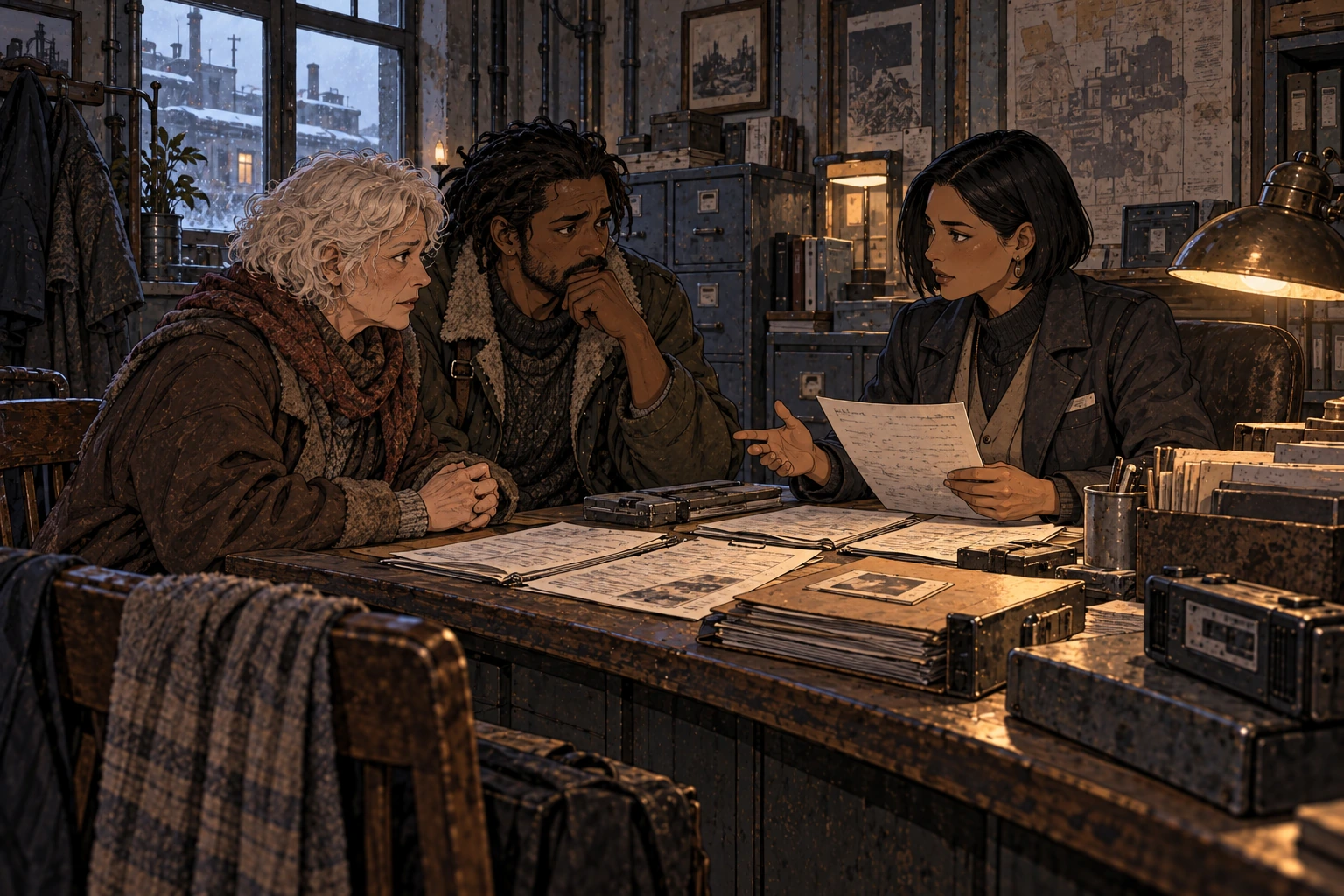
A tenant and a helper assemble records for an arrears hearing. A practical remedy remains possible, though time, incomplete papers and unequal access make it difficult.
Open full-size illustration ↗People in this picture · 3
Hela Bransk
left, presenting her papers · Goes by Hela
Residence: Rook Court, Northbank, Stavenbruck. Hela works irregular kitchen shifts and is seeking a workable answer to rent arrears. She has kept the envelopes as well as the letters. Tariq is a neighbour helping organise her evidence.
Tariq Ovel
centre, listening beside Hela · Goes by Tariq
Residence: Rook Court, Northbank, Stavenbruck. Tariq is a repair-shop bookkeeper who sometimes helps neighbours put household records in order. Hela is his neighbour, not his dependent; Jun is hearing their case.
Jun Sever
right, holding the hearing paper · Goes by Jun
Residence: Old Exchange, Stavenbruck. Jun is a housing case officer who must reconcile the file with the resident’s account. She asks which documents are missing before closing a query. Hela is the applicant and Tariq her chosen helper.
Protected cultivation
Growing food is dangerous because of the glowing rain. Gardens must be fully enclosed overhead and on all sides in transparent polyurethane or plastic greenhouses that keep the rain off the plants. This includes food and flower gardens. .
Illustrated scenes
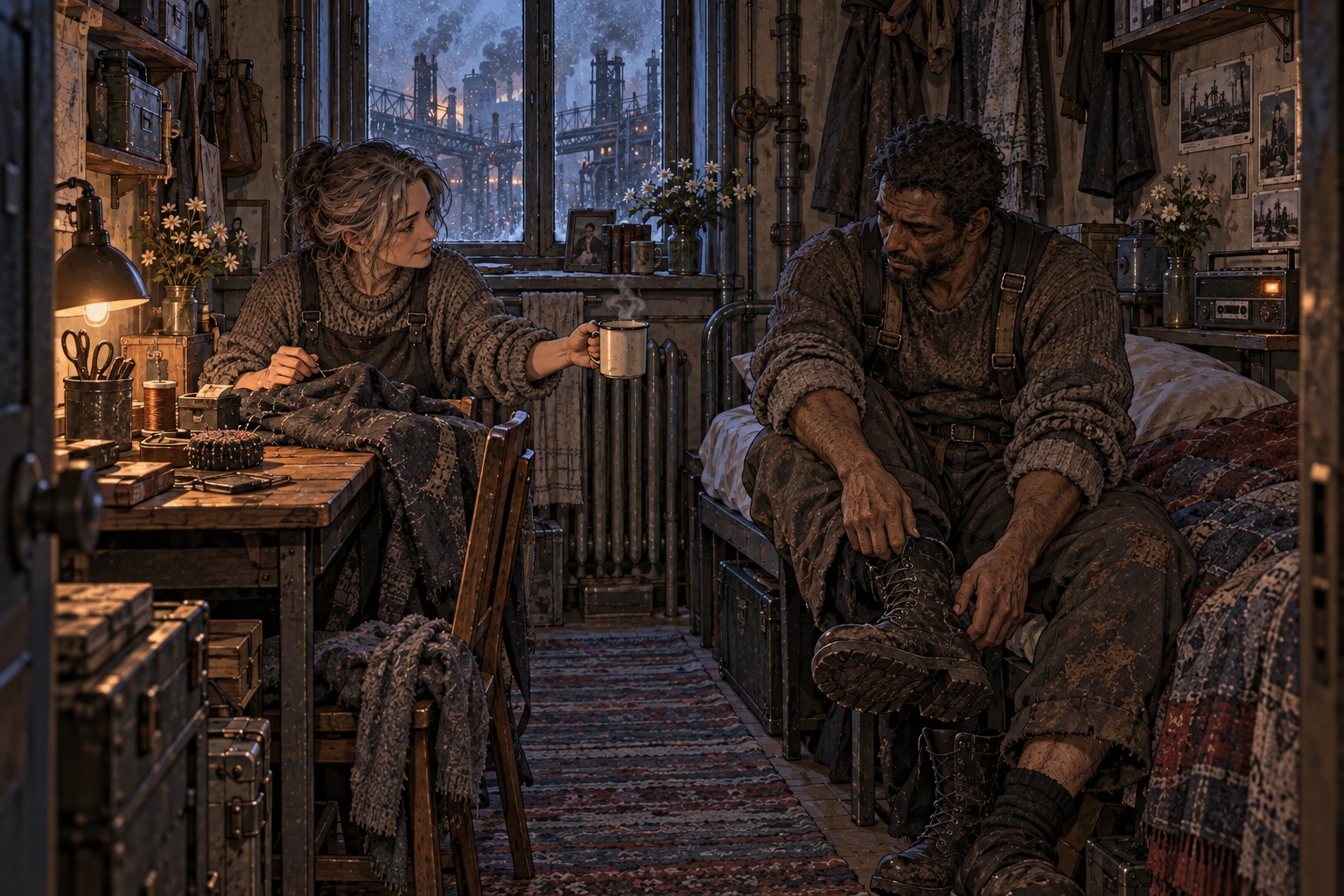
People in this picture · 2
Anika Brenov
left, offering the mug · Goes by Ani
Residence: Pump Ward, Stavenbruck. Ani mends workwear for cash and manages the household’s small repairs. She has left the evening’s difficult conversation until both have sat down. Yarek is her partner, returning from his shift.
Yarek Brenov
right, seated on the bed · Goes by Yar
Residence: Pump Ward, Stavenbruck. Yar is a boiler cleaner who comes home with little energy left. He values practical care without wanting every evening to become a report on exhaustion. Ani is his partner; they share this cramped room.