The laundry's weather
The laundry has weather of its own. Heat gathers beneath the pipes, damp works into cuffs, and a draft at the wrong doorway can chill a person whose shirt was comfortable a moment earlier. The room smells of wet cloth, hot metal and the cleaning material issued that day. Mik Sorev knows its changes through his hands. He can tell when a load has held more water than usual before anybody weighs or counts it.
Useful knowledge makes him a worker other people want nearby. It also makes him somebody they can blame. A spoiled batch needs an explanation; the explanation is easier to obtain from a prisoner than from an overburdened machine. Mik has learned to name a fault while it is still small enough to be described without sounding like an accusation. Sometimes the warning is recorded. Sometimes it is remembered only after the damage.
Laundry work touches almost every part of Kaltbruch without giving its workers free movement through them. Linen and garments arrive with labels, smells and signs of use. People speculate. A stain cannot establish a person's story, and Mik dislikes the confident inventions that follow certain bundles. He has enough difficulty keeping his own history from becoming other people's entertainment.
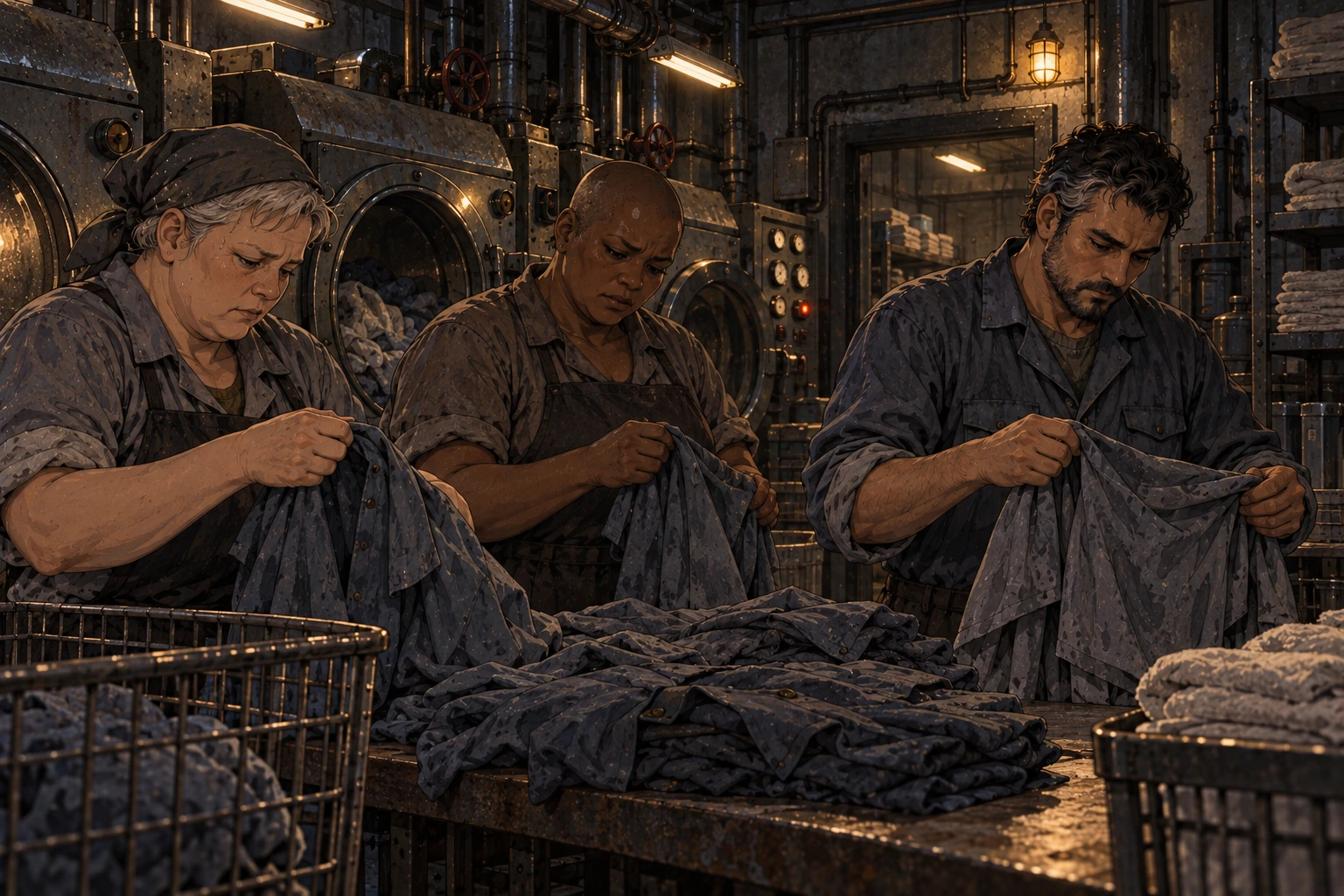
The laundry provides warmth through exhausting work.
Open full-size illustration ↗People in this picture · 3
Mik Sorev
right, sorting a work shirt · Goes by Mik
Kaltbruch ID: B00018462
Residence: Room Group Cinder, Kaltbruch. A laundry worker imprisoned for violence, Mik is skilled with cloth and easily ashamed of needing help. Present kindness does not erase his past conduct. Maura and Amin are his laundry coworkers; their shared task does not make them a faction.
Maura Nesk
left, wearing the laundry cap · Goes by Maura
Kaltbruch ID: B00007306
Residence: Kaltbruch adult shared housing. Maura is an inmate laundry sorter who checks cloth before passing it to the machines. She saves small offcuts for permitted repairs. Amin and Mik share her work shift.
Amin Hest
centre, examining the shirt · Goes by Amin
Kaltbruch ID: A00025980
Residence: Kaltbruch adult shared housing. Amin works in the prison laundry and keeps the counting piles separate until the batch is complete. A hurried recount means more work for everyone. Maura and Mik are coworkers, not relatives.
Keeping a part in service
Runa Drell repairs things that would be easier to replace if replacements regularly arrived. Her bench holds fittings of different ages, small containers with worn lids, and tools whose handles carry the shape of repeated repairs. She can recognise an inferior substitute without being able to obtain a better one. That distinction irritates officers who hear criticism wherever a worker describes a limit.
A useful repair changes a day. A door closes without a shove; a chair stops threatening its occupant; a warm-air outlet reaches the corner it was meant to heat. Such improvements belong to particular rooms and people. They can survive the shift that made them. Runa measures some successes by whether anyone remembers to mention the problem again.
Her association with Warm Bench grew from practical help. She will explain a repair to someone willing to listen. She will also stop when a request becomes an expectation that she must spend every free moment keeping other people functional. Her skill is shared under pressure, but it remains hers.

A small repair can change conditions for an entire room.
Open full-size illustration ↗People in this picture · 2
Runa Drell
left, holding the short fitting · Goes by Runa
Kaltbruch ID: B00009241
Residence: Room Group Cinder, Kaltbruch. A repair worker associated with Warm Bench, Runa offers practical help with firm limits. An argument need not end her care for a neighbour. Maksim is her fellow repair worker, checking the same part.
Maksim Tal
right, examining the fitting with Runa · Goes by Maks
Kaltbruch ID: A00030966
Residence: Kaltbruch adult shared housing. Maks is an inmate repair assistant who wants to understand which measurements make a salvaged part usable. Runa is the experienced coworker teaching him through this repair.
Before the serving hatch opens
Kitchen assistants arrive before the meal is visible to those waiting for it. They handle containers, clean surfaces, shift weight and work around equipment that retains heat unevenly. Posted quantities and available portions must meet through these hands. A kitchen worker can know that a batch is short without knowing whether the shortage began in supply, storage, measurement or somebody's interference.
The ordinary issue is paste. Its temperature, thickness and treatment affect whether a tired person can face eating it, even when its ingredients do not change. Pan-edge cakes require an available heated surface and permission to use it; they are a variation on an issue, not evidence of a hidden abundance. Fresh produce belongs to exceptional supply and conditional privilege. There is no open kitchen garden feeding the prison.
Food work brings proximity to a necessity. That can create petty opportunities, accusations and real advantages. It also brings searches, suspicion and the unpleasant certainty that hungry neighbours notice who has been near the containers. The work does not make every assistant well fed.
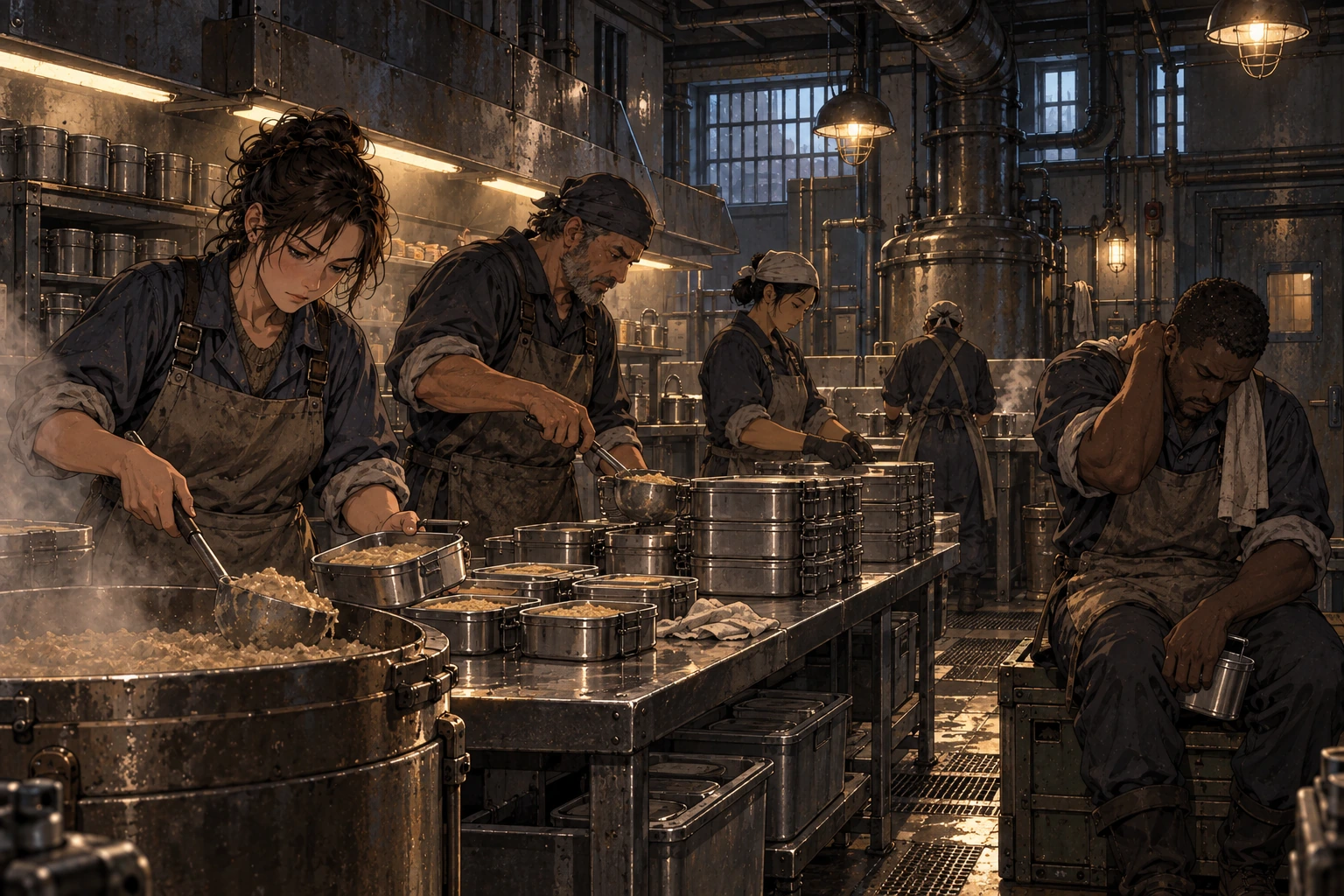
Paste service depends on repetitive labour and a difficult schedule.
Open full-size illustration ↗People in this picture · 3
Mila Kost
left foreground, portioning paste · Goes by Mila
Kaltbruch ID: B00011805
Residence: Kaltbruch adult shared housing. Mila works on the prison kitchen detail and checks serving tins before filling them. She wants work recognised without accepting responsibility for every shortage. Oren and Arun share her kitchen shift.
Oren Kel
centre-left, serving from the next pot · Goes by Oren
Kaltbruch ID: A00024813
Residence: Kaltbruch adult shared housing. Oren is an inmate kitchen worker who keeps the serving line moving by preparing the next batch of tins early. Mila and Arun are his coworkers in custody.
Arun Vel
right, seated with a hand at his shoulder · Goes by Arun
Kaltbruch ID: A00026172
Residence: Kaltbruch adult shared housing. Arun washes and carries kitchen equipment in custody. He wants a short rest to be heard as a work need rather than refusal. Mila and Oren are fellow kitchen workers.
A name on the list
The work list joins a person to a place, an expected movement and an official account of the day. It can determine clothing, equipment and whether an absence attracts attention. Being omitted may cost a prisoner more than the task itself. A worker waiting for correction can lose access to an issue while remaining visible enough to be blamed for standing idle.
Orel Vask prefers a completed receipt to a complicated explanation. His stores desk is arranged to make the next signature easy. A broad acknowledgement saves him a return visit and may conceal a shortage in what has actually been handed over. A prisoner who insists on inspecting the issue delays the desk. Whether that insistence succeeds depends on who is listening and whose impatience matters.
Orders for extra food, medical restrictions and specialist equipment must be read in their particular context. Useful work does not automatically confer them. Staff may honour a written restriction, contest it, forget it or make the prisoner carry it from one desk to another. The paper travels through the same institution as the body it describes.
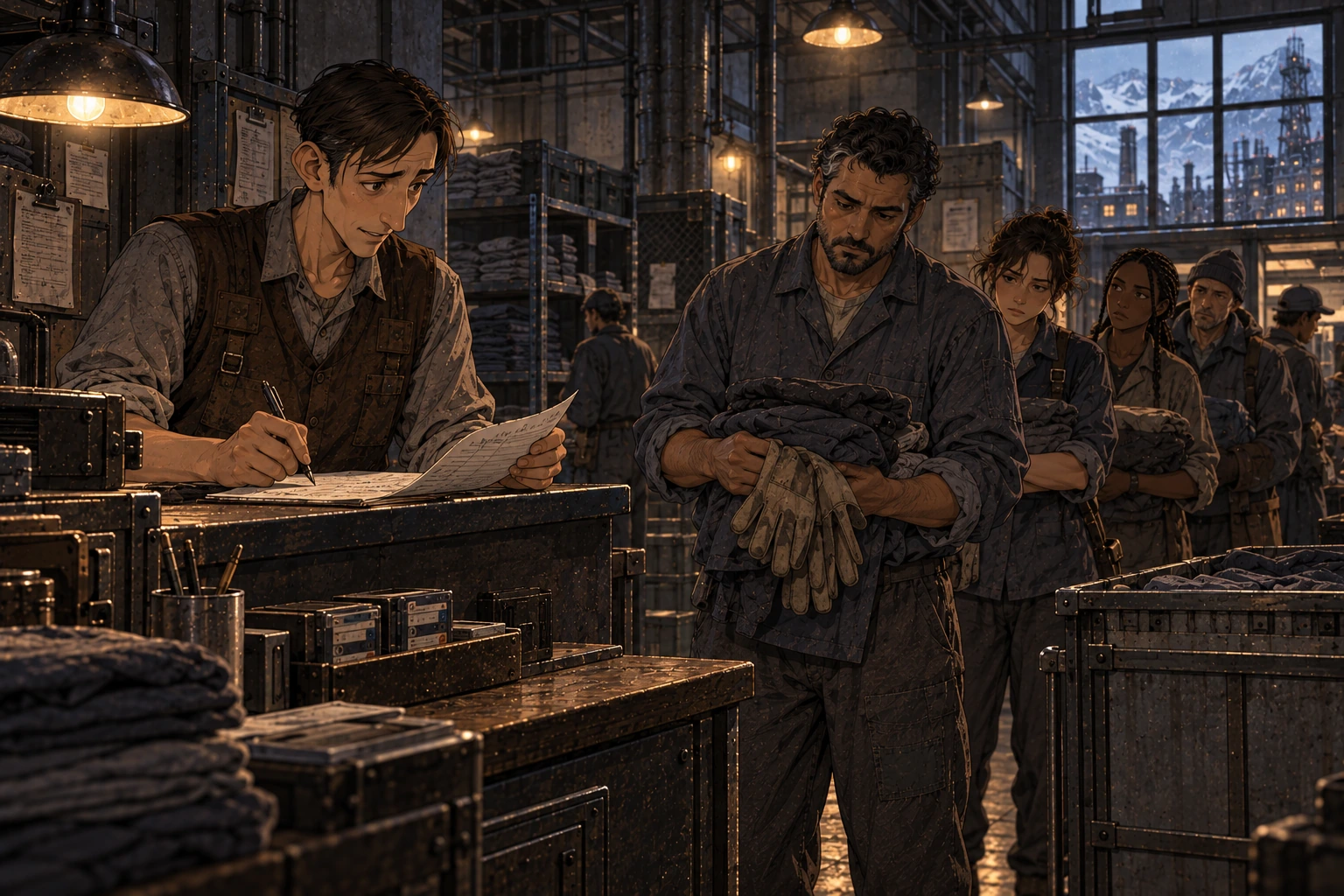
An assignment changes who can be useful and who must wait.
Open full-size illustration ↗People in this picture · 2
Orel Vask
left, consulting the work list · Goes by Orel
Residence: service lodging outside Kaltbruch’s adult housing. A civilian prison stores worker, Orel wants signatures that protect his own accounts. He fears discrepancies more than uncomfortable explanations. Mik is waiting for the stores worker to account for his assignment.
Mik Sorev
right, holding laundry gloves · Goes by Mik
Kaltbruch ID: B00018462
Residence: Room Group Cinder, Kaltbruch. A laundry worker imprisoned for violence, Mik is skilled with cloth and easily ashamed of needing help. Present kindness does not erase his past conduct. Orel handles the work list; the waiting prisoners behind Mik are not individually foregrounded.
Being difficult to replace
Skilled workers sometimes speak of Last Shift as if it were a place a person could enter. Its real boundaries lie in relationships: who trusts a repair, who will confirm that a warning was given, who knows which substitute will last until another delivery. Membership and influence overlap with other attachments. No committee reliably speaks for everyone with a useful trade.
Competence can win a narrow allowance. It can also make refusal costly. Mik may be asked to train a replacement, cover a missing worker or accept responsibility for a damaged item because he is the person who understands it. An officer can praise his judgement in the morning and deny his account in the afternoon. Mik notices both.

Experience includes the small signs a written instruction misses.
Open full-size illustration ↗People in this picture · 2
Tavi Kelm
left, listening beside the machine · Goes by Tavi
Kaltbruch ID: A00032706
Residence: Room Group Cinder, Kaltbruch. An adult newcomer assigned to the prison laundry, Tavi wants a predictable place in the day. He listens carefully before allowing a group to claim him. Mik is a more experienced inmate coworker explaining the control.
Mik Sorev
right, indicating the laundry-machine control · Goes by Mik
Kaltbruch ID: B00018462
Residence: Room Group Cinder, Kaltbruch. A laundry worker imprisoned for violence, Mik is skilled with cloth and easily ashamed of needing help. Present kindness does not erase his past conduct. Tavi is learning the machine from him; this is practical instruction, not an officer’s command.
Coming back from work
A shift ends through cleaning, return of equipment, movement and the next count. A finished task does not necessarily release its worker on time. People carry the day's discomfort into the shared room: a hot face, stiff fingers, the smell of a process that washing has not quite removed.
They also bring news, small pride and occasionally enough energy to care about something beyond recovery. Mik likes a difficult load returned properly. Runa appreciates a repair nobody can see. These satisfactions do not justify confinement or compulsory work. They are parts of the lives people continue to have within it.
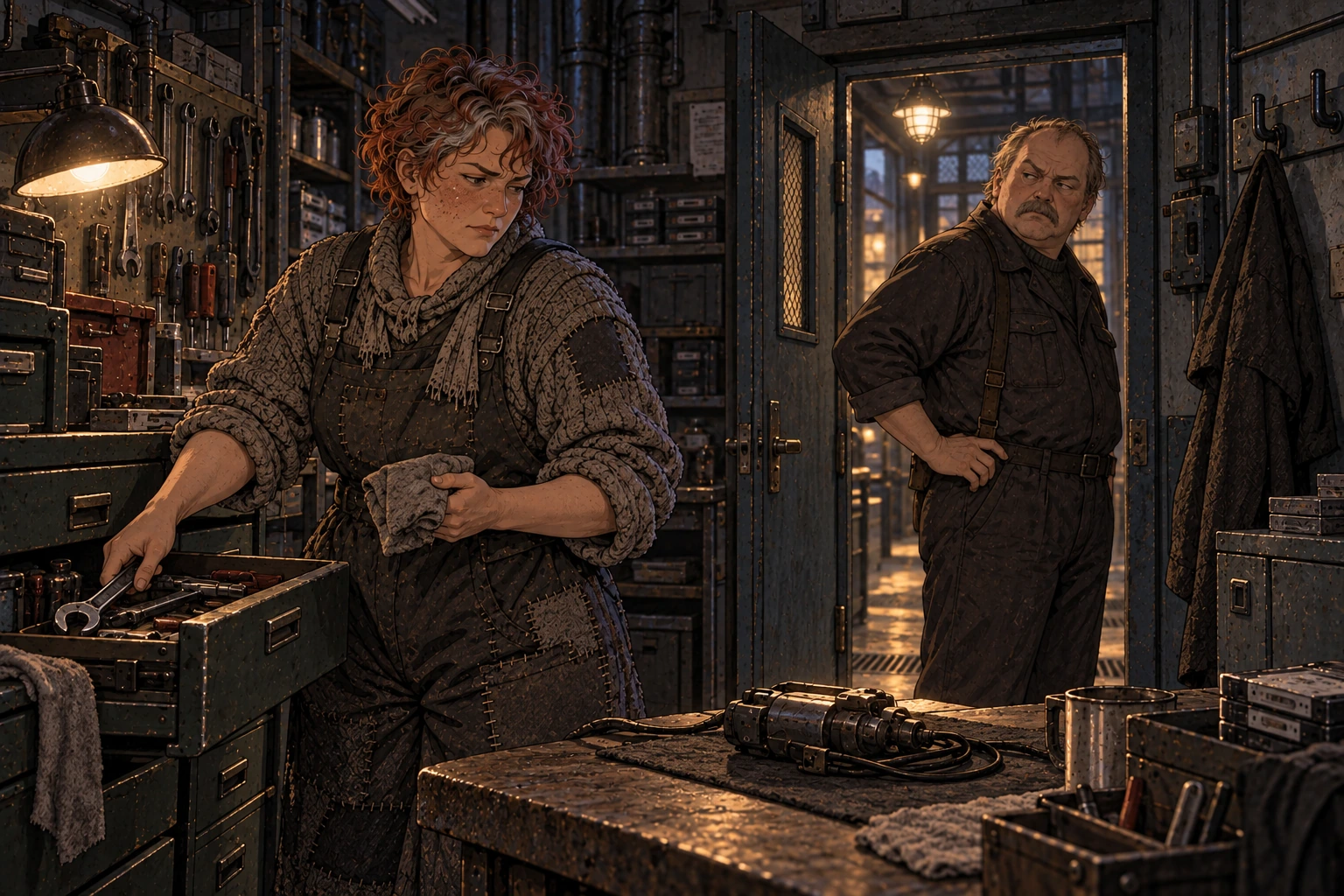
Finishing the task does not settle what the institution owes.
Open full-size illustration ↗People in this picture · 2
Runa Drell
left, putting away the tool · Goes by Runa
Kaltbruch ID: B00009241
Residence: Room Group Cinder, Kaltbruch. A repair worker associated with Warm Bench, Runa offers practical help with firm limits. An argument need not end her care for a neighbour. Edren is the custody supervisor waiting for the workroom to close.
Edren Mol
right, at the doorway · Goes by Edren
Military rank: Stabsserzhant
Residence: Kaltbruch service barracks. The senior custody supervisor knows every local custom. He often treats another person’s need as an interruption he can punish. Runa is an inmate finishing her repair shift under his supervision.