Find people by name, familiar name, home, work, rank or prisoner number →
| Field | Marta Velska | Irena Koss |
|---|---|---|
| Identity and role | Municipal waterworks technician in Stavenbruck | Kitchen organiser for the Northbank tenement |
| Immediate need | Inspect intake seals while pressure favours continued pumping | Keep the communal kitchen functioning |
| Relationships | Supervisor and people dependent on the water supply; personal household unspecified | Residents and those who collect or prepare food |
| Practical access | Portable meter, protective equipment and waterworks tools | Kitchen coordination within her role |
| Constraints | Exposure and tension between supply and safe water | Available provisions and working shared facilities |
| Known information | What she observes and learns at work | Information obtained through her actual role; no automatic access to prison records |
A cast with work tomorrow
Marta Velska — keeping a result honest
Marta is a municipal waterworks technician whose work includes second-shift intake inspections. Her proposed recurring professional relationships are with Lena Drost at Northbank Clinic and Vera Senk at the Institute, who need useful observations for different reasons. Lena wants a clear account of what patients may have encountered; Vera wants measurements collected consistently; Marta wants neither to turn her shift into work her supervisor has not allotted time to do.
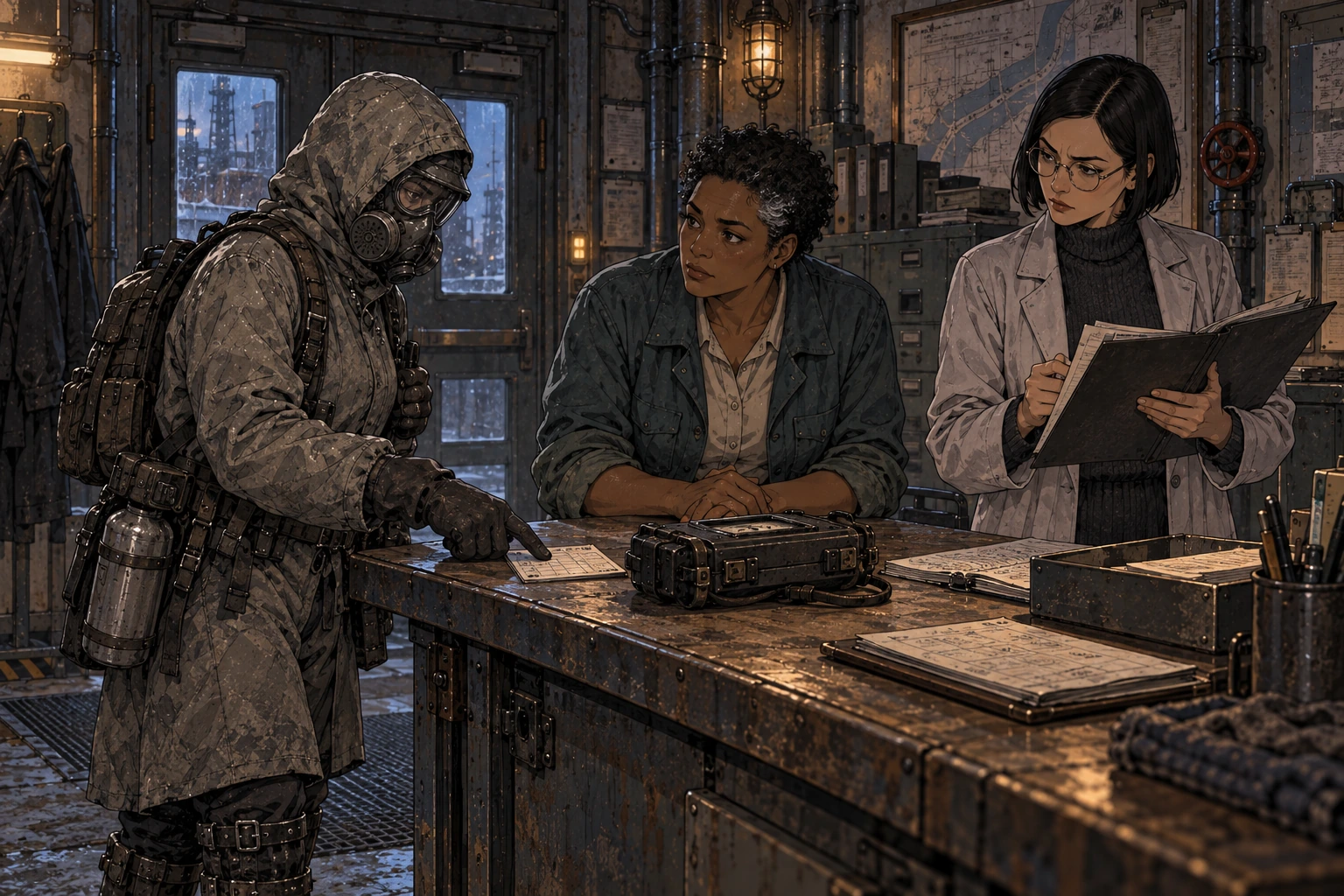
Marta’s observations matter to Lena and Vera for different reasons. Her proposed professional ties do not give her unrestricted knowledge.
Open full-size illustration ↗People in this picture · 3
Marta Velska
left, in covered field equipment · Goes by Marta
Residence: Pump Ward, Stavenbruck. A municipal waterworks technician, Marta wants a field result reported honestly even when it delays pumping. Lena and Vera are professional contacts discussing the observations from her waterworks shift.
Lena Drost
centre, listening at the bench · Goes by Lena
Residence: a rented Northbank room shared with Sera Anvek, Stavenbruck. A Northbank Clinic nurse, Lena worries about the unpaid time recovery requires as well as the treatment itself. Marta’s field account can inform Lena’s clinic work; Vera brings a different measurement question.
Vera Senk
right, comparing the protocol · Goes by Vera
Residence: Pump Ward, Stavenbruck. Vera works on materials and calibration at the Institute of Applied Measures. She wants useful methods published and their makers credited. Marta is the field technician and Lena the nurse consulting with her; their access remains professional and limited.
Irena Koss — a kitchen is not a command post
Irena organises Rook Court's common kitchen and takes pride in keeping it usable without making every household eat together. She enjoys live singing and has a talent for altering sleeves, although neighbours remember the kitchen before they remember her own interests. She wants a second paid organiser and a cupboard whose lock works. She disagrees with Leva Dorn about how much unrecorded care can reasonably fit a form. Their quarrels do not prevent them from helping the same resident.
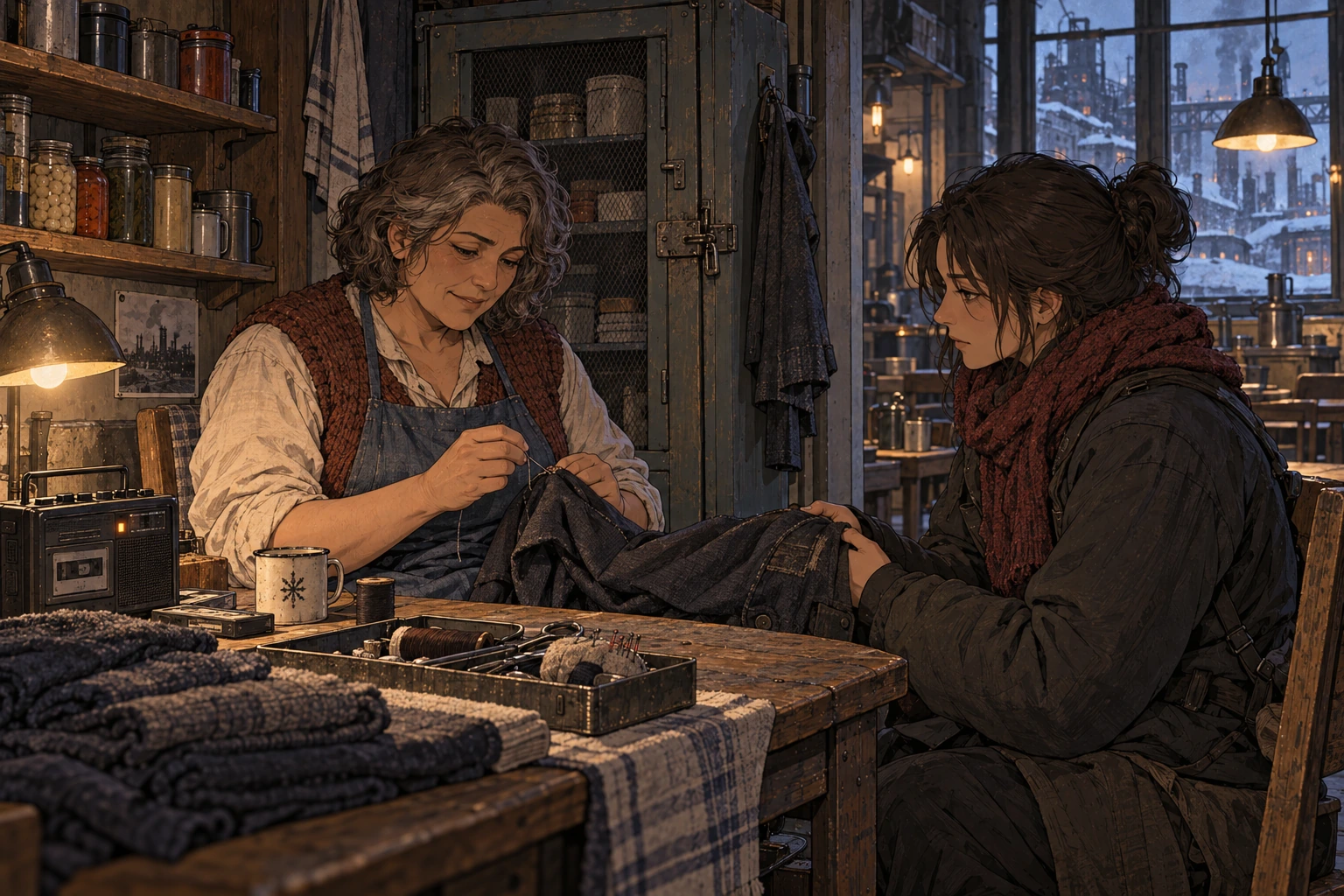
Irena’s kitchen role shares her life with craft, music and needs that are not municipal commands.
Open full-size illustration ↗People in this picture · 2
Irena Koss
left, sewing the sleeve · Goes by Irena
Residence: Rook Court, Northbank, Stavenbruck. Irena organises the common kitchen and alters clothing. She wants her sewing and singing remembered alongside her unpaid favours. Adela is a resident whose garment she is helping repair.
Adela Osk
right, holding the garment · Goes by Ada
Residence: Rook Court, Northbank, Stavenbruck. Ada is a municipal kitchen cleaner who would like her repaired coat to last another season. She can mend a hem but asks for help with sleeves. Irena is her neighbour and the more experienced sewer.
Lena Drost and Sera Anvek — two people who cannot always come home
Lena, the clinic nurse, and Sera, the ferry pilot, are partners with incompatible busy periods. Sera wants to expand the boat service's repair reserve before buying another vessel. Lena thinks a reliable second boat would give Sera more time at home. Each sees clearly the unnecessary sacrifice in the other's job and calls their own sacrifice unavoidable. They enjoy cooking when neither is too tired and dislike being praised as a public example of endurance.
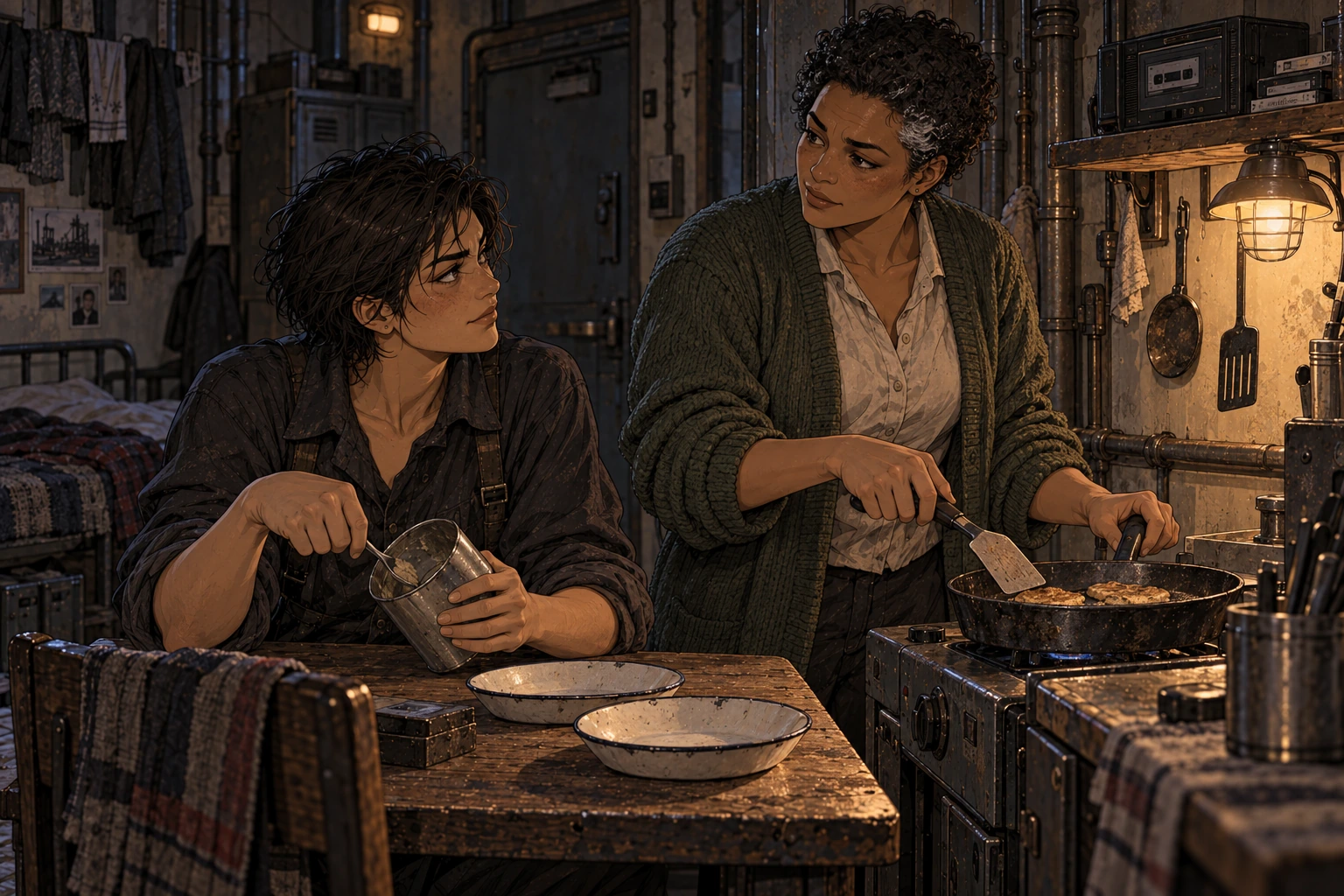
The partners prepare pan-edge cakes from issued paste, sharing a little time between shifts.
Open full-size illustration ↗People in this picture · 2
Sera Anvek
left, scraping paste from the tin · Goes by Sera
Residence: a rented Northbank room shared with Lena Drost, Stavenbruck. Sera pilots the Roven Ferry service. She wants a repair reserve large enough to stop every breakdown consuming her home life. Lena is her partner; this is their shared kitchen between working shifts.
Lena Drost
right, tending the pan · Goes by Lena
Residence: a rented Northbank room shared with Sera Anvek, Stavenbruck. A Northbank Clinic nurse, Lena worries about the unpaid time recovery requires as well as the treatment itself. Sera is her partner. They are making issued paste cakes together, without an extravagant spread.
Oda Kern — skill is not a family heirloom
Oda is a senior Cinderbank moulder with reduced strength in one hand and extensive practical knowledge. She supports apprentice equipment, paid instruction and a less punitive injury policy. She dislikes the foundry owner's claim that the workforce is “one family” when relatives are placed ahead of trained workers. Her disagreement with apprentice Rika Dren is that Rika wants broadly circulated drawings before the people who developed them have secured any reward. Both favour better access to knowledge but differ over whose labour gets recognised.
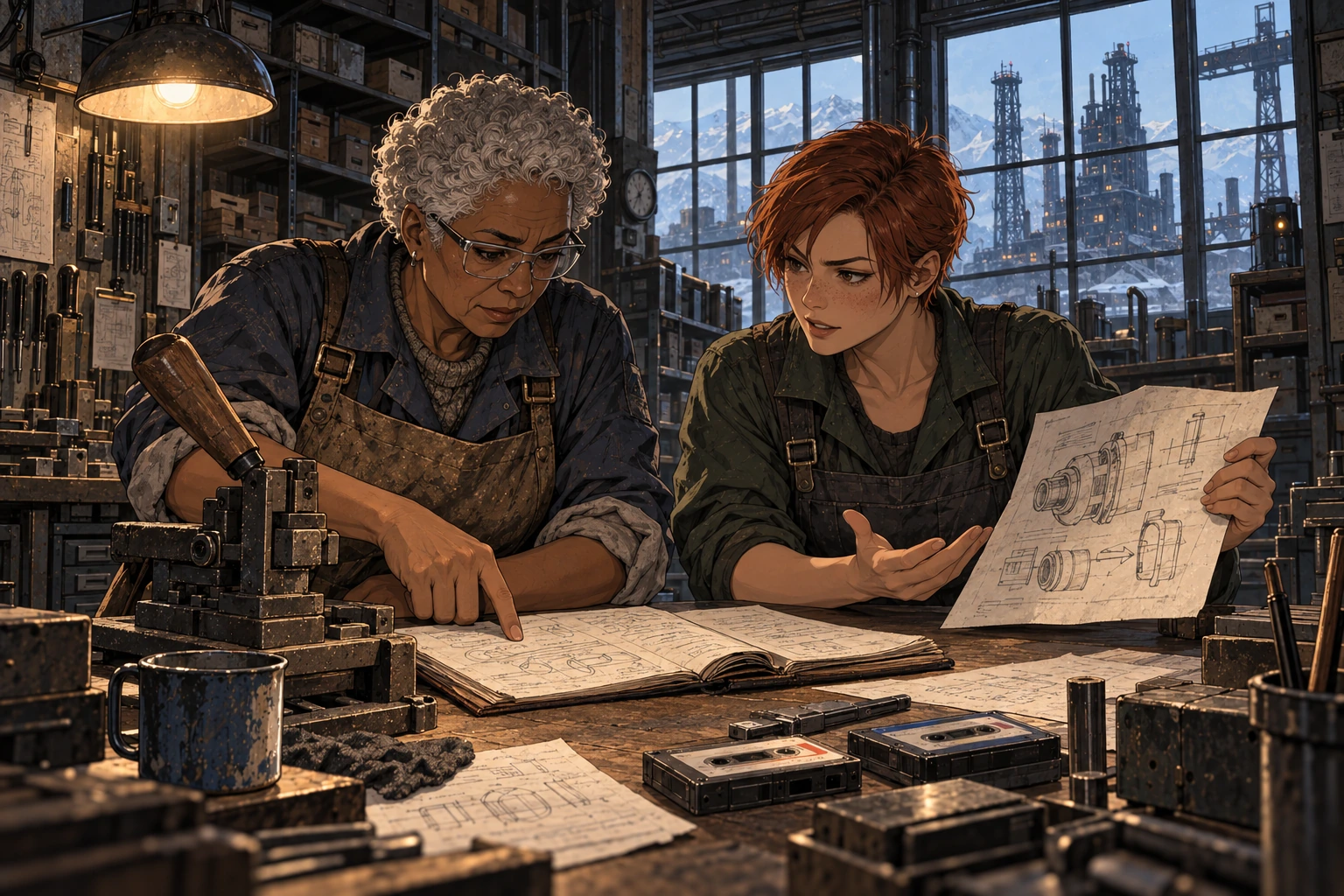
Practical adaptation and access to knowledge raise questions about whose labour receives credit.
Open full-size illustration ↗People in this picture · 2
Oda Kern
left, pointing to the maker’s record · Goes by Oda
Residence: a brick terrace near Cinderbank Foundry, Brackenzell. A senior moulder, Oda teaches ways to work around reduced hand strength and insists that skilled labour deserves credit. Rika is a younger workshop collaborator; they disagree over credit and the circulation of designs.
Rika Dren
right, holding the adapter drawing · Goes by Rika
Residence: rooms above Dren & Daughter, Stavenbruck. Rika makes small mechanisms and adapters. She wants her own name attached to her work without abandoning the family workshop. Oda is an experienced collaborator whose practical methods Rika wants others to learn.
Pavel and Rika Dren — a workshop's next generation
Pavel owns part of Dren & Daughter and treats machine upkeep as the first claim on every spare kron. He is proud of Rika's ability and slow to let her speak for the shop. Rika repairs small mechanisms, designs adapters and wants her name on work she completes. She also loves her father and knows the debts he has not fully described. A dispute over a publication or new investor can matter to them more than a stranger's dramatic mission. Pavel plays Nine Posts badly and confidently; Rika tries not to correct him every time.
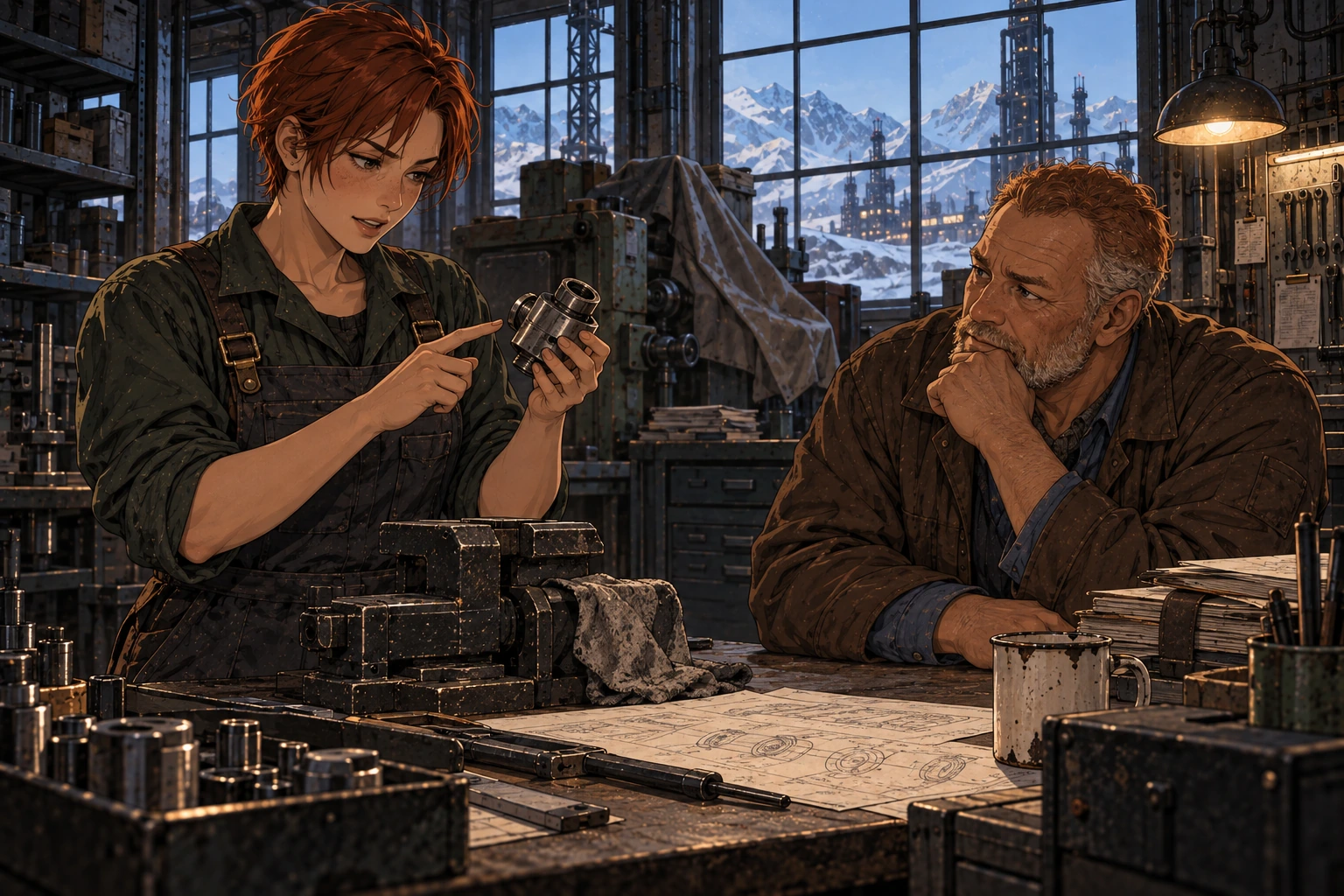
A maker’s recognition, training costs and a family workshop’s future can pull in different directions.
Open full-size illustration ↗People in this picture · 2
Rika Dren
left, holding the completed adapter · Goes by Rika
Residence: rooms above Dren & Daughter, Stavenbruck. Rika makes small mechanisms and adapters. She wants her own name attached to her work without abandoning the family workshop. Pavel is her father and a co-owner of the family workshop.
Pavel Dren
right, listening across the bench · Goes by Pavel
Residence: rooms above Dren & Daughter, Stavenbruck. Pavel co-owns Dren & Daughter. Proud of his daughter’s skill, he finds handing over responsibility harder than maintaining machinery. Rika is his daughter and a skilled maker in her own right.
Teren Vale — the right edition
Teren catalogues the Municipal Reading Exchange and remembers which donor tried to pass off an incomplete manual as a generous gift. He wants a reliable second listening deck and a catalogue that survives his retirement. He supports Anja Rusk's evening learners but worries about losing books entrusted to him. He likes sentimental music he pretends merely to tolerate for patrons. His knowledge is specific: titles, copies, readers and access. It is not a substitute for knowing every secret in the world.
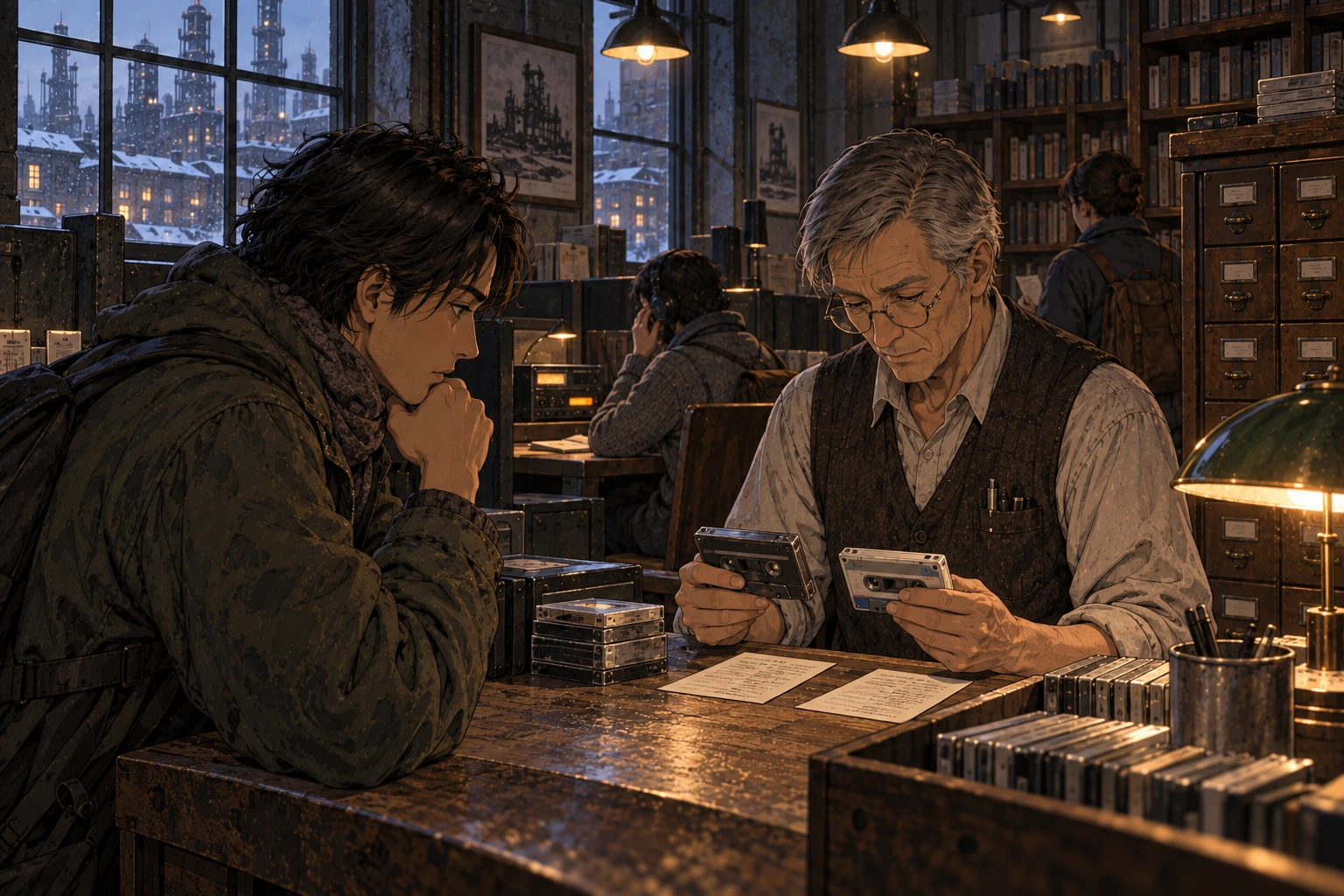
An edition, a usable copy and time with a listening deck are different forms of access.
Open full-size illustration ↗People in this picture · 2
Teren Vale
right, comparing two cassette editions · Goes by Teren
Residence: Old Exchange, Stavenbruck. Teren catalogues the Municipal Reading Exchange. He wants a useful collection that survives his retirement, including its unfashionable music. Niko is a reader asking which copy will serve his study.
Niko Svaren
left, leaning toward the editions · Goes by Niko
Residence: Freight Ward, Stavenbruck. Niko is a repair apprentice who uses evening access to the Reading Exchange. He wants a manual he can follow with borrowed equipment. Teren is helping him as a reader, not assessing him for employment.
Anja Rusk — questions worth teaching
Anja teaches at Rook Lane School and repairs its classroom receiver. She wants pupils to make things, test claims and distinguish an observation from a repeated answer. She also wants the school to retain its building. She disagrees with Vera Senk over institute recruitment that takes promising pupils away before they have received enough general education. Anja collects cheap postcards of places she hopes to visit; her life is not wholly consumed by rescuing students.
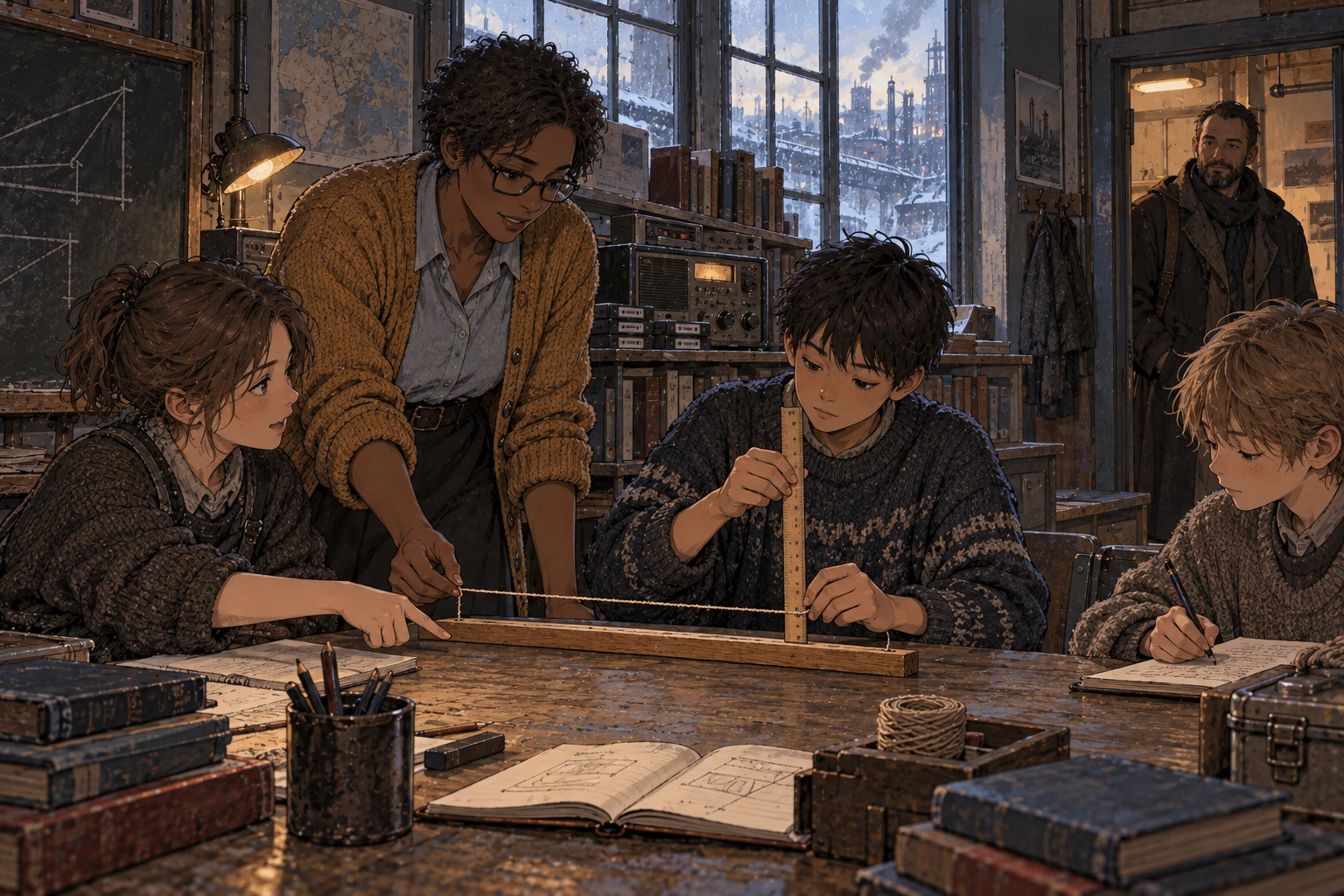
Anja asks learners to explain observations, while official answers and institutional pressure remain part of school life.
Open full-size illustration ↗People in this picture · 4
Anja Rusk
standing at the centre of the demonstration · Goes by Anja
Residence: Northbank, Stavenbruck. Anja teaches at Rook Lane School and repairs its receiver. She values a demonstrated observation more than a confidently repeated answer. She is teaching Leni, Davi and Misha, who are classmates.
Leni Tervik
pupil seated at the left · Goes by Leni
Residence: Northbank, Stavenbruck. Leni is a school pupil without paid employment. She likes working out how a model behaves before being told its name. Davi and Misha are classmates; Anja is their teacher.
Davi Koren
pupil at the centre with the upright ruler · Goes by Davi
Residence: Northbank, Stavenbruck. Davi is a school pupil without a paid job. He wants to hold the measuring tool himself rather than copy another pupil’s result. Anja teaches him; Leni and Misha share the experiment.
Misha Vell
pupil at the right, writing · Goes by Mish
Residence: Northbank, Stavenbruck. Mish is a school pupil without paid employment. He keeps notes carefully enough to discover where two attempts disagree. Leni and Davi are classmates, not siblings.
Vera Senk — a result someone else can repeat
Vera works on materials and calibration at the Institute of Applied Measures. She wants workshop-accessible methods published and is ambitious enough to care whose name accompanies them. She can be impatient with Marta's practical objections until a field visit makes their cost obvious. Her sponsor wants exclusivity; her students want equipment and a future. Vera is not automatically a dissident or a secret collaborator. Those would be consequential facts for a later story to establish.

Calibration, careful records and access to equipment shape the Institute’s work.
Open full-size illustration ↗People in this picture · 2
Vera Senk
left, working at the dial gauge · Goes by Vera
Residence: Pump Ward, Stavenbruck. Vera works on materials and calibration at the Institute of Applied Measures. She wants useful methods published and their makers credited. Kian is her laboratory colleague and is recording the observations.
Kian Vesel
right, writing beside the gauge · Goes by Kian
Residence: Pump Ward, Stavenbruck. Kian is an Institute laboratory assistant. He prefers a blank entry to a tidy figure nobody actually observed. Vera supervises this calibration work; they do not share a household.
Nell Tavor — permanence at a stopping place
Nell runs the Blue Kettle at Vesk Halt and gives correspondence learners room when the evening rush allows. Her daughter Evi, a school-age child, wants a classroom that does not disappear under somebody's delayed supper. Nell wants the same thing but fears a formal school rate that her business cannot afford. She dislikes being told how generous she is by passengers who leave without paying. Her favourite private luxury is an uninterrupted morning with a book.
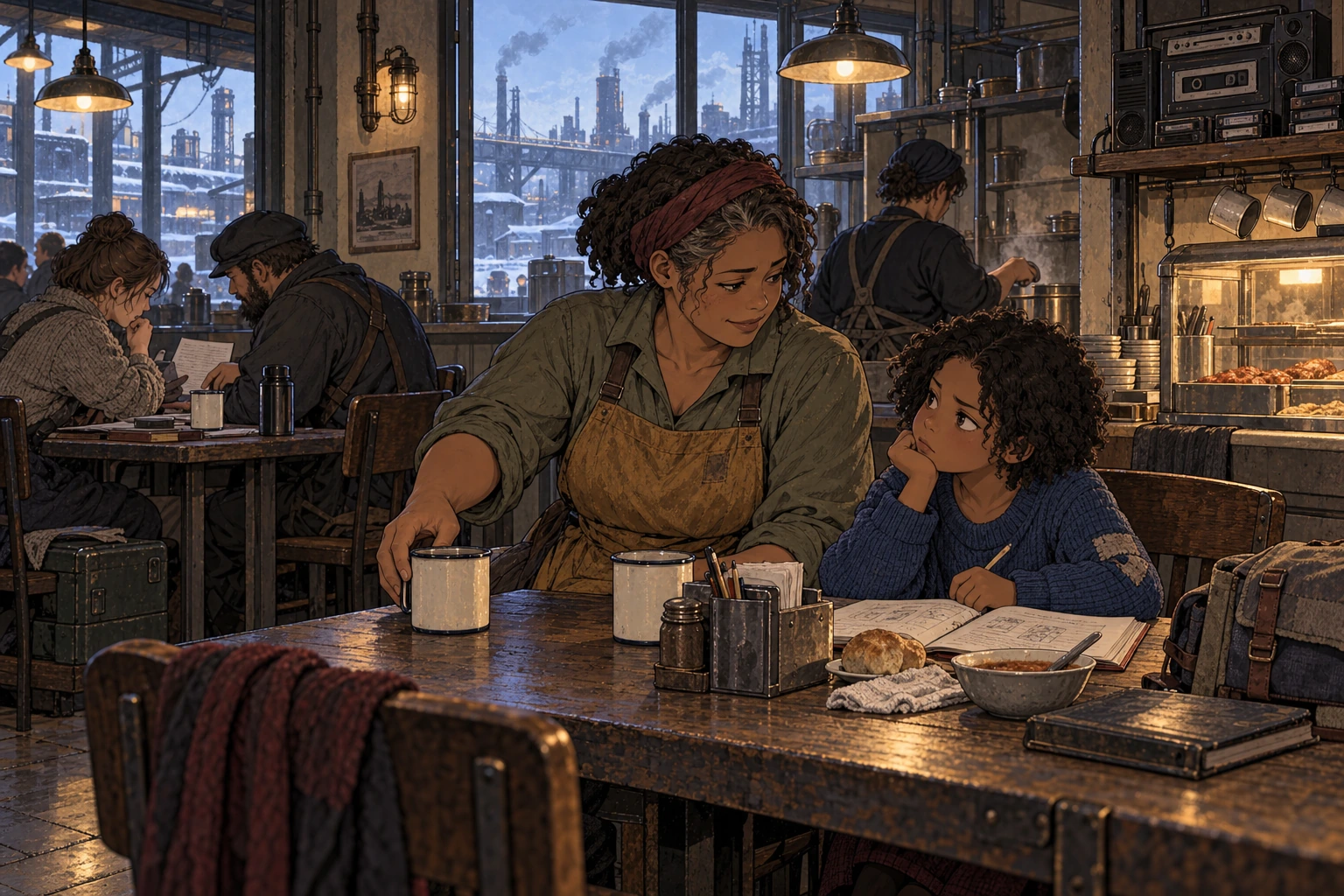
A canteen can support learning without providing the permanence a child wants.
Open full-size illustration ↗People in this picture · 2
Nell Tavor
left, clearing a mug from the table · Goes by Nell
Residence: rooms above the Blue Kettle, Vesk Halt. Nell runs the Blue Kettle canteen. She supports evening learning but wants her daughter’s lessons to have a permanent place. Evi is her daughter, trying to finish lessons in the canteen.
Evi Tavor
right, beside the open schoolbook · Goes by Evi
Residence: rooms above the Blue Kettle, Vesk Halt. A child without paid employment, Evi is a school-age learner who wants a classroom that cannot be displaced by a late supper. Nell is her mother. Evi has no paid job; this is her study time.
Mila Renn, Hessa Korr and Maren Ilt — adjacent stalls
Mila cooks at the Copper Ladle, Hessa sells fish parts and Maren alters clothing. They share customers, borrow change and argue over deliveries blocking the aisle. Mila wants a tasting evening; Hessa wants a fair crate-deposit system; Maren wants a workroom with daylight. Hessa distrusts Mila's fancy menu descriptions but saves her particularly useful trimmings. Maren dresses both friends for occasions while refusing to make their continual “small adjustments” free. Their cooperation is durable enough to include resentment and laughter.
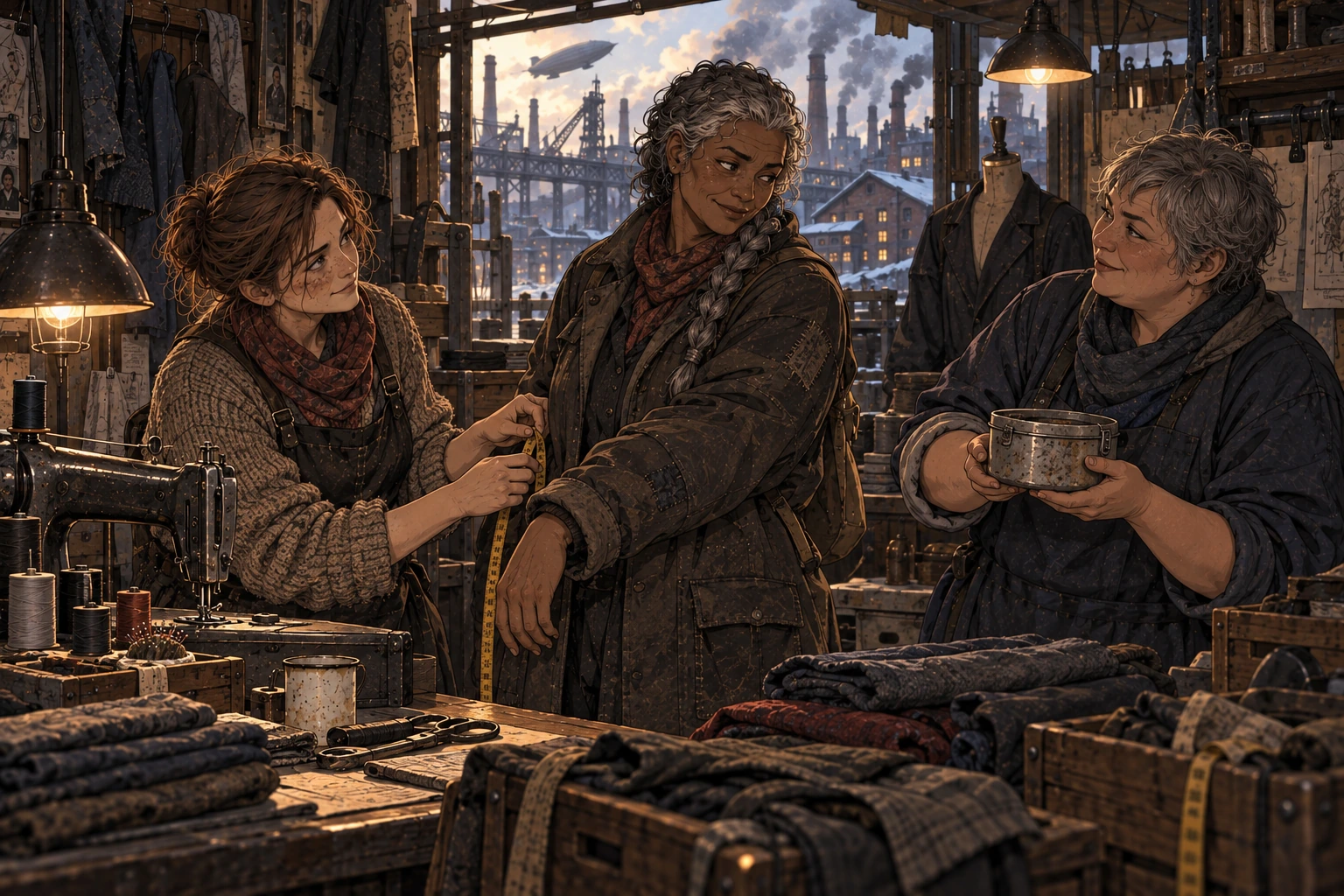
Durable cooperation can contain friendship, prices, inconvenience and disagreement.
Open full-size illustration ↗People in this picture · 3
Maren Ilt
left, measuring the sleeve · Goes by Maren
Residence: Northbank, Stavenbruck. Maren alters clothing near Return Arch and shares a protected greenhouse strip. She wants daylight for sewing and payment for small alterations. Mila and Hessa are neighbouring sellers and friends; these small alterations are still skilled work.
Mila Renn
centre, having the coat measured · Goes by Mila
Residence: the streets beside Canvas Square, Stavenbruck. Mila cooks at the Copper Ladle. She experiments carefully with issued paste and scarce additions, without treating fresh produce as ordinary. Maren is altering her coat; Hessa is their neighbouring trader and friend.
Hessa Korr
right, holding the container · Goes by Hessa
Residence: the streets beside Canvas Square, Stavenbruck. Hessa sells fish parts and argues for fair crate deposits. Her sharp bargaining coexists with a dependable eye for useful trimmings. Mila and Maren share her market aisle; their friendship includes arguments about prices and favours.
Jarek Vos and Ada Rell — upstream and downstream
Jarek repairs Tarnfeld's pumps; Ada manages Hollenmere boat shares and makes nets. They know each other through drainage disputes and seasonal repair exchanges. Jarek wants a local apprentice workshop and thinks Ada demands expensive sampling before every useful change. Ada wants an independent sampler and thinks upstream people call damage minor only while it happens to someone else. They are capable of being right about different parts of the same problem.

Different practical responsibilities can make two people right about different parts of a drainage problem.
Open full-size illustration ↗People in this picture · 2
Jarek Vos
left, holding the pump fitting · Goes by Jarek
Residence: Tarnfeld. Jarek repairs Tarnfeld’s pumps and wants a local apprentice workshop. He dislikes improvements that cannot be maintained with available parts. Ada is his downstream counterpart in recurring drainage disputes and repair exchanges.
Ada Rell
right, pointing at the river sketch · Goes by Ada
Residence: Hollenmere. Ada makes nets and manages boat shares. She argues for independent water sampling and dislikes upstream reassurances unsupported by measurements. Jarek repairs upstream pumps; she brings the concerns of downstream households to their discussion.
Leva Dorn and Toma Vesk — paperwork and the floor below it
Leva handles Northbank counter work; Toma maintains Rook Court's shared spaces within the limits of a caretaker's role. Toma believes a request should describe what a resident is experiencing; Leva needs the technical and administrative category that will get a crew dispatched. They can waste an afternoon arguing and then produce a better work order together. Neither has authority to repair the whole municipality. Their recurring conflict makes a service system human without reducing it to incompetence.
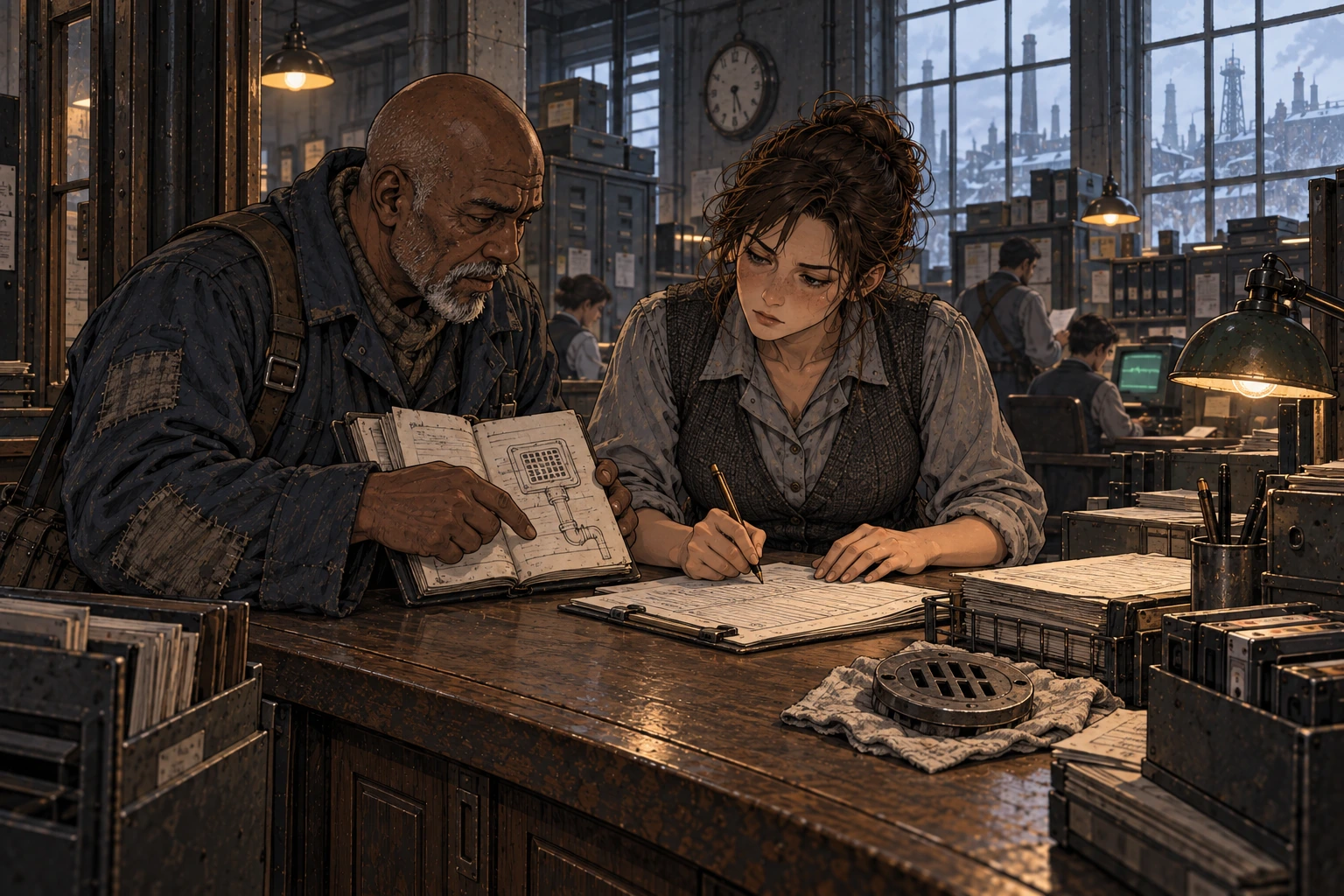
A resident’s experience and a crew’s technical category can both matter to getting work done.
Open full-size illustration ↗People in this picture · 2
Toma Vesk
left, holding the notebook open · Goes by Toma
Residence: a caretaker’s room at Rook Court, Stavenbruck. Toma maintains Rook Court’s shared spaces. He records what residents experience before arguing about the category their complaint belongs in. Leva is his municipal counter contact; they are trying to turn a resident’s report into a usable work order.
Leva Dorn
right, writing the work order · Goes by Leva
Residence: Northbank, Stavenbruck. Leva handles municipal counter work. She tries to translate a resident’s problem into a work order a crew can actually act upon. Toma is Rook Court’s caretaker and the source of the observations she is recording.
Dara Venn and Mik Sorev — lives continuing in custody
Dara's former freight experience and wish to contact her sister differ from Mik's laundry competence and wish for dependable work. They share Room Group Cinder's co-ed adult environment, not a predetermined alliance. Dara resents being assumed responsible for every document. Mik dislikes being treated as useful only when a heavy job needs doing. Neither accusation nor past conduct supplies a complete character. Their histories beyond the stated facts remain available for deliberate development rather than a surprise revelation inserted to defeat a player's judgement.
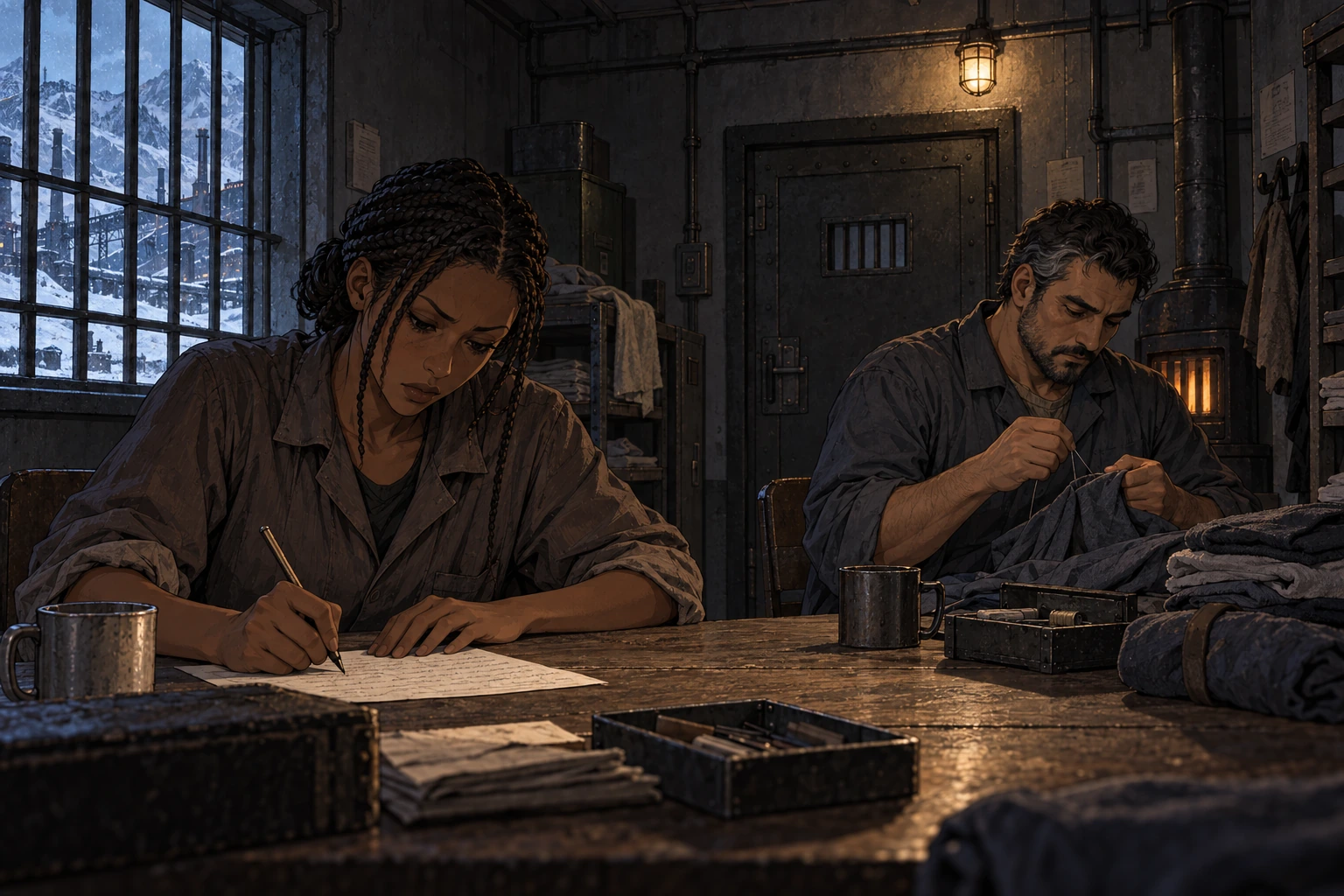
Dara and Mik retain different skills and wishes within Room Group Cinder’s co-ed adult environment.
Open full-size illustration ↗People in this picture · 2
Dara Venn
left, writing at the table · Goes by Dara
Kaltbruch ID: A00031874
Residence: Room Group Cinder, Kaltbruch. A former freight tally clerk, Dara wants to reach her sister and keep some time for herself. Literacy does not make her everyone’s unpaid clerk. Mik shares Room Group Cinder with her. They have different skills and needs and are not a couple.
Mik Sorev
right, mending clothing · Goes by Mik
Kaltbruch ID: B00018462
Residence: Room Group Cinder, Kaltbruch. A laundry worker imprisoned for violence, Mik is skilled with cloth and easily ashamed of needing help. Present kindness does not erase his past conduct. Dara is a fellow resident, not his appointed clerk or a relative.
Following relationships
These people can be met through work, recreation, kinship, trade or ordinary disagreement. Their immediate needs do not wait frozen for a player character to arrive. For a scenario, choose which matter is currently active and establish its facts then. A cast member may help, decline, misunderstand, negotiate or pursue an independent opportunity. The result need not turn them into a permanent quest-giver or antagonist.