Money that travels less easily than goods
Stavenbruck's working cash unit is the kron, written kr, divided into one hundred nibs. Small purchases use stamped tokens or worn paper notes; larger settlements use receipted account transfers between recognised offices. The Stavenbruck Clearing Office reconciles municipal, employer and merchant accounts. It is a local institution, not a planetary central bank or an omniscient financial network.
A shop can accept an outlying cooperative's voucher at a discount, decline it or know a trader who will settle it. What looks like greed may reflect the cost of sending the voucher back to its issuer; it can also be exploitation. Clearing records travel over Spoolline or on sealed cassette copies. A clerk's acknowledgement means a transfer was received for processing, not that money is already spendable at another counter. Larger employers gain influence by paying reliably and by making their own shops the easiest place to spend their paper.
Ration claims remain separate. Stavenbruck's three daily registered meal claims are not wages, a kron denomination or proof of adequate nourishment. There is no general exchange rate between a pressed disc, a city claim and cash. A seller quotes the transaction it will actually accept. This prevents a household budget from silently assuming it can buy unlimited food entitlements for a fixed sum.

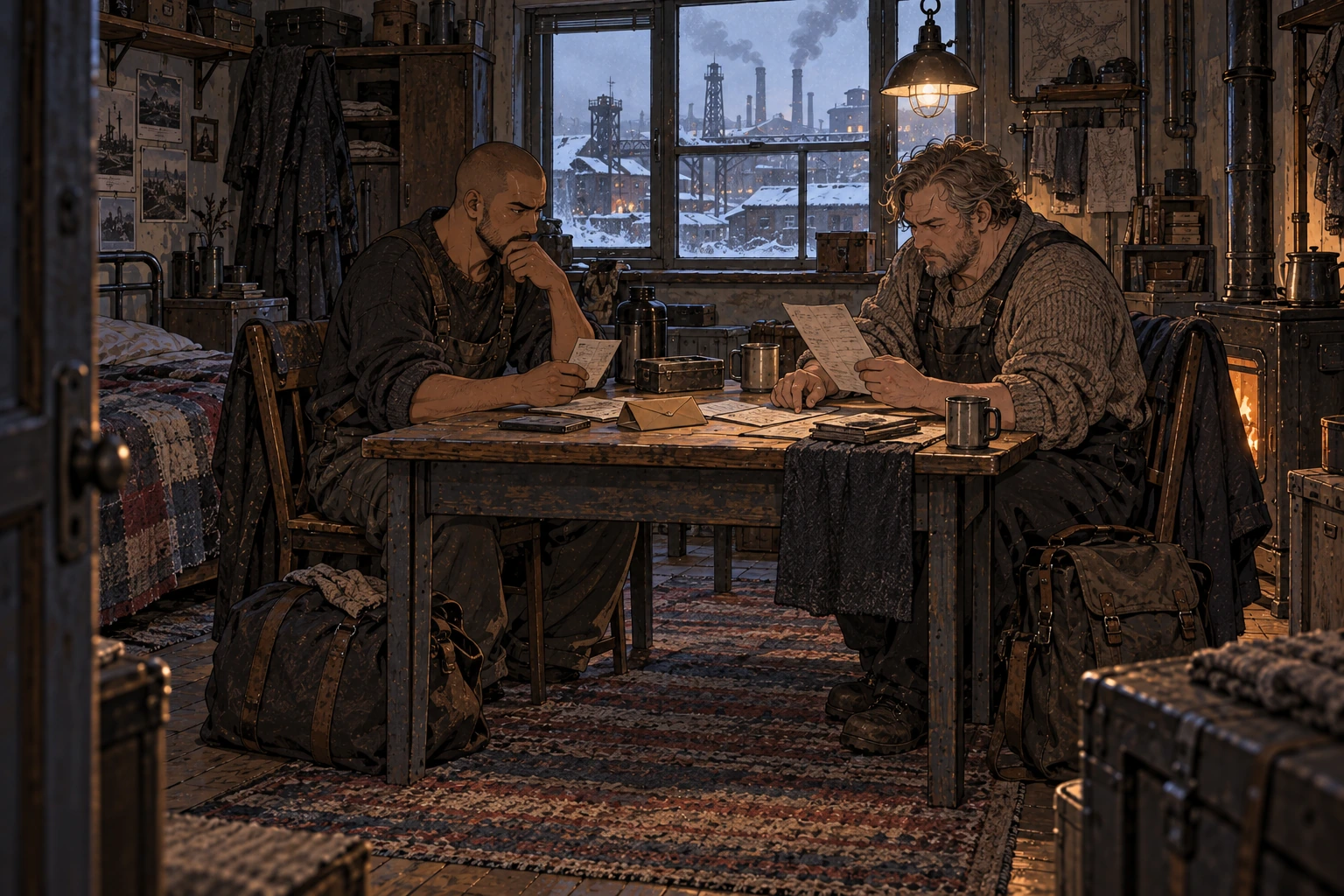
Receipted accounts, physical media and worn notes belong to a proposed local cash economy. Receipt for processing is not proof that money is already spendable elsewhere.
Open full-size illustration ↗People in this picture · 2
Milos Rennik
left, carrying the shoulder bag · Goes by Milo
Residence: Freight Ward, Stavenbruck. Milo is a delivery porter who checks a payment receipt before making plans for money that may not yet be available. Greta is the clearing clerk assisting him.
Greta Selm
right, holding the cassette · Goes by Greta
Residence: Old Exchange, Stavenbruck. Greta is a clearing clerk who keeps physical media and cash receipts distinct. She dislikes promising what another office must complete. Milo is her customer; they have no personal financial arrangement.
A usable cash baseline
The following proposals describe ordinary Stavenbruck transactions during a functioning supply week. A budgeting week is seven conventional days, with six paid shifts where that employment arrangement applies. It is an accounting convention alongside Event Days, Marks and Cycles, not a new calendar ruling. Paid work commonly uses an eight-hour shift, with exceptions and abusive overtime negotiated in the fiction. All amounts are nominal, before exceptional debts or benefits.

A household considers a boot repair against replacement. The chapter’s proposed prices describe an ordinary functioning supply week, not a universal fixed market.
Open full-size illustration ↗People in this picture · 2
Ilian Marvek
left, holding the worn boot · Goes by Ilian
Residence: the streets beside Canvas Square, Stavenbruck. Ilian is a cobbler who explains how much leather remains before recommending another repair. Tala is a returning customer considering the cost.
Tala Bren
right, considering the boot · Goes by Tala
Residence: Northbank, Stavenbruck. Tala works on a packing line and needs boots that survive the walk as well as the shift. Her budget leaves little room for experiments. Ilian repairs her footwear; she is not employed by his shop.
| Income or purchase | Proposed cash amount | Assumption |
|---|---|---|
| Casual porter, six paid shifts | 48–66 kr/week | Work actually obtained; no guaranteed full week |
| Regular works labourer or junior clerk | 66–84 kr/week | Posted ordinary wage, excluding overtime |
| Skilled fitter, experienced nurse or signals technician | 90–126 kr/week | Certified skill or recognised experience |
| Scarce specialist or senior supervisor | 140–220 kr/week | Access and responsibility vary more than title suggests |
| Lockable small room | 28–42 kr/week | Municipal or modest private tenancy; heat separate |
| Larger shared household rooms | 42–60 kr/week | Better space, not an entire fine house |
| Heating charge | 8–16 kr/week per tenancy | Season and building condition matter |
| Ordinary cooking fuel contribution | 3–6 kr/week | Shared stove use, not a private heated apartment |
| Tram or ordinary local road-service ride | 0.6–1.2 kr | A route operating normally; no basin permit included |
| Boots repaired / sound replacement pair | 4–9 / 24–40 kr | Repairable damage versus ordinary work quality |
| Basic compatible replacement filter | 5–9 kr | Approved local type in stock; no universal hazard protection |
| Public text dispatch | 1–3 kr | Short ordinary message; urgency and long routes cost more |
| Listening-room seat / modest dance admission | 0.5–1 / 1–2 kr | Ordinary programme, not a visiting star |
| Grain cake or modest cooked extra | 0.5–1.5 kr | Additional purchase; not conversion of a meal claim |
Two households, different room to breathe
Rook Court, one income: a regular worker receives 72 kr. Their illustrative weekly cash plan is 34 rent, 12 heat, 4 cooking fuel, 6 transport, 8 purchased food additions, 4 washing and small supplies, and 4 put aside for clothing: 72 kr in all. Registered meal claims are held separately and are not counted as cash income. There is no cash reserve in this example. The next boot repair may mean borrowing, walking, reducing extras or getting help, even if every posted claim is honoured.
Two earners sharing rooms: two 72-kr wages total 144 kr. Their illustrative costs are 44 rent, 14 heat, 4 cooking fuel, 24 food additions, 10 transport, 12 debt instalments and 8 clothing/washing: 116 kr, leaving 28 kr. This household has more room to save or enjoy itself because some costs are shared, not because its members have different nutritional needs. A care interruption, a missing wage or an extra lodger changes the arrangement.
Neither table describes every family. A Tarnfeld household may possess food and tools while lacking cash; a Vesk driver may earn more but spend it on away-from-home beds. A Brackenzell job may include heat priced below the city rate, giving the employer a hold that cannot be understood from wages alone.

The accompanying example allocates all 72 kr of a worker’s weekly cash. Meal claims are separate; the image establishes no new denomination or additional income.
Open full-size illustration ↗People in this picture · 1
Aneta Sorn
alone at the household table · Goes by Anet
Residence: a rented single room in Northbank, Stavenbruck. Anet is a piecework packer living on one wage. She reads for pleasure but must plan purchases around rent and ordinary repairs. No companion is shown; she manages this household budget herself.
The accompanying example has 144 kr income, 116 kr costs and 28 kr remaining. Shared costs create room to save while care interruptions or missed wages can change the arrangement.
Open full-size illustration ↗People in this picture · 2
Rafi Lenek
left, beside the open household papers · Goes by Raf
Residence: Pump Ward, Stavenbruck. Raf is a furnace attendant who wants a small repair reserve before buying anything that commits another week’s wages. Emil is his partner; they share household expenses.
Emil Voren
right, reading the bill · Goes by Em
Residence: Pump Ward, Stavenbruck. Em works in a municipal washhouse. He favours saving but worries about what another missed shift would do to their plan. Raf is his partner and fellow contributor to the household budget.
Ownership, debt and bargaining
Small workshops combine savings, kin loans and machine shares. At Dren & Daughter, a lathe belongs to three investors while its operator owns most of the attachments. Selling the machine would not magically produce a functioning replacement business. Merchant debt often takes the form of unpaid supplies, while household debt begins with rent arrears, a funeral, a work injury or equipment needed to obtain employment.
The Rook Mutual Box is a small resident-run loan fund with a written lending limit and two keyholders. Its members argue about favouritism and whether protecting the fund has become more important than helping a neighbour. It does not erase municipal bills or guarantee rescue. Workplace committees bargain over protective equipment, apprentices' boots, shift notices and who gets paid while a machine is stopped. Some owners prefer an organised representative to a room full of individual disputes; others punish organisers while calling the punishment poor performance.
A clerk can build a better life through competence and savings. A labourer may use a committee to win a predictable schedule. A merchant might risk a new supply route rather than hoard. Economic pressure supplies choices and conflict without requiring every transaction to end in destitution.

Two keyholders and a neighbour discuss help from a small resident loan fund. Shared resources can support a household without erasing its bills or guaranteeing rescue.
Open full-size illustration ↗People in this picture · 3
Zelia Remek
left, turning one key · Goes by Zel
Residence: Rook Court, Northbank, Stavenbruck. Zel is a retired seamstress and one of the resident loan box’s keyholders. She insists that help and repayment both be recorded. Hugo is the other keyholder; Iva is their neighbour seeking assistance.
Iva Dornik
centre, watching the box · Goes by Iva
Residence: Rook Court, Northbank, Stavenbruck. Iva takes temporary cleaning shifts. She is asking for help with a bill rather than pretending that her next wage is certain. Zel and Hugo are neighbours entrusted with the shared fund.
Hugo Velt
right, turning the second key · Goes by Hug
Residence: Rook Court, Northbank, Stavenbruck. Hug repairs locks and serves as the fund’s second keyholder. He wants rules that do not change according to who asks. Zel shares responsibility for the box; Iva is its applicant.