Care in an industrial city
The Northbank Clinic offers ordinary consultations, dressings, maternity appointments and referrals within a network of overstretched district clinics. The Stavenbruck Municipal Hospital handles surgery, complex illness and specialist care. A works infirmary can assess a job injury sooner than either, but its employer may favour a quick return to duty.
Basic district assessment is funded through municipal provisioning. Medicines, travel and time away from work can still impose costs, and private consultations buy shorter waits or a preferred practitioner. This distinguishes a nominal right to be seen from access to everything a person needs. Referral and employer-certificate disputes can require repeated visits, copies of records held elsewhere and an independent appointment that is difficult to obtain. A person may lose pay arranging evidence before any disputed absence is recognised. Clinic staff can correct a record or support a referral, but their limited administrative time means a persistent patient or helper may have to follow the request through several desks. A successful correction or funded journey can materially improve access without guaranteeing a medical outcome. A clinic's refusal to sell a scarce medicine does not prove it has no supply; the stock may be reserved for another indication or sponsor. Conversely, a suspicious patient is not automatically correct about corruption.
Lena Drost, Northbank's senior nurse, knows which employers honour a rest certificate and which demand another stamp. She is strict about attendance at follow-up because missed care causes real problems, yet tries to arrange appointments around shifts. She dislikes being described as an angel: she wants more staff, an intact roof and enough time to eat her own meal. Her partner, ferry pilot Sera Anvek, thinks she is keeping an impossible rota alive by refusing to take leave.

Clinical care depends on staff time, follow-up and the practical demands of patients’ lives.
Open full-size illustration ↗People in this picture · 2
Lena Drost
left, seated at the clinic desk · Goes by Lena
Residence: a rented Northbank room shared with Sera Anvek, Stavenbruck. A Northbank Clinic nurse, Lena worries about the unpaid time recovery requires as well as the treatment itself. She is listening to Alena’s account of a work injury and the shift obligations around it.
Alena Borsk
right, holding a shift sheet with a dressed wrist · Goes by Alena
Residence: Northbank, Stavenbruck. Alena is a laundry worker who needs a realistic account of what she can manage at work. She has brought her shift sheet to the clinic. Lena is her nurse; the consultation is not a family meeting.
Different places, different access
Roven Ferry maintains a small clinic with visiting hospital staff and a transport arrangement for urgent referrals when the crossing is usable. Tarnfeld's cooperative pays a nurse and maintains a maternity room, but specialist referrals take people away from work and dependants. Brackenzell has more industrial first-response equipment than its size suggests and fewer independent specialists than workers want. Hollenmere relies on a clinic launch and designated local carers during parts of the year. Vesk Halt's clinic register contains people whose official address is somewhere they have not reached in months.
These differences create unequal care without making rural people medically ignorant or every employer's clinician dishonest. A village carer can be excellent at recognising when a familiar problem has become unfamiliar. A city specialist can make a wrong assumption about the conditions in which instructions will be followed. Distance, clean water, privacy, time and transport are part of whether a plan works.

Distance and transport shape care in Hollenmere alongside local skill.
Open full-size illustration ↗People in this picture · 3
Vera Molen
left, supporting the older passenger · Goes by Vera
Residence: Hollenmere. Vera is a paid local carer who coordinates journeys with the clinic launch. She asks what help a passenger wants before taking an arm. Elsbeth is the resident she is accompanying; Mira is the clinic worker meeting them.
Elsbeth Meren
centre, using the cane · Goes by Els
Residence: Hollenmere. Els is a retired net maker who retains a sharp interest in other people’s knots. She is travelling for a clinic appointment. Vera is her carer for this journey, not her daughter.
Mira Danov
right, carrying the clinic bag · Goes by Miri
Residence: staff rooms at Hollenmere’s clinic landing. Miri is a clinic launch attendant who checks that bags and passengers can board without competing for the same space. She works with Vera to assist Els onto the launch.
Injury, disability and a life beyond assessment
Crush injuries, burns, hearing loss, repetitive strain and chronic breathing problems are recognised occupational concerns. Employer and municipal records can disagree about whether work caused an injury. The Return Bench Office at the labour exchange arranges adapted placements, with mixed success: sometimes a genuinely useful role, sometimes a humiliating desk that exists to close a claim.
Oda Kern uses modified handles and shares tasks differently after losing strength in one hand; she remains a senior craftworker, not a lesson in inspirational endurance. Rook Court residents propose a quieter ground-floor room for an older neighbour who cannot manage stairs, then disagree over which waiting household should yield its place. Accessibility is a question of space, maintenance and competing needs as well as goodwill. A person's need for care does not erase their privacy, judgement or desires.

Practical adaptation and access to knowledge raise questions about whose labour receives credit.
Open full-size illustration ↗People in this picture · 2
Oda Kern
left, pointing to the maker’s record · Goes by Oda
Residence: a brick terrace near Cinderbank Foundry, Brackenzell. A senior moulder, Oda teaches ways to work around reduced hand strength and insists that skilled labour deserves credit. Rika is a younger workshop collaborator; they disagree over credit and the circulation of designs.
Rika Dren
right, holding the adapter drawing · Goes by Rika
Residence: rooms above Dren & Daughter, Stavenbruck. Rika makes small mechanisms and adapters. She wants her own name attached to her work without abandoning the family workshop. Oda is an experienced collaborator whose practical methods Rika wants others to learn.
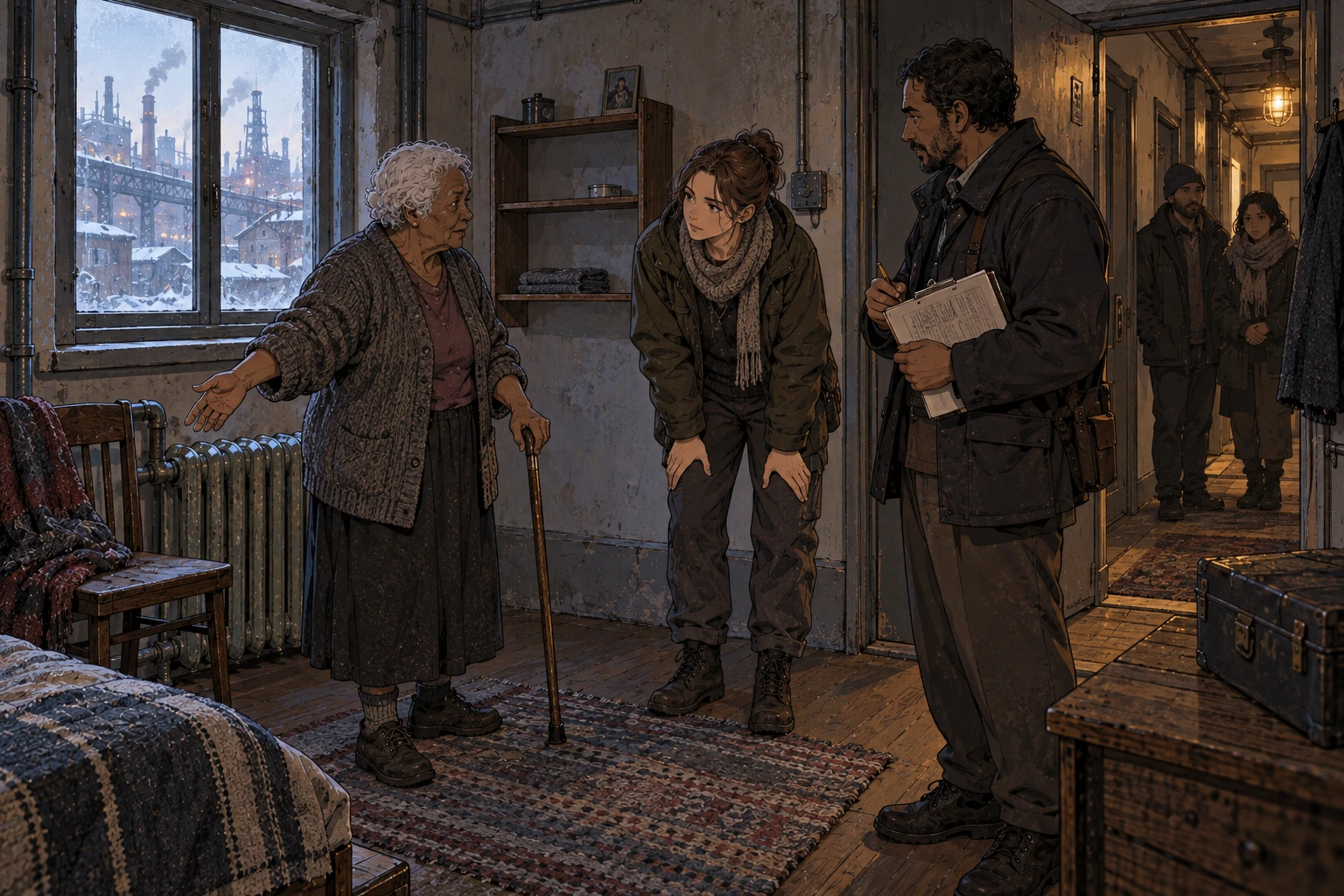
Accessible space involves the resident’s wishes, maintenance and competing household needs.
Open full-size illustration ↗People in this picture · 3
Hedda Vorn
left, indicating the place for her chair · Goes by Hedda
Residence: a ground-floor room in Rook Court, Stavenbruck. Hedda is a retired canteen worker who wants the new room arranged around her own routines. She has not surrendered those decisions to helpers. Lina is helping her move; Oren represents the housing office.
Lina Rems
centre, leaning forward to listen · Goes by Lina
Residence: Rook Court, Northbank, Stavenbruck. Lina takes paid household-care shifts and helps neighbours move small possessions when she has time. Hedda is her neighbour; she is accompanying her to this room inspection.
Oren Dalt
right, holding the housing papers · Goes by Oren
Residence: Old Exchange, Stavenbruck. Oren is a municipal housing inspector who records access and repair needs. He wants his description to match how the resident will use the room. He is inspecting Hedda’s accommodation while Lina assists her.
Mental health, grief and Rift suspicion
The municipal hospital has a small Rest and Listening Service staffed by clinicians with different approaches and limited appointments. People also seek help from trusted relatives, congregations, peers or nobody. Sleep disruption, grief, trauma and unusual experiences are not automatically Rift effects. Rift-Touched classification is not a diagnostic shortcut, and a person's distress is not evidence of alien identity.
Some employers treat attendance at the service as responsible maintenance; others use it as a reason to deny promotion. Patients may therefore conceal care without rejecting its value. Teren Vale keeps the Reading Exchange's quiet room available for people who need a low-demand place to sit, while declining to call it treatment. A listening room, a friend and clinical care can offer different kinds of help rather than competing for one explanation of a person.
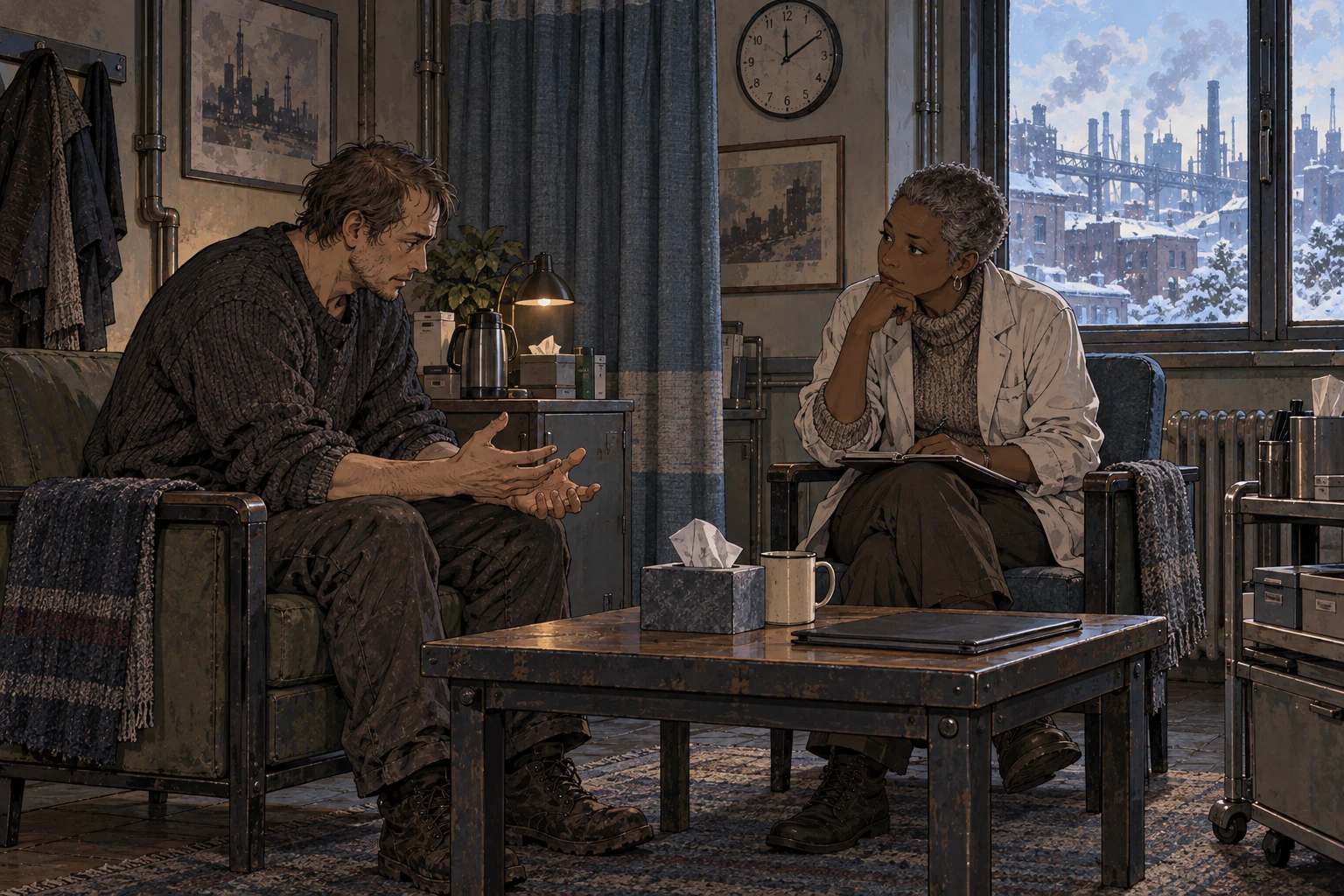
Grief, unusual experiences and the need for care do not establish Rift effects or alien identity.
Open full-size illustration ↗People in this picture · 2
Goran Velek
left, speaking with open hands · Goes by Gor
Residence: Freight Ward, Stavenbruck. Gor is a rail-yard fitter taking time for a private care appointment. He wants to explain what is troubling him in his own words. Ruth is the clinician listening; the picture establishes no diagnosis.
Ruth Ansel
right, seated with the notebook · Goes by Ruth
Residence: Northbank, Stavenbruck. Ruth is a clinic counsellor who makes space for an account before deciding which question to ask next. Gor is her patient. Their conversation remains a care encounter, not public gossip.
Birth, childhood and public sanitation
Maternity care belongs to clinics, trained birth attendants and the hospital according to location and need. Registration and the already established reproductive controls can make families wary of sharing information. A household can celebrate a birth while fearing the administration around it.

A household can welcome a child while worrying about registration and the administration around it.
Open full-size illustration ↗People in this picture · 4
Jelena Ostvek
left, seated beside the infant · Goes by Jela
Residence: Northbank, Stavenbruck. Jela is a paid linen mender currently occupied with caring for a new baby. She wants enough quiet to learn the household’s changed routines. Ravi is her partner; Tova is their baby.
Ravi Ostvek
centre, holding the swaddled infant · Goes by Ravi
Residence: Northbank, Stavenbruck. Ravi is a workshop porter arranging shifts around a new child. Holding the baby still takes his complete attention. Jela is his partner and Tova their child.
Tova Ostvek
the swaddled infant in Ravi’s arms · Goes by Tova
Residence: Northbank, Stavenbruck. Tova is a newborn with no job. The household’s immediate work is warmth, feeding, care and finding time to rest. Jela and Ravi are Tova’s parents; the visiting attendant is Ilse.
Ilse Kavel
right, closing the care bag · Goes by Ilse
Residence: Northbank, Stavenbruck. Ilse is a community birth-care attendant who visits households after an arrival. She checks what support is practical before leaving instructions. She is assisting Jela, Ravi and Tova in her professional role.
Public health work is also drains, refuse collection, washrooms and clean water. Toma Vesk reports a blocked court drain before it becomes a neighbourhood crisis. Marta Velska deals with supply and intake conditions rather than having the authority to solve every household problem herself. Their jobs overlap through work orders and actual observations. A possible story centres on obtaining an independent workplace assessment; another follows a family arranging travel for care while trying to keep a tenancy and apprenticeship intact. The stakes need not be a miraculous cure.

A resident’s experience and a crew’s technical category can both matter to getting work done.
Open full-size illustration ↗People in this picture · 2
Toma Vesk
left, holding the notebook open · Goes by Toma
Residence: a caretaker’s room at Rook Court, Stavenbruck. Toma maintains Rook Court’s shared spaces. He records what residents experience before arguing about the category their complaint belongs in. Leva is his municipal counter contact; they are trying to turn a resident’s report into a usable work order.
Leva Dorn
right, writing the work order · Goes by Leva
Residence: Northbank, Stavenbruck. Leva handles municipal counter work. She tries to translate a resident’s problem into a work order a crew can actually act upon. Toma is Rook Court’s caretaker and the source of the observations she is recording.