Valkrisch (English designation: Valkric) is New Frostmarch’s common language, not a declared universal language of Earth #0239. Germanic, Slavic, Prussian/Baltic and English influences have developed into one language rather than alternating borrowed words. It uses a Latin-derived alphabet.
| Register | Use |
|---|---|
| High Valkrisch | Law, proclamations, formal education and ceremony |
| Service Valkrisch | Signs, transport, factories, forms and institutional commands |
| Street Valkrisch | Markets, barracks, workshops and ordinary conversation |
Readable signs
| Sign | Meaning |
|---|---|
| KALTBRUCH STRAFKOMPLEKS | Kaltbruch Penal Compound |
| EINTRIT VERBOT. | Entry forbidden |
| AUSWEIS ZEIG. | Present identification |
| WART HIER. | Wait here |
| HAFTBLOK | Detention block |
| WODASTAZ | Water station |
| HEIZWERK | Boiler plant |
| MEDSTAZ | Infirmary |
| SCHUTZKLET | Shelter |
VERBOT is the clipped institutional form; VERBOTEN belongs to fuller speech or High Valkrisch. Institutional signs commonly use uppercase text and omit articles. Civilian speech permits more personal expression.
Service Valkrisch governs local administration. Other home languages and variable literacy remain possible. Message clerks can read or transcribe for a sender.
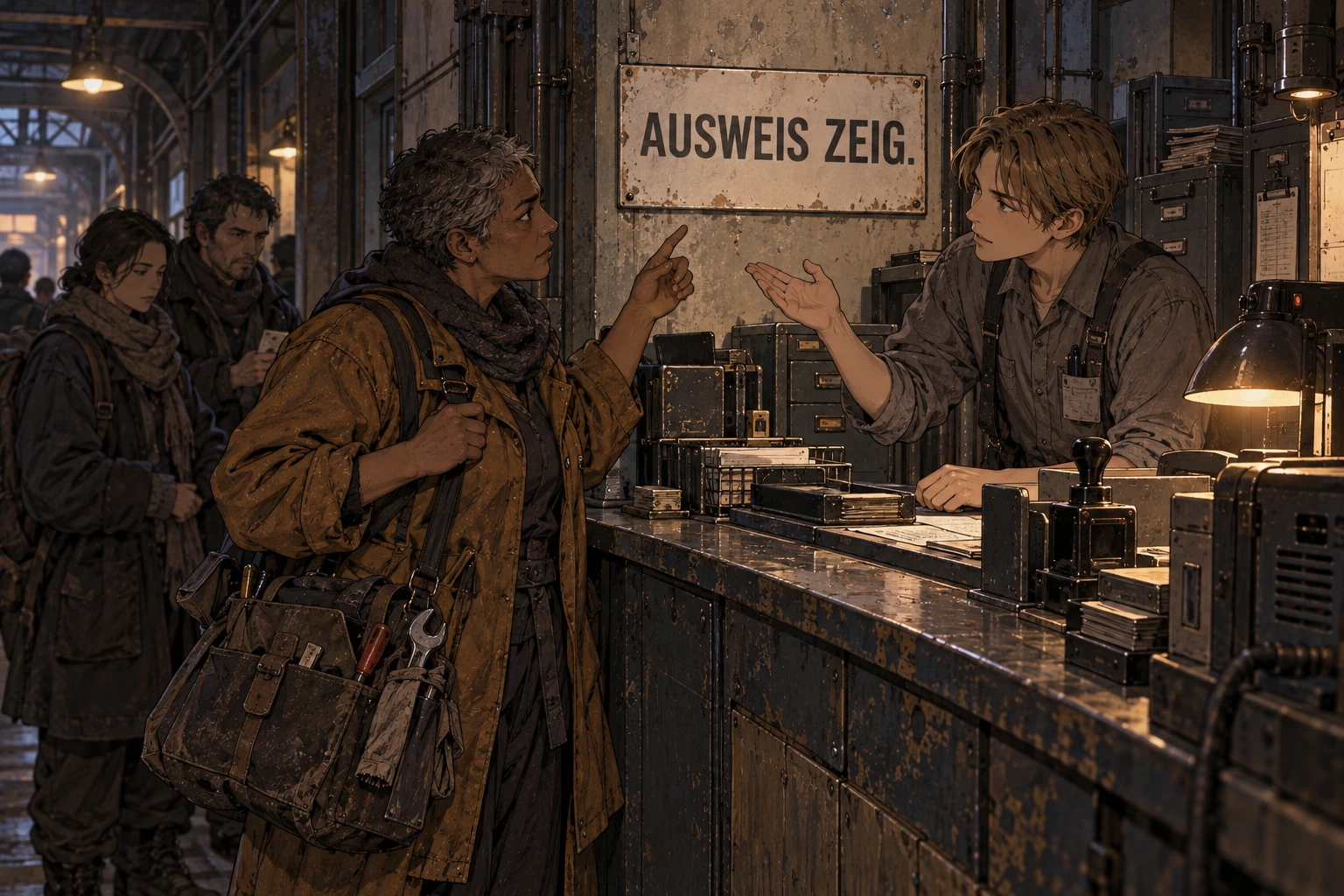
Reading a notice involves its conditions and authority as well as its words.
Open full-size illustration ↗People in this picture · 2
Zoya Harnik
left, pointing at the sign · Goes by Zoya
Residence: Freight Ward, Stavenbruck. Zoya is a tradeswoman who repairs luggage clasps. She is asking what proof this counter requires rather than guessing from a familiar phrase. Erik is the clerk explaining the notice.
Erik Varen
right, behind the counter · Goes by Erik
Residence: Old Exchange, Stavenbruck. Erik is a municipal counter clerk who tries to explain an instruction’s conditions without turning it into a lecture. Zoya is his visitor; he has no authority over her workshop.
Speaking to a person and addressing an office
A person can move among High, Service and Street registers without changing allegiance. A works supervisor may issue a clipped instruction on the floor, speak warmly over supper and reach for ceremonious language when frightened of a hearing. The register change can be revealing without serving as proof of dishonesty.
At a counter, knowing the expected category can matter more than an elaborate accent. Leva Dorn sometimes translates a resident's account into the phrase that gets a request handled, then explains the result back in ordinary speech. Another clerk may use the same specialised vocabulary to exclude or intimidate. Public literacy is therefore not simply the ability to sound out letters: people need to recognise a date, an entitlement, a condition and who has authority to change it.
Home languages and mixed households
The Roven Reach contains households whose home speech differs from administrative Valkrisch. Children can interpret familiar notices for adults who are expert in other matters, an arrangement that offers help while sometimes burdening the child with responsibilities beyond their age. Clerks and interpreters are paid for some work; neighbours perform other translation as part of an actual relationship.
A mixed household might preserve a song in one language and settle bills in another. An older relative may fear that grandchildren are losing words attached to family stories, while the children dislike having every new phrase treated as disloyalty. Neither position supplies a complete judgement of the household's culture. Songs, recipes, jokes and naming habits can change through adoption rather than cultural disappearance.
Writing as an object
Notes travel folded into coat pockets, pinned inside shared cupboards or recorded for somebody who prefers listening. A neatly typed letter can communicate care, official authority or borrowed access to a machine. A poor spelling does not make its account false. The Reading Exchange's classes let adults improve skills without pretending that they arrived without knowledge. These practices connect language to privacy, education, technology and belonging alongside the language’s grammar and vocabulary.

Home languages and shared recordings preserve connections beyond official vocabulary.
Open full-size illustration ↗People in this picture · 3
Sorin Mahvek
right, speaking into the microphone · Goes by Sorin
Residence: Northbank, Stavenbruck. Sorin is a retired tram conductor who records family stories in the speech he used at home. He wants the familiar turns of phrase kept. Nadja is his daughter and Kori his grandchild.
Nadja Mahvek
left, making notes · Goes by Nadja
Residence: Northbank, Stavenbruck. Nadja is a garment cutter who writes down names while her father speaks. She knows a recording still needs a label people can find. Sorin is her father; Kori is her child.
Kori Mahvek
child listening between the adults · Goes by Kori
Residence: Northbank, Stavenbruck. Kori is a school pupil with no paid job. Listening to family recordings has become a reason to ask about places beyond the district. Nadja is Kori’s mother and Sorin the grandfather.
Cultural dominance and human diversity
Valkrisch spread through contracts, trade and administration beyond its earliest speaking communities. Its present official role reflects that institutional history. People of different ancestries can speak it as their first language, hold office or belong to established local families; other household languages also persist.