Ground that could be kept
Kaltbruch was built after the ground beneath it had been checked often enough for powerful people to trust their investment. The shelf was useful because it stayed itself while the basin beyond it did not. Survey marks, repeated observations and the labour of keeping instruments working came before a prison could be promised. The view is still unsettling. Distant light seems to hesitate where it ought to fall cleanly, and a familiar ridge can disappear behind atmospheric disturbance. The compound stands on its shelf, not at the physical lip of the aperture.
The institution's history has no single version that satisfies everyone who depends on it. Official accounts begin with necessary custody and the protection of a damaged world. Transport workers remember the loads that began taking priority over repairs elsewhere. Families remember a relative being sent to a place from which an answer became difficult to obtain. Long-serving personnel remember the first room where the heating actually worked. These memories can describe the same development without assigning it the same meaning.

Early construction crews work on verified stable ground, with the altered basin distant.
Open full-size illustration ↗People in this picture · 2
Zelda Orvek
left foreground, recording survey notes · Goes by Zel
Residence: temporary shelf-service lodgings at the historical time shown. Zel was a civilian survey recorder during the early works. She checked field notes before construction decisions made an uncertain mark expensive. Adal operated the instrument for their survey pair.
Adal Krehn
centre-left, using the survey instrument · Goes by Adal
Residence: temporary shelf-service lodgings at the historical time shown. Adal worked as a civilian survey technician on the early shelf works. He preferred a repeated measurement to an impressive-looking stake line. Zel was his recording colleague. Neither is depicted as a prisoner.
The emergency acquires a stores account
Early service accommodation was organised around keeping people and equipment functioning on a difficult site. Shelter, water, fuel, transport and a dependable place to hold a person could not be obtained simply by issuing an order. Builders used what reached them. A serviceable fitting stayed in use after the drawing that specified it was replaced; a temporary partition remained because taking it down would interrupt work.
As custody became continuous, temporary arrangements acquired owners. Somebody kept the keys to a store, somebody received replacement bedding, and somebody could explain why a requisition had not been filled. Those positions became departmental work. An institution emerged partly through decisions about who was allowed to ask for which ordinary thing.
The shift did not make every early employee cruel or every later official efficient. It made unfinished emergency powers easier to inherit. A rule written for an exceptional intake could become the justification for handling ordinary arrivals harshly. Staff arriving later learned the practice before learning its origin. “We have always done it this way” often meant that nobody present remembered being able to do otherwise.
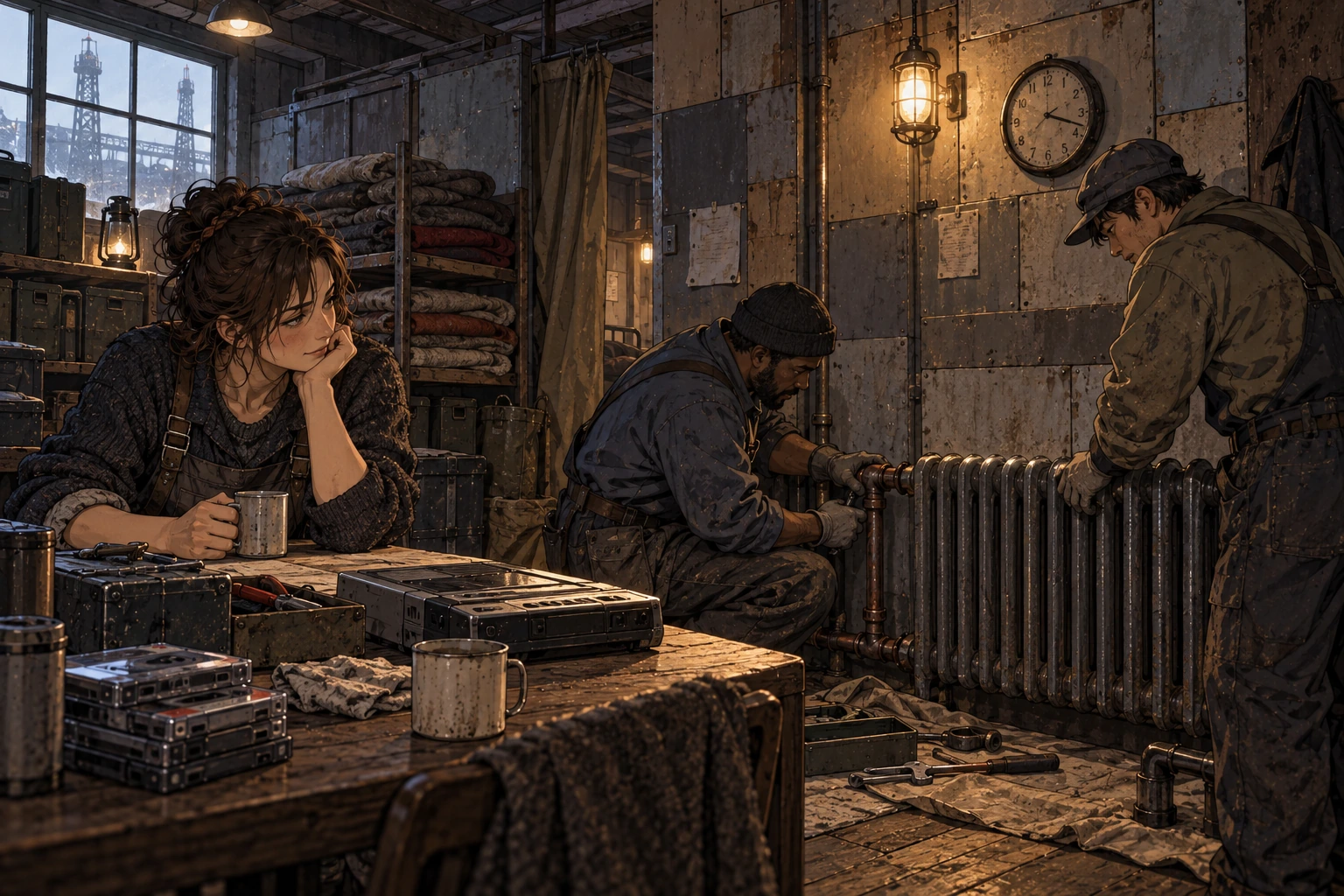
Emergency accommodation became an enduring institution through additions and repairs.
Open full-size illustration ↗People in this picture · 3
Katlin Ild
left, at the service-room desk · Goes by Kat
Residence: temporary Kaltbruch service lodging in the period depicted. Kat was a civilian accommodation clerk who kept track of blankets, partitions and unresolved repairs as temporary rooms filled. Bruno and Nazim were the repair crew working in her service room.
Bruno Reh
centre, kneeling beside the radiator · Goes by Bruno
Residence: temporary Kaltbruch service lodging in the period depicted. Bruno was a civilian heating fitter who extended service into rooms never designed for a long stay. Nazim worked beside him; Kat recorded the accommodation’s repair needs.
Nazim Ved
right, leaning over the radiator · Goes by Naz
Residence: temporary Kaltbruch service lodging in the period depicted. Naz was a civilian fitter’s assistant learning to make existing pipework serve another occupied room. Bruno supervised his practical work. This historical scene establishes no prisoner status.
The paper institution
Older forms survived alongside newer classifications. Their survival was practical: a stock of printed sheets represented paper, printing time and an approved appearance. A clerk could cross out one heading and retain the rest. Repeated copying carried old categories into a different situation. The resulting record might look continuous even when the people using it understood the words differently.
Salka Ren has handled folders whose bindings have outlasted several arrangements of responsibility. She distrusts the phrase “the original” when nobody can say original to what. A first entry, a first copy and the first document a particular office received need not be the same thing. Her caution does not give her access to every sealed record. It makes her attentive to the small, ordinary errors other people want settled quickly.
The prison's departments acquired interests of their own. Stores wants an issue acknowledged. Custody wants the count closed. Medical wants a patient seen or returned to an appropriate place. Command wants these activities to appear compatible. Much of Kaltbruch's everyday history is the history of people living in the gaps between those requirements.

Older records remain in use beneath newer institutional language.
Open full-size illustration ↗People in this picture · 1
Salka Ren
foreground, comparing the older files · Goes by Salka
Residence: a rented room in Northbank, Stavenbruck. A civilian prison records clerk, Salka keeps conflicting copies rather than pretending they agree. Her caution can still make precise help possible. No companion is foregrounded. These are workplace records, not a disclosure of private intelligence.
Repairs are a kind of history
A wall can remember more honestly than a commemorative notice. Different coats of paint stop at the outline of a removed cabinet. A pipe enters a room through a patch that was made by a crew with another supply of brick. A door has been closed because the space beyond it stopped being worth heating. None of these traces supplies a usable route through the compound, but together they show a place repeatedly adapted rather than completed once.
Prisoners and staff read these details differently. A maintenance worker notices a joint that will need attention. A newly assigned officer notices a blind stretch of wall. A person who has lived nearby for years remembers who used to sit against it. The older inhabitant's knowledge can be useful without being complete or safe to share.
Kaltbruch now belongs to the region's ordinary economy. It consumes food, cloth, energy, transport and technical skill; it supplies wages, contracts, fear and absences. A contractor's apprentice can have grown up knowing the prison as a dependable customer. A prisoner may remember when that same contractor's family were neighbours. The institution is entrenched partly because so many lives touch it in different ways.
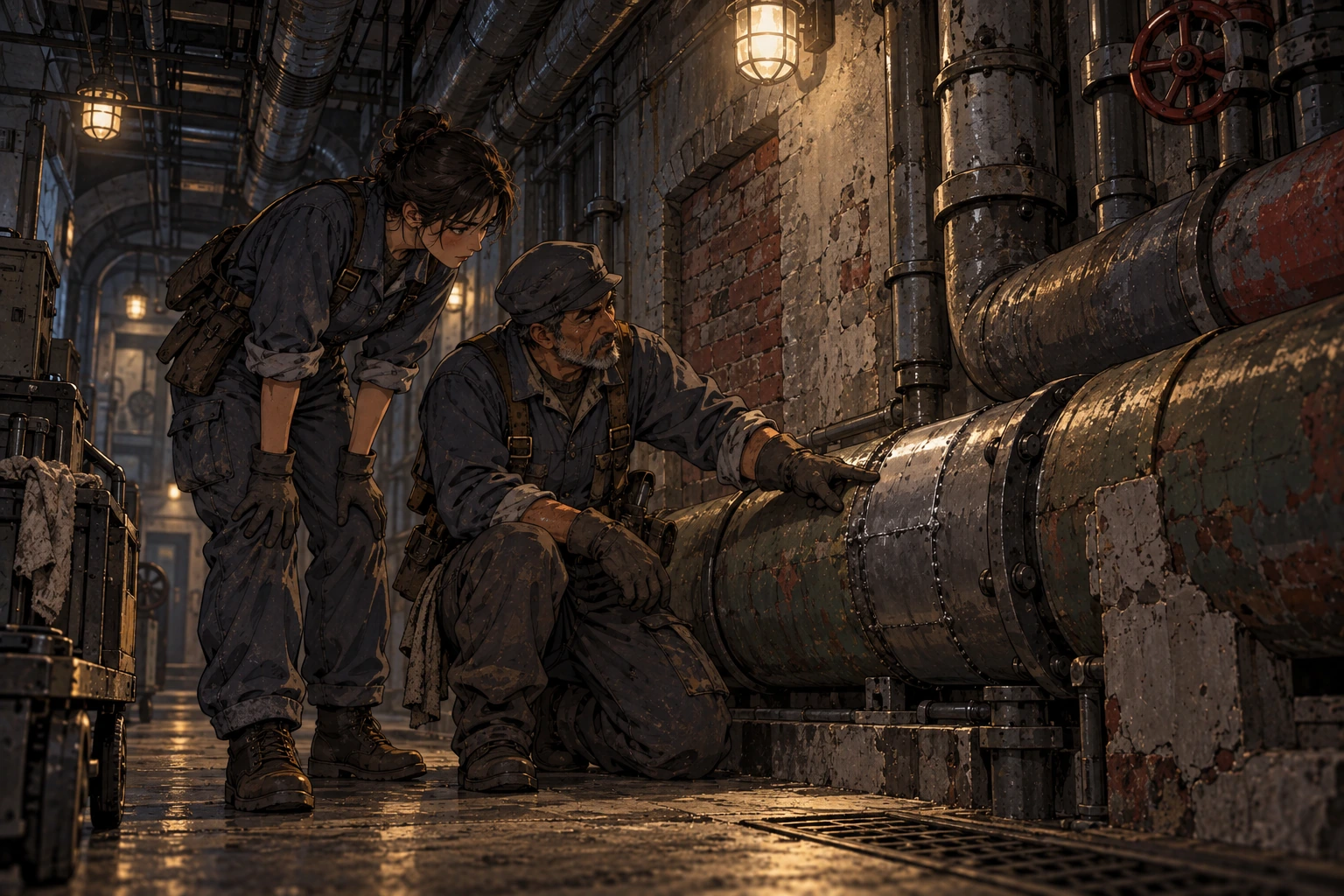
A retired service passage bears the repairs of successive crews.
Open full-size illustration ↗People in this picture · 2
Petr Anov
right, kneeling and pointing to the repair · Goes by Petr
Residence: service lodging beside Kaltbruch’s maintenance workshops. Petr is a civilian maintenance fitter who remembers why several old pipe routes were abandoned. He explains earlier repairs to the younger worker beside him. Tessa is his younger colleague.
Tessa Mil
left, leaning toward Petr · Goes by Tess
Residence: service lodging beside Kaltbruch’s maintenance workshops. Tess is a civilian pipework assistant who wants older repairs explained before they become her responsibility. Petr is her workplace mentor; they are not inmates.
The present command
Colonel Severine Holt commands a prison with habits older than her appointment. She values those habits when they shelter her decisions and dislikes them when they shelter someone else's independence. Her military commission supplies rank; the warden's appointment supplies custody authority. Neither alone gives her control of every road, regiment or civilian office outside the compound.
Holt cultivates the appearance of a place that can be made orderly through sufficient attention. She can remember a subordinate's minor failure long after a damaged prisoner has disappeared from that subordinate's daily work. Her beauty and careful bearing are part of the impression she makes. The institution around her is maintained less carefully than the impression.