Stavenbruck has no single state religion. Small congregations, family observances, secular people and private beliefs coexist. A local custom is reading absent people’s names at a household remembrance meal; participation and religious meaning vary. This is not a universal festival.
Households can include partners, relatives, friends sharing costs, single residents, lodgers and chosen family. Residence and nominated dependants or carers are recorded without imposing one compulsory family form. Neighbour care, household cooperation, workplace collections, school meals and overstretched clinics give uneven support. Shared mending evenings, traded music cassettes, simple table games and communal meals provide local texture.
Pre-Event cultural histories and faiths exist. Social colour grouping is not a universal government classification. Zealotry against Rift-Touched people exists, including a prison faction; not all believers are zealots. Coercive reproductive policy does not settle marriage, kinship or every household relationship.
One household may read an absent neighbour’s name over a shared meal while another remembers privately. The custom does not establish a single religious belief or a fixed date.
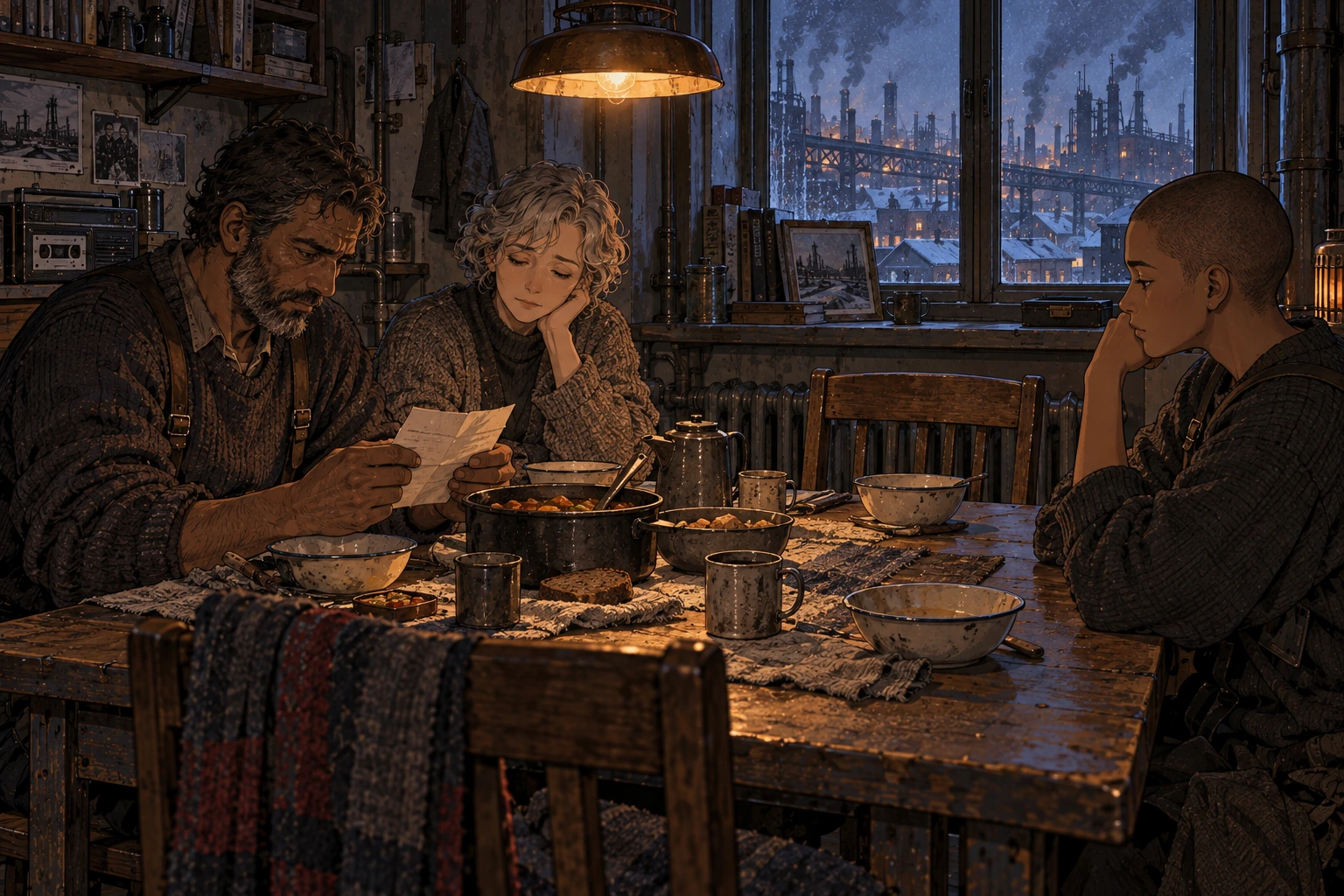
A remembrance meal can hold shared grief and different private meanings. This local custom is not a universal festival.
Open full-size illustration ↗People in this picture · 3
Boris Temel
left, reading the folded paper · Goes by Boris
Residence: Northbank, Stavenbruck. Boris repairs cooking stoves and has taken an evening away from call-outs for this remembrance meal. Yana is his sister and Safa their friend; they are remembering their late father.
Yana Temel
centre, listening beside Boris · Goes by Yana
Residence: Northbank, Stavenbruck. Yana is a garment finisher who keeps small family letters wrapped against damp. She has chosen this one to be read. Boris is her brother; Safa knew their father through work.
Safa Oren
right, with a shaved head · Goes by Safa
Residence: Pump Ward, Stavenbruck. Safa works in a boiler shop and remembers the practical favours that rarely enter a formal account of a life. She is a friend of Boris and Yana’s family, joining their remembrance.
Belief at the scale of a neighbourhood
The proposed Open Hearth Fellowship rents a modest room in Northbank for shared worship, remembrance and practical help. Its members differ on doctrine, and the organisation claims no citywide religious authority. Mira Solt, its lay keeper, arranges gatherings while working ordinary paid shifts as a records copyist. She wants the room to remain available to people who need quiet without making assistance conditional on belief. Some members argue that an open door leaves too little money for their own congregation.
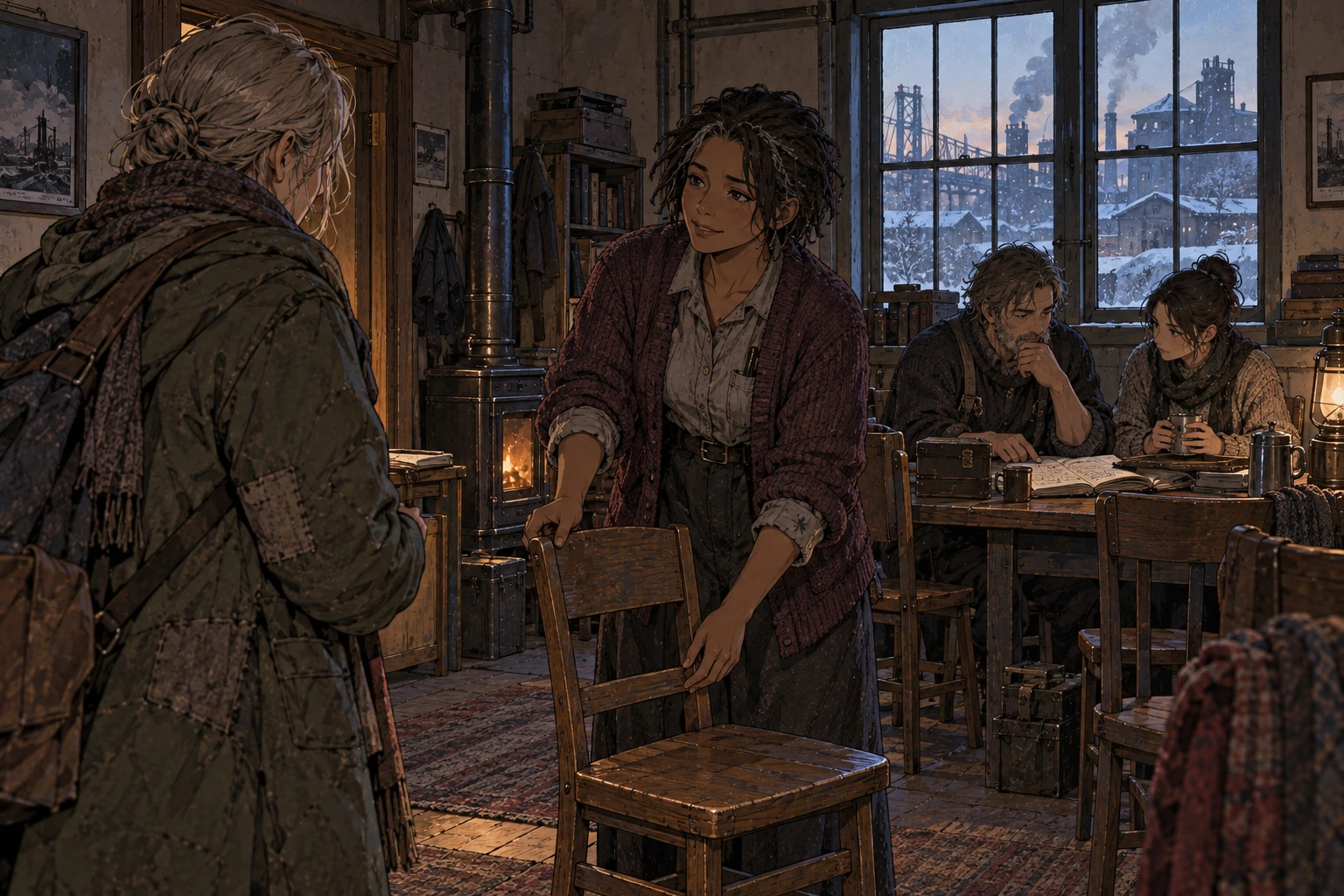
The proposed Open Hearth Fellowship makes room for quiet and practical help while its members disagree about scarce resources.
Open full-size illustration ↗People in this picture · 2
Mira Solt
centre, pulling the chair forward · Goes by Mira
Residence: Northbank, Stavenbruck. Mira is a records copyist and lay keeper of the Open Hearth Fellowship. She wants practical help to remain available without a test of belief. She is welcoming Helga; accepting the seat does not require Helga to join the Fellowship.
Helga Nerst
left foreground, facing Mira · Goes by Hel
Residence: Northbank, Stavenbruck. Hel is a retired cleaner who sometimes wants company without being asked to perform cheerfulness. She has come for a quiet room. Mira is the Fellowship’s lay keeper, offering her a place to sit.
The Plain Table Circle is a secular discussion and mutual-help group meeting at the Reading Exchange when a room is free. It argues over ethics, history, work and the responsibilities of institutions. Teren Vale lends space without endorsing every speaker. The Circle and Fellowship sometimes cooperate on a care collection and disagree sharply about its accompanying words. There is no requirement that one is secretly rational and the other foolish, or that both become identical once people behave kindly.

The proposed secular Circle makes room for disagreement about ethics, work and institutions.
Open full-size illustration ↗People in this picture · 4
Zofia Naren
left, explaining her point · Goes by Zofi
Residence: Pump Ward, Stavenbruck. Zofi is a retired draughtswoman who enjoys an argument that changes someone’s reasoning rather than simply their volume. The others are fellow Plain Table participants, not members of her household.
Rina Kestrel
second from left, listening · Goes by Rin
Residence: Northbank, Stavenbruck. Rin works in a small print room and reads discussion pamphlets after setting other people’s words all day. She knows Zofi, Daren and Tomasz through the Plain Table Circle.
Daren Vosk
centre-right, arms folded · Goes by Dar
Residence: Freight Ward, Stavenbruck. Dar repairs rail couplings and brings a worker’s impatience with neat theories to the Circle’s discussions. He is debating with fellow members Zofi, Rin and Tomasz.
Tomasz Iven
right, studying the paper · Goes by Tomasz
Residence: Old Exchange, Stavenbruck. Tomasz is a retired accounts clerk who likes to ask which assumption a confident conclusion depends upon. He meets the others through the Plain Table Circle; their agreement is not assured.
Tarnfeld households may attach observances to land, kin, labour or a congregation with which they maintain ties. Hollenmere's crossing remembrance can include people who share no theology.
Taboos, courtesy and actual consent
Rook Court residents generally consider opening another household's carrier without permission a serious intrusion. At Hollenmere, taking a boat-share tool without telling its keeper can provoke more anger than borrowing a small amount of cash. Such expectations concern trust and scarce objects; they are not universal sacred laws. A visitor can misunderstand them and apologise without being expelled from society.
Some neighbours expect a courtship to become a public partnership quickly; others defend privacy. Mourning practices can conflict with a bereaved person's wishes. Assistance does not grant the giver authority over the receiver's relationships. The almanac treats these as disagreements among people rather than one culture speaking with a single voice. Comfort, faith, disbelief and criticism can all belong to ordinary life without dictating a character's virtue or role in a story.
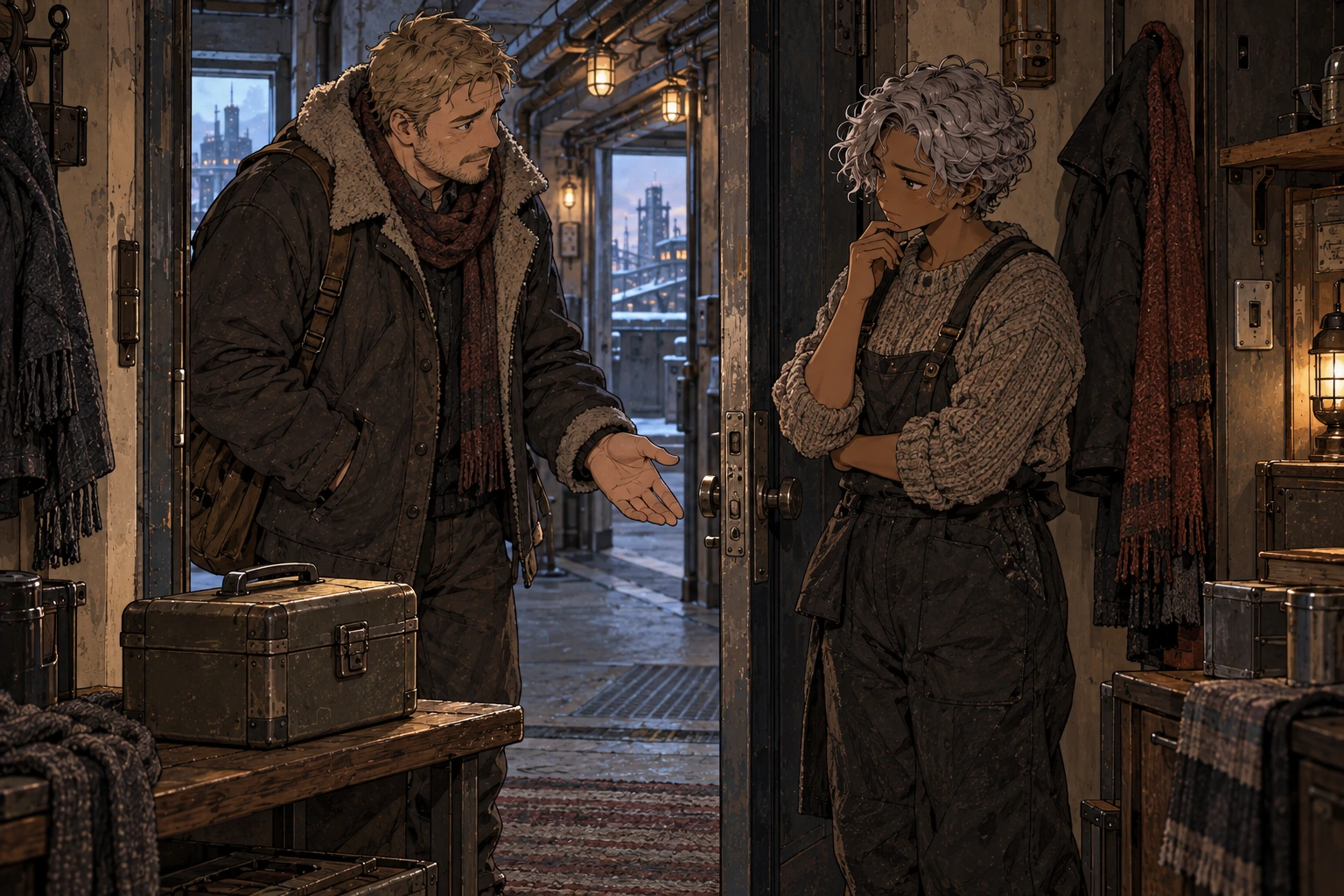
Care and familiarity do not remove another household’s privacy.
Open full-size illustration ↗People in this picture · 2
Pavel Osen
left, waiting at the doorway · Goes by Pash
Residence: Northbank, Stavenbruck. Pash delivers repaired domestic equipment. He has learned to wait for an invitation even when a household knows him well. Mara is his neighbour and the keeper of this home.
Mara Kels
right, inside her doorway · Goes by Mara
Residence: Northbank, Stavenbruck. Mara takes repair sewing at home and chooses when visitors may enter. Familiarity does not remove her need for privacy. Pash is a neighbour returning equipment; they do not live together.