A region held together by ordinary journeys
The working regional name is the Roven Reach: Stavenbruck and the inhabited river-and-rail country that supplies it. It is an economic region with disputed edges, not a newly declared country. The Roven leaves the colder industrial basin through Stavenbruck, then runs past Roven Ferry towards Tarnfeld and the downstream reed country at Hollenmere. Settlements exchange food, tools, fuel, labour and news in both directions. None exists solely to provision Kaltbruch. The prison is an important institutional customer among waterworks, rail depots, workshops, households and military installations.
People describe distance by the journey they can actually make: a ferry crossing, a morning freight connection, a day in a covered goods wagon. The routes below describe how places connect. They do not fix surveyed distances or grant a dependable timetable through storms.
Roven Ferry: the town that counts everything twice
Roven Ferry occupies the usable crossing below Stavenbruck's freight approaches. Its low wharves smell of rope, river mud and hot fish fat. The old stone ferryhouse now shares its roof with a weigh office and a marriage registrar; couples sometimes emerge into the middle of a cargo dispute. The Bent Oar is a public eating room where pilots leave annotated river boards for the next crew. Sera Anvek, ferry co-owner and working pilot, keeps the chalk warnings legible even when a profitable passenger would prefer them erased.
Fishers need ice, salt, crates and repair parts. Stavenbruck needs their food and the crossing; upstream farms need a buyer who will not condemn an entire load over one disputed basket. The boat crews resent city weighing deductions, while city inspectors complain that every ferry-town family appears to own its own definition of a full crate. Both sides have honest grievances. Teenagers can enter ferry apprenticeships without leaving home, but narrow family ownership leaves talented outsiders waiting years for a berth.
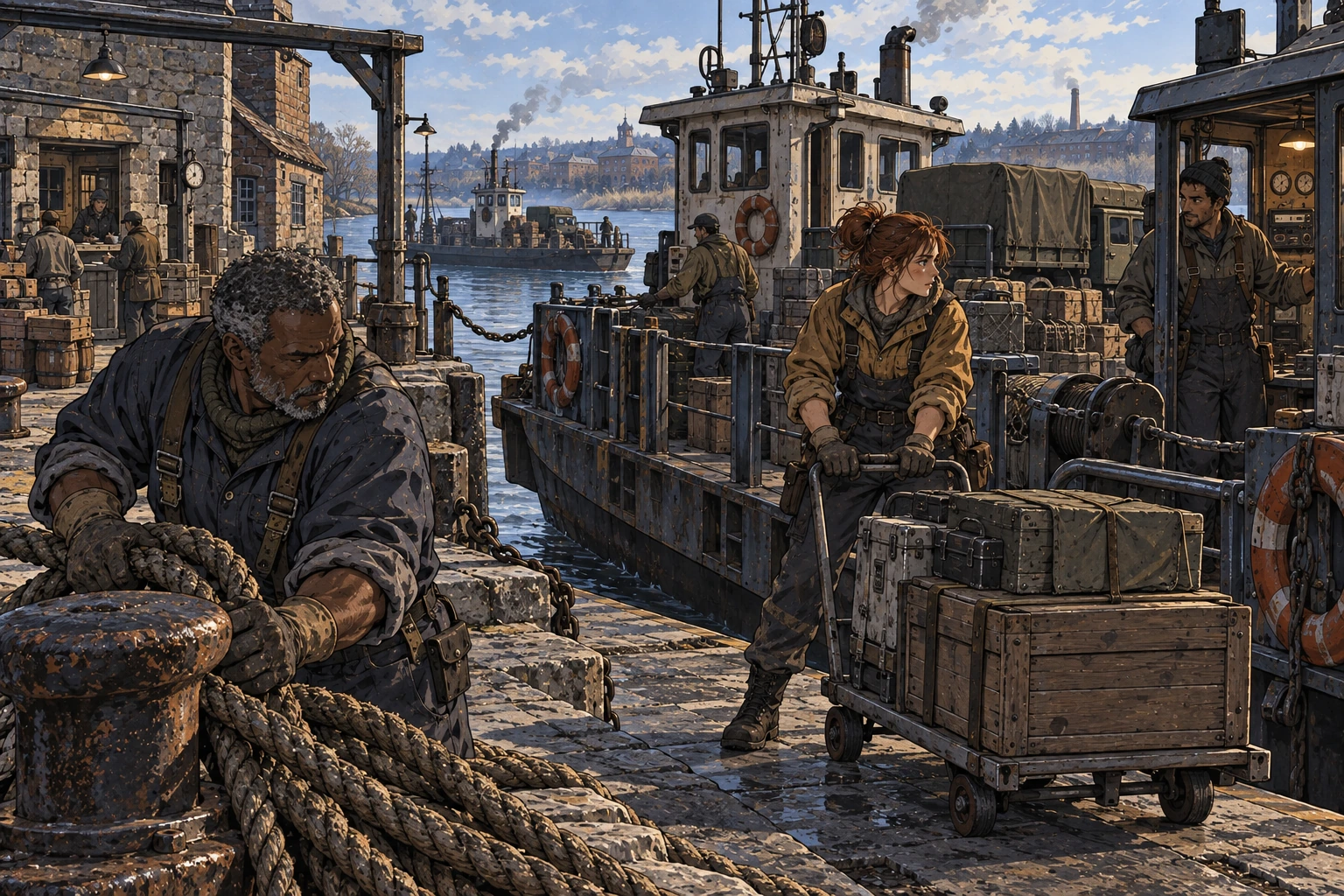
Low wharves, practical ferryboats and the old stone ferryhouse give Roven Ferry its working shape.
Open full-size illustration ↗People in this picture · 3
Haris Broven
left foreground, working the mooring rope · Goes by Haris
Residence: Roven Ferry. Haris is a ferry deckhand who checks a worn rope by touch as well as sight. He wants replacements ordered before a busy crossing. Mara and Dani are members of the same ferry crew.
Mara Jent
centre-right, handling the loaded trolley · Goes by Mar
Residence: Roven Ferry. Mar is a cargo porter who balances awkward crates before pulling away from the quay. She dislikes being treated as spare labour for every delay. Haris handles the mooring and Dani the deck end of this load.
Dani Kas
right, beside the ferry rail · Goes by Dani
Residence: Roven Ferry. Dani is a ferry deckhand who keeps the landing space clear when passengers and freight arrive together. Haris and Mar are colleagues on the crossing.
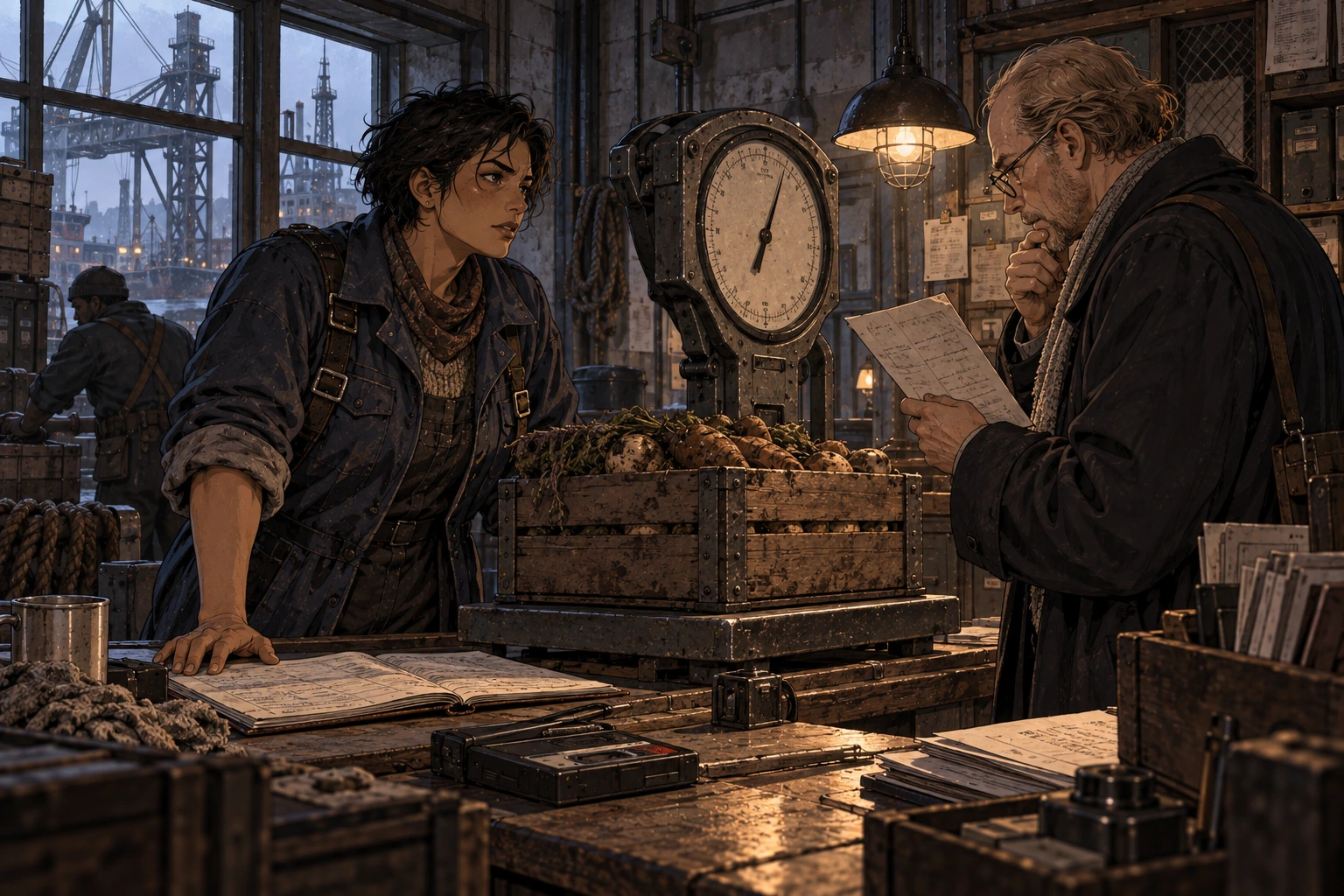
A working pilot and an inspector face the same loaded scales from different sides of a difficult bargain.
Open full-size illustration ↗People in this picture · 2
Sera Anvek
left, across the crate and scales · Goes by Sera
Residence: a rented Northbank room shared with Lena Drost, Stavenbruck. Sera pilots the Roven Ferry service. She wants a repair reserve large enough to stop every breakdown consuming her home life. The city inspector, Oskar, is checking a consignment carried by her ferry service.
Oskar Renvik
right, reading the inspection paper · Goes by Oskar
Residence: Old Exchange, Stavenbruck. Oskar is a municipal cargo inspector who wants the weights and documents to agree before accepting a shipment. Sera is the working ferry pilot negotiating the disputed crate, not his subordinate.
Tarnfeld: fields worth arguing over
Farther down the productive valley, Tarnfeld combines protected cultivation strips, drainage pumps, small livestock yards and the South Press, a cooperative disc works. Its houses face inward around long drying courts, with seedlings and garden beds kept inside fully enclosed transparent polyurethane or plastic greenhouses, rather than exposed to glowing rain. Farm households do not all own their land: some rent, some share inherited strips, and some work requisitioned plots under renewable permits. The surviving agricultural corridor is valuable precisely because neighbouring land is less dependable.
The cooperative presses grain and vegetable blends into rural ration discs while selling premium fresh produce to buyers able to pay. Members quarrel over that division. A good fresh-vegetable contract buys a replacement pump, but too many diverted roots make the ordinary issue poorer. Jarek Vos, the cooperative's repairer, wants an apprenticeship workshop; the board would rather retain his cheap emergency availability. People stay for land, kin, practical competence and the rare pleasure of watching something grow. Others leave because every acre seems already promised to someone older.
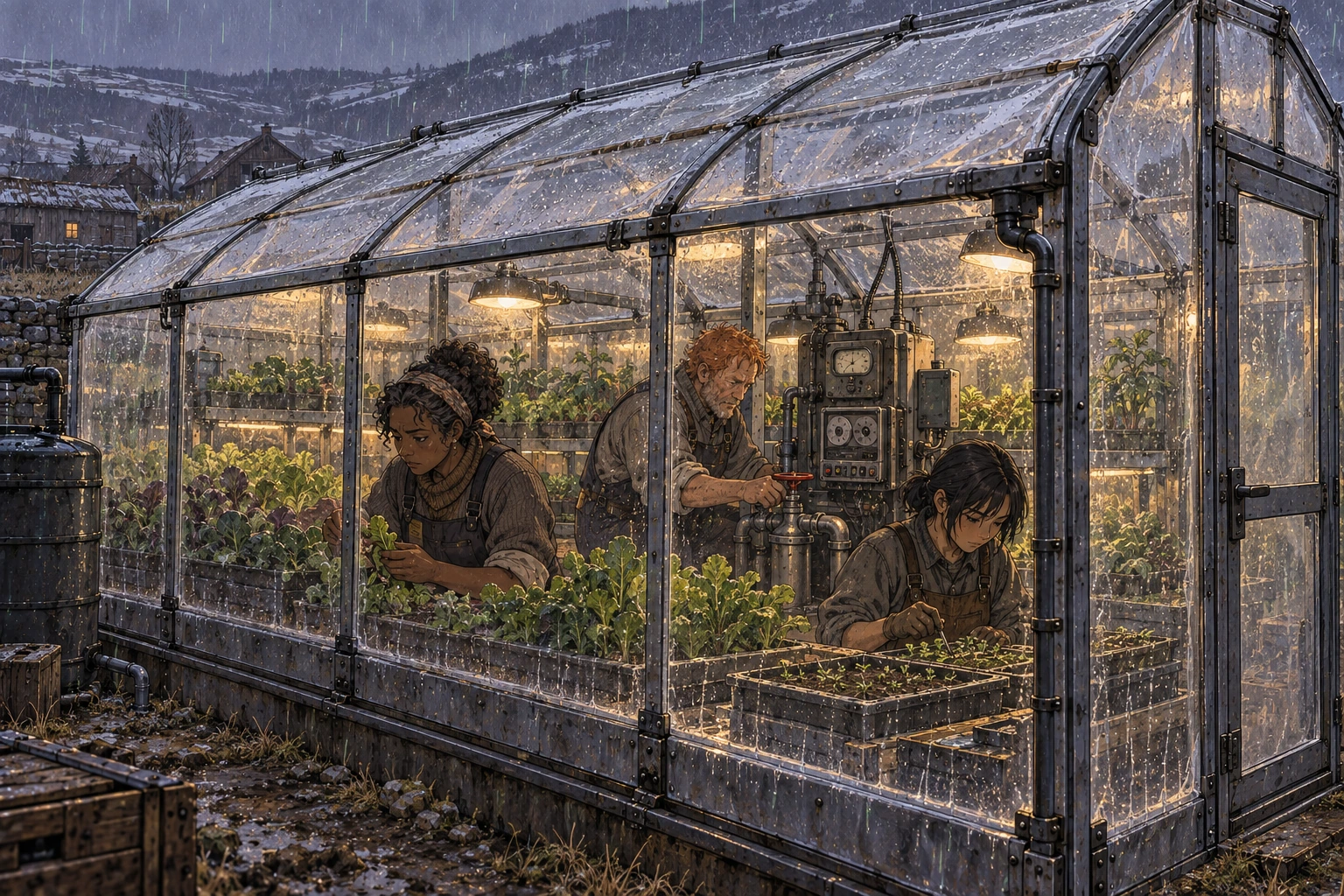
Crops and workers remain inside a fully enclosed transparent greenhouse while contaminated rain falls outside. This is an illustrative enclosure, not an engineering specification.
Open full-size illustration ↗People in this picture · 3
Nadia Terrek
left, tending plants inside the glass · Goes by Nad
Residence: Tarnfeld. Nad is a cooperative greenhouse grower who checks the enclosure before tending the beds. A crop is not safe merely because it is sheltered today. Tomas is her pump-maintenance colleague; Mila is a fellow grower.
Tomas Velnik
centre, at the greenhouse pump controls · Goes by Tom
Residence: Tarnfeld. Tom maintains greenhouse pumps and watches for faults that would waste a season’s permitted growing space. Nad and Mila tend the crop that depends on his equipment.
Mila Orven
right, tending the near planting bench · Goes by Mila
Residence: Tarnfeld. Mila works on the cooperative growing crew and records losses as well as healthy trays. She wants the fragile harvest divided honestly. Nad is her growing colleague; Tom maintains the shared pump.
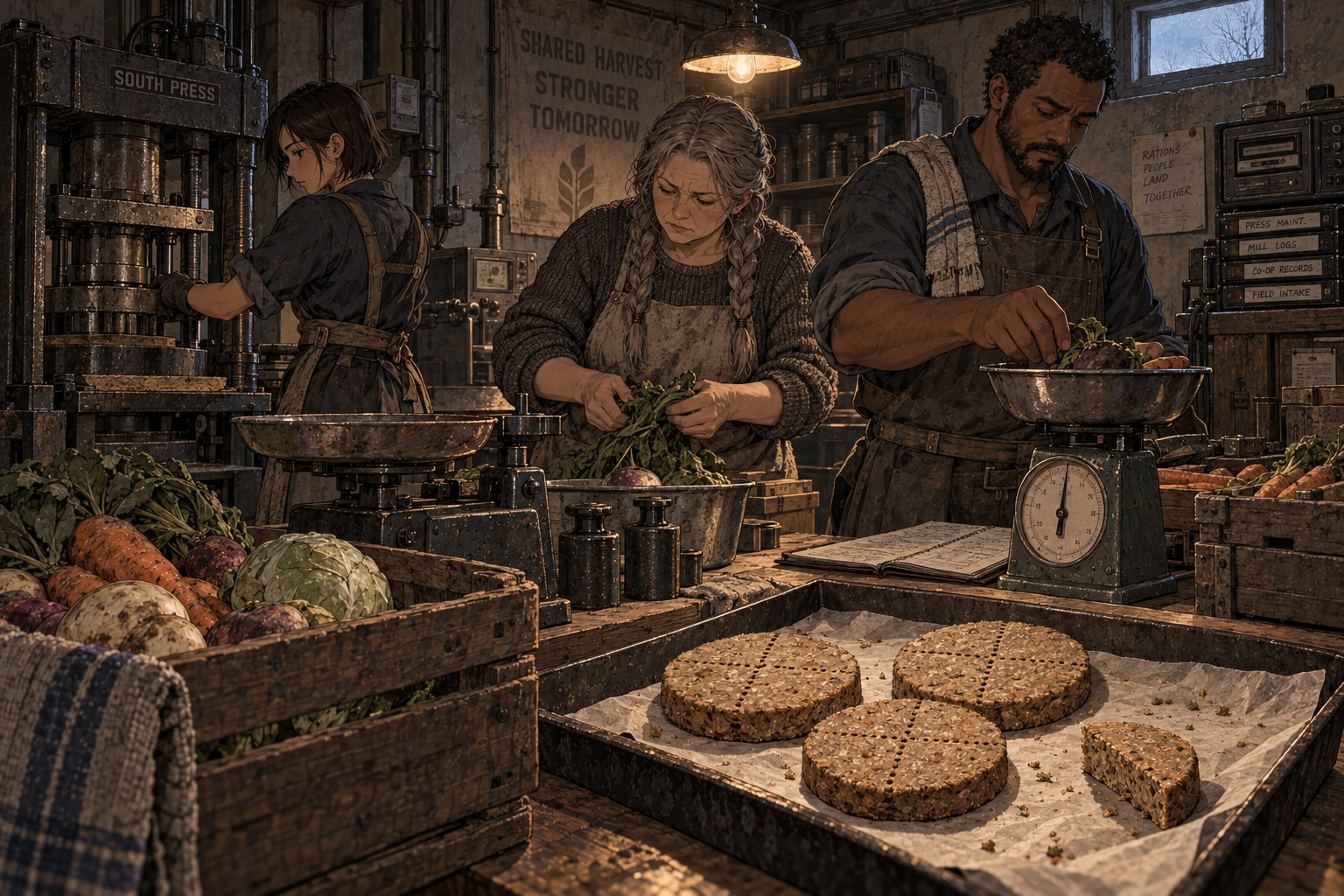
Ration-disc production and premium fresh produce share a cooperative workplace. The division pays for repairs while placing ordinary food under pressure.
Open full-size illustration ↗People in this picture · 3
Ema Rovek
left, operating the cooperative press · Goes by Ema
Residence: Tarnfeld. Ema is a South Press operator who checks the ration-disc batch before it reaches the packing table. Rosa and Tariq work in the same cooperative, sorting and weighing produce.
Rosa Talvek
centre, sorting produce · Goes by Rosa
Residence: Tarnfeld. Rosa sorts the cooperative harvest and separates damaged leaves from the premium fresh portion. Handling abundance at work does not give her a household share of it. Ema and Tariq are cooperative coworkers.
Tariq Meln
right, at the produce scale · Goes by Tariq
Residence: Tarnfeld. Tariq is a South Press weighing clerk who records what leaves the room. He wants the repair fund’s claims stated alongside the ordinary households’ needs. Rosa prepares the produce he weighs; Ema operates the press.
Brackenzell: heat, skill and black windowsills
Brackenzell's brick terraces cluster around the Cinderbank Foundry and two small boiler works. Even winter washing hung near the yard can dry, although it comes down carrying soot. Foundry whistles mark shifts; the municipal bathhouse buys waste heat under a contract renegotiated every year. Its landmark is a disused lifting crane whose frame has become a weather station and children's forbidden climbing ground.
The town exports castings, stove plates and repaired pump housings. It needs food, clean process water and railway access. Oda Kern, senior moulder, remembers when the foundry paid for apprentices' boots and wants that provision restored. Skilled households can enjoy better heat than a city clerk while lacking a specialist clinic or a choice of employers. The owner cannot simply close the plant without losing contracts, but workers cannot easily walk away from mortgages, family and scarce compatible jobs. Its summer brass-and-drum procession is paid for jointly by competing workshops; pride in workmanship is real even among people furious with management.
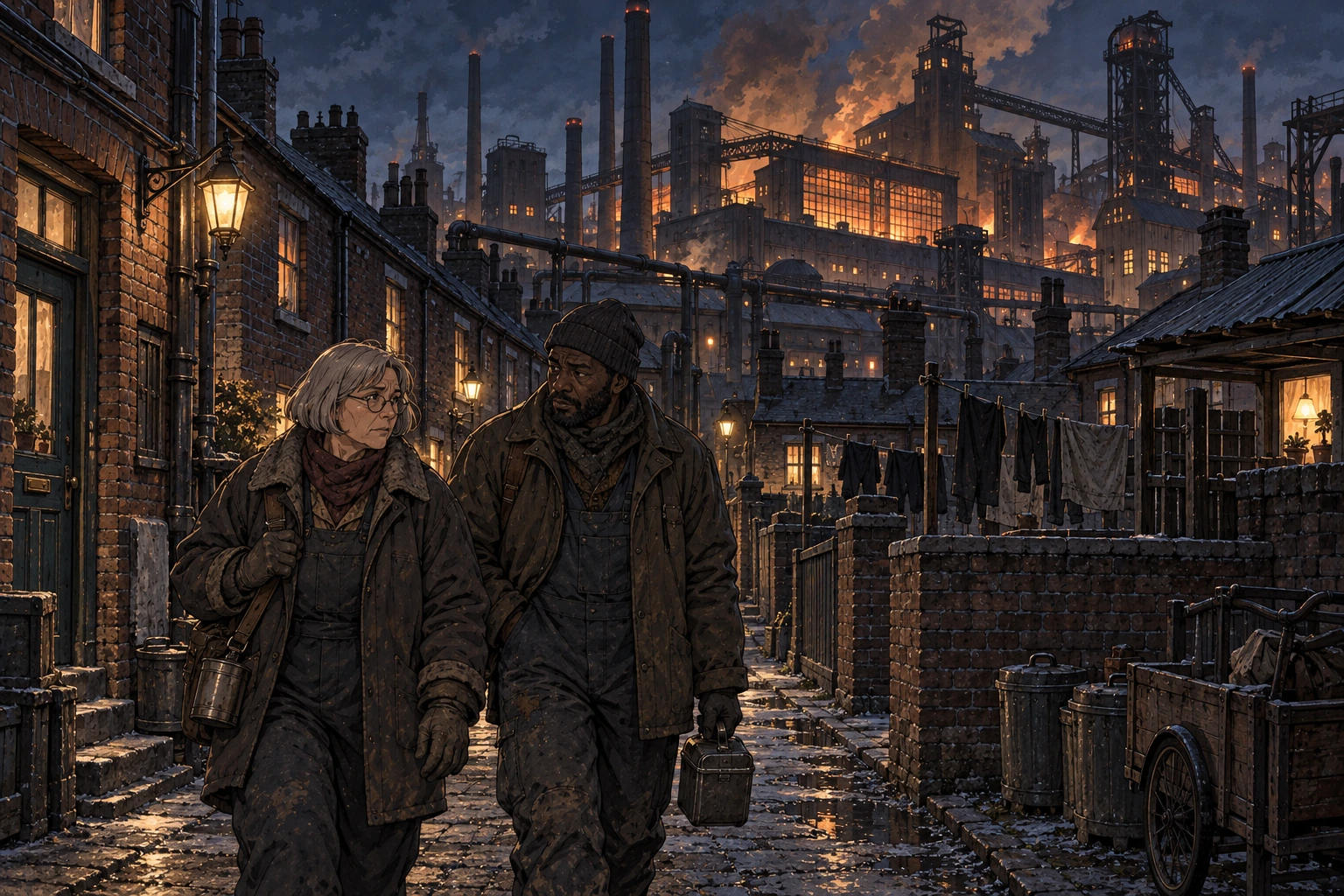
Foundry heat colours blackened windows beside the brick terraces of Brackenzell. The shift reaches beyond the factory walls.
Open full-size illustration ↗People in this picture · 2
Ester Pov
left, walking past the brick terraces · Goes by Ester
Residence: Brackenzell. Ester is a foundry assay-room cleaner finishing a late shift. She wants the bathhouse open long enough to reach it after work. Jovan is her neighbour and a coworker at Cinderbank.
Jovan Sarl
right, carrying the lunch vessel · Goes by Jov
Residence: Brackenzell. Jov is a furnace hand who notices which upstairs windows are still lit on the walk home. He is saving for a room farther from the noisiest yard. Ester lives on his street; they are walking home from separate foundry duties.
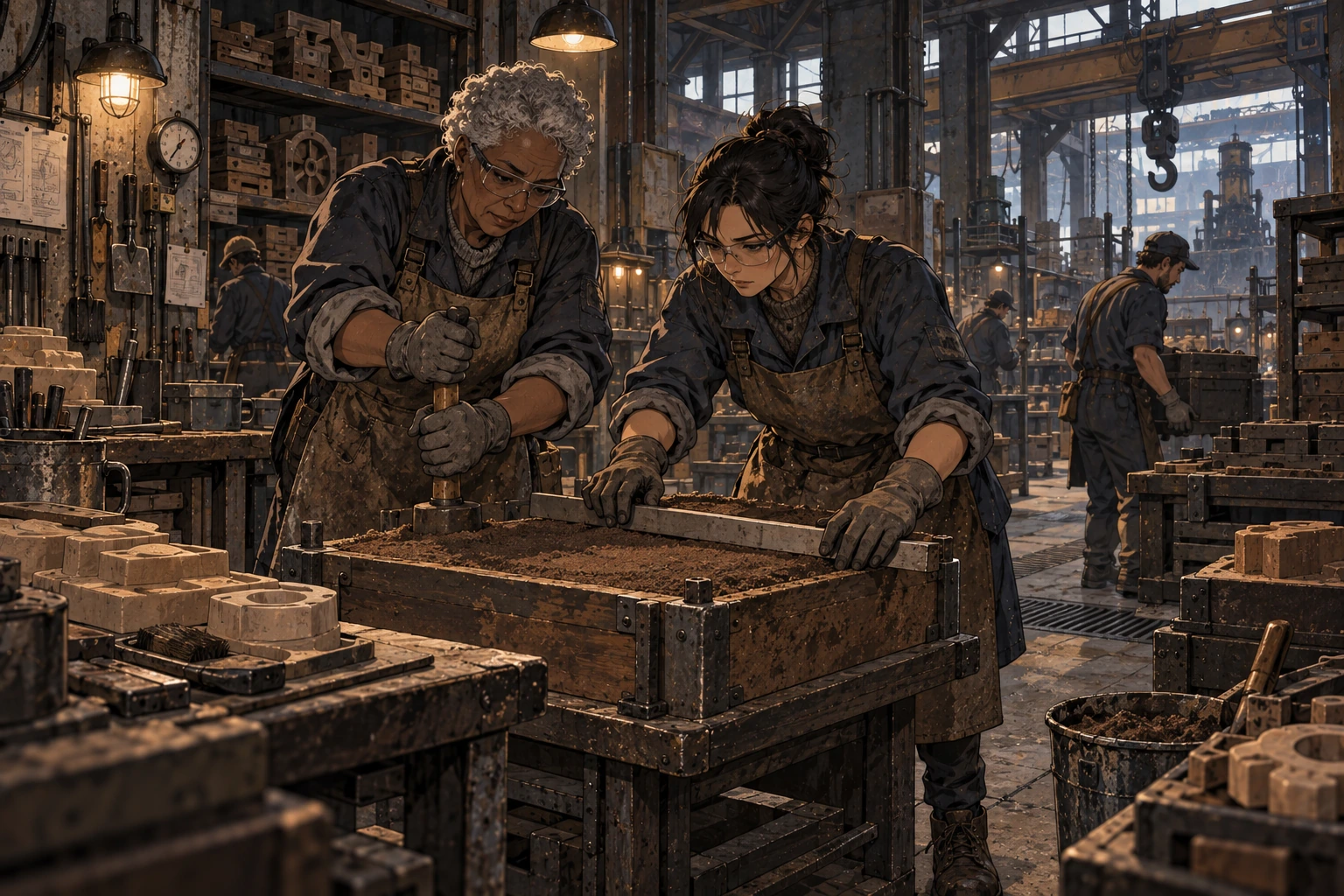
Oda Kern and an apprentice concentrate on mould preparation. Their proposed appearances express skill, fatigue and pride in difficult work.
Open full-size illustration ↗People in this picture · 2
Oda Kern
left, demonstrating at the moulding bench · Goes by Oda
Residence: a brick terrace near Cinderbank Foundry, Brackenzell. A senior moulder, Oda teaches ways to work around reduced hand strength and insists that skilled labour deserves credit. Mira is an apprentice learning the mould from her; she is not Rika Dren.
Mira Ken
right, preparing the mould beside Oda · Goes by Miri
Residence: Brackenzell. Miri is a foundry apprentice who wants her training hours protected when the next production rush arrives. Oda is her workplace instructor; they are not relatives.
Vesk Halt: a place made out of waiting
At the rail-road transfer north of the productive valley, Vesk Halt began as a siding and grew into lodging houses, a machine shed, a schoolroom and the Blue Kettle canteen. People arrive expecting one night and acquire neighbours before their missing axle arrives. Freight clerks know destinations that never appear on passenger notices. The settlement's modest pride is its covered common platform: passengers helped pay for the roof through a long subscription, and railway officials now claim sole credit.
Nell Tavor, canteen proprietor, rents a warm corner to an evening correspondence class. She wants a permanent school because her daughter is tired of lessons moving around the freight schedule. Drivers like Vesk's tolerant lodging arrangements; established residents dislike being treated as temporary people. The Halt depends on movement yet offers one of the few places where newcomers can become useful without producing a local family name.
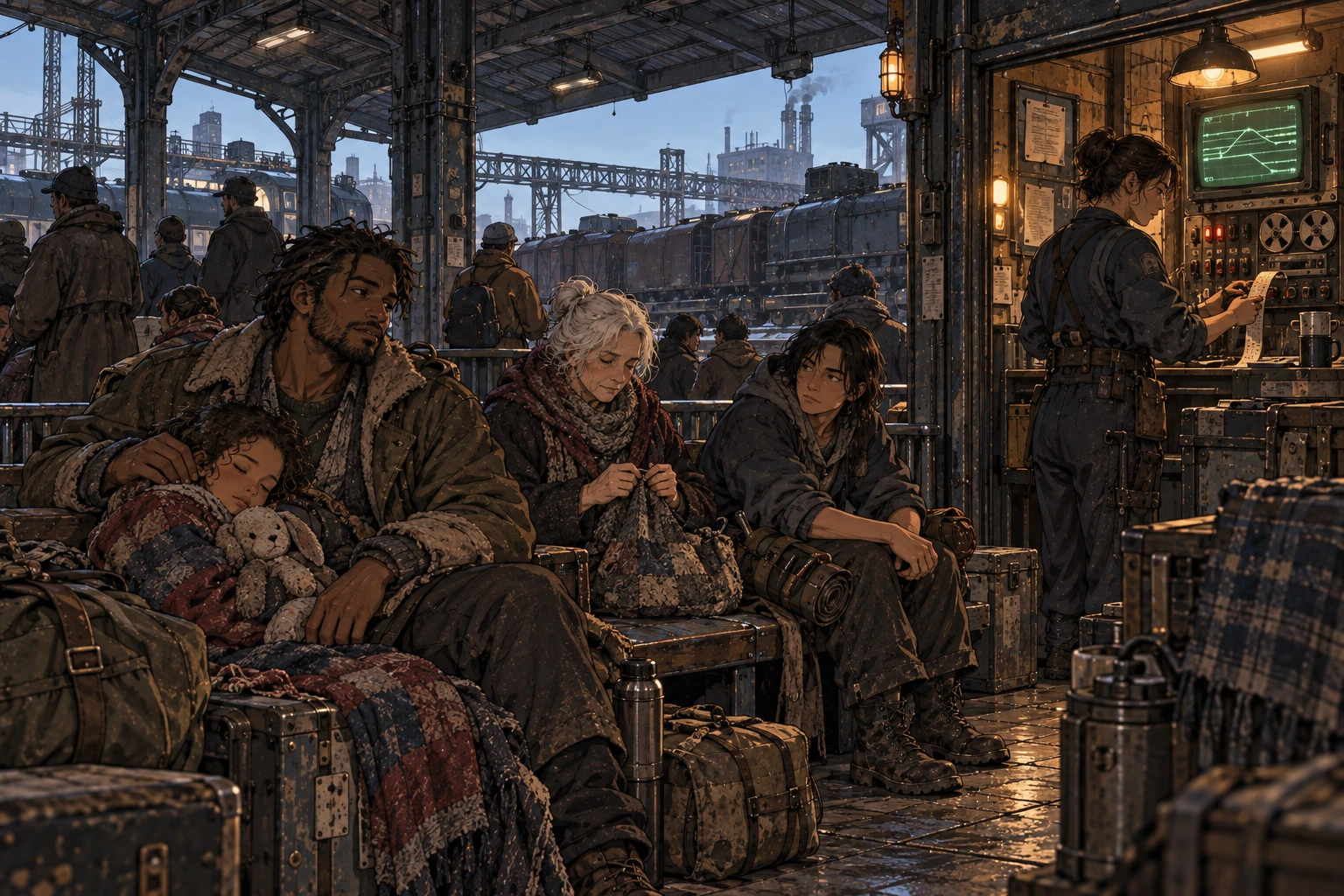
Freight, belongings and waiting households gather beneath the common platform roof. A place built around movement has lives that cannot stay temporary.
Open full-size illustration ↗People in this picture · 4
Darin Kovel
left, seated with the sleeping child · Goes by Dar
Residence: temporary rooms near Vesk Halt’s common platform. Dar is a travelling workshop fitter waiting for a delayed connection. He has learned to count meals and sleeping places as part of a journey. Leni is his daughter, Hana his mother and Alex his younger brother.
Leni Kovel
asleep against Darin · Goes by Len
Residence: temporary rooms near Vesk Halt’s common platform. Len is a young child with no job. Her family has brought a familiar toy among the belongings needed for the journey. Dar is her father, Hana her grandmother and Alex her uncle.
Hana Kovel
centre of the bench, mending while she waits · Goes by Hana
Residence: temporary rooms near Vesk Halt’s common platform. Hana is a retired garment worker who takes small repairs on the road. She wants the waiting hours to produce something more useful than irritation. Dar and Alex are her sons; Len is her granddaughter.
Alex Kovel
right end of the family’s bench · Goes by Alex
Residence: temporary rooms near Vesk Halt’s common platform. Alex is seeking an apprenticeship and has no paid job yet. He hopes the next stop will become somewhere to stay. Dar is his brother, Hana his mother and Len his niece.
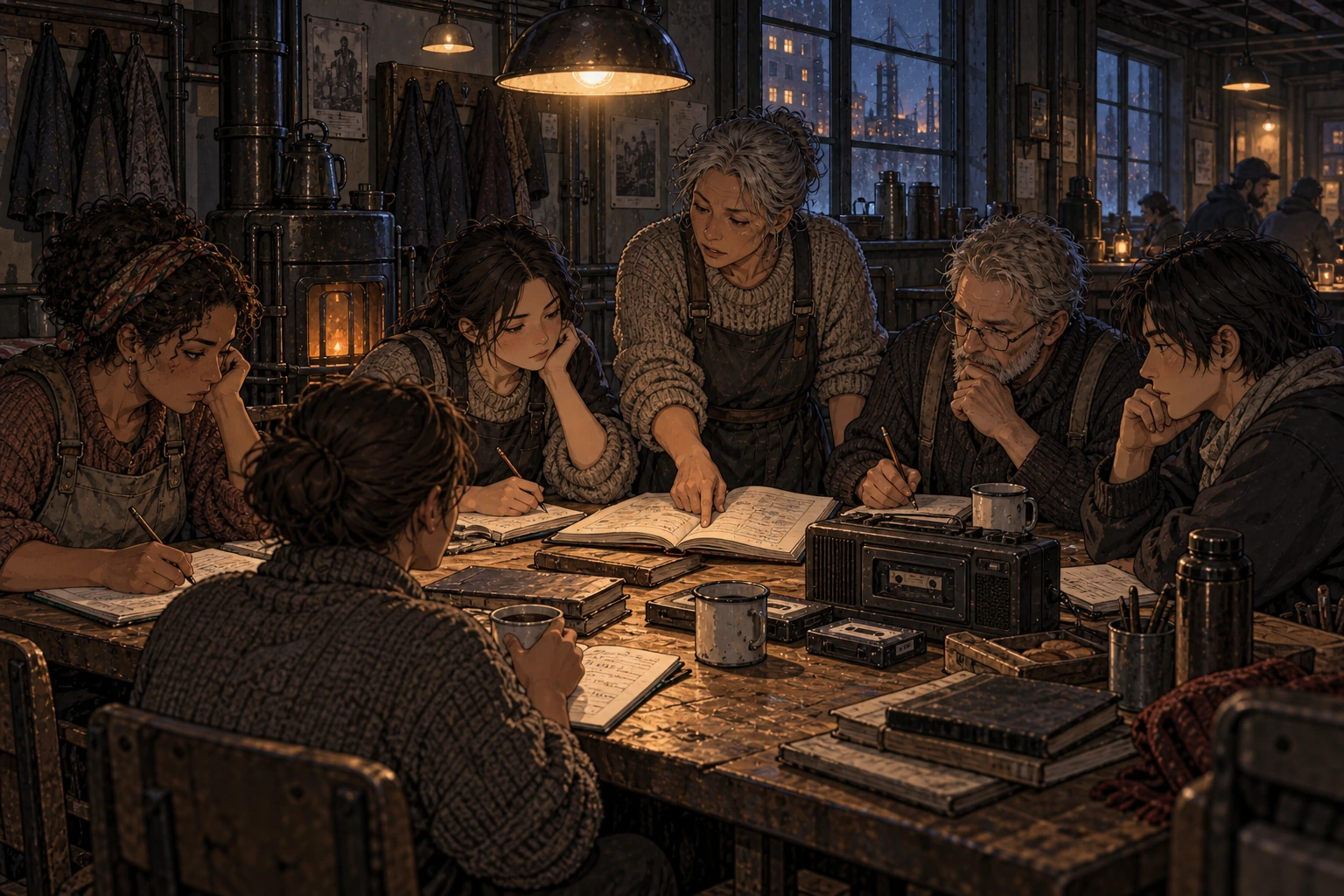
An evening class makes room for learning among repaired chairs and the demands of a working canteen.
Open full-size illustration ↗People in this picture · 6
Magda Terv
standing in the centre, guiding the lesson · Goes by Magda
Residence: Vesk Halt. Magda is a paid correspondence tutor who teaches around the Blue Kettle’s working hours. She wants students to leave with a method they can use alone. The five seated learners are her class, not her household.
Hava Vernek
far left, beside the open notebook · Goes by Hava
Residence: Vesk Halt. Hava works on a canteen preparation crew and studies arithmetic in the evening. She wants to understand the stock figures she is asked to copy. Magda is her tutor; the others are classmates.
Lara Ostvik
centre-left, leaning toward the book · Goes by Lara
Residence: Vesk Halt. Lara is a laundry assistant studying mechanical drawing after work. She takes borrowed pages back dry and in order. She attends Magda’s class with the other learners.
Vera Hask
foreground, back toward the viewer · Goes by Vera
Residence: Vesk Halt. Vera repairs packing cloth and is improving her written Valkrisch through evening lessons. Magda is her tutor; the group shares a classroom rather than a workplace.
Petr Selen
centre-right, writing beside the tutor · Goes by Petr
Residence: Vesk Halt. Petr is a retired freight clerk learning unfamiliar technical notation. He is willing to be a beginner if the explanation is useful. The younger learners are classmates, not pupils he supervises.
Havi Toren
far right, listening across the table · Goes by Havi
Residence: Vesk Halt. Havi is a school-age correspondence learner without paid employment. He wants a quiet study place that stays available after the canteen fills. Magda is his tutor; the adults are fellow learners.
Hollenmere: the water beyond the road
Hollenmere lies among managed reed beds, fish ponds and old drainage channels downstream of Tarnfeld. Households build raised wooden stores, mend netting and cut reeds for packing and mats. A small smokehouse association markets its fish under a heron stamp. Strong local reciprocity can be welcoming or suffocating: somebody will notice a damaged roof, and somebody will also notice an unfamiliar overnight guest.
The town needs salt, metal, medicines and news of upstream discharge. It supplies food and river knowledge rather than bulk grain. Ada Rell, net-maker and boat-share secretary, argues for keeping a paid public water sampler; others say Stavenbruck ought to fund what its factories endanger. Residents leave for education or winter wages and often return with cassette music and irritating new opinions. Hollenmere is neither a pastoral refuge nor uniformly miserable. A household may have a poor cash income, a crowded room, good fish and an afternoon spent laughing over nets with people it loves.
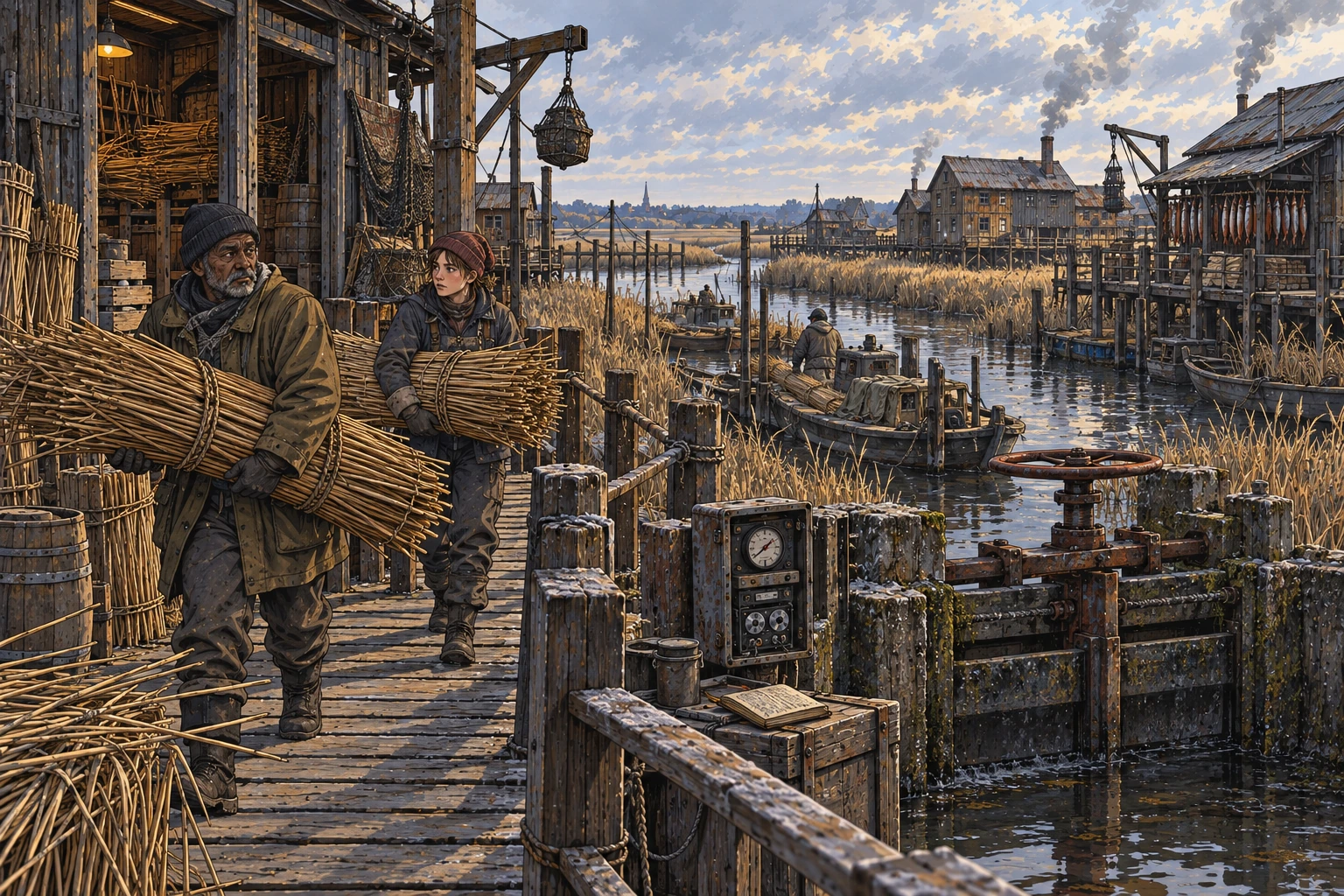
Raised stores, reed beds, smokehouses and boats line Hollenmere’s drainage channels. Local beauty does not establish water safety.
Open full-size illustration ↗People in this picture · 2
Ilya Dors
left, carrying the larger reed bundle · Goes by Ilya
Residence: Hollenmere. Ilya cuts and grades reeds for packing and mat-making. He wants a price that recognises drying and transport as part of the work. Hava is his partner and fellow reed worker.
Hava Dors
behind Ilya, carrying another bundle · Goes by Hava
Residence: Hollenmere. Hava harvests reeds and makes mats for sale. She checks the narrow landing before adding another bundle to it. Ilya is her partner; they share work and a raised waterside home.
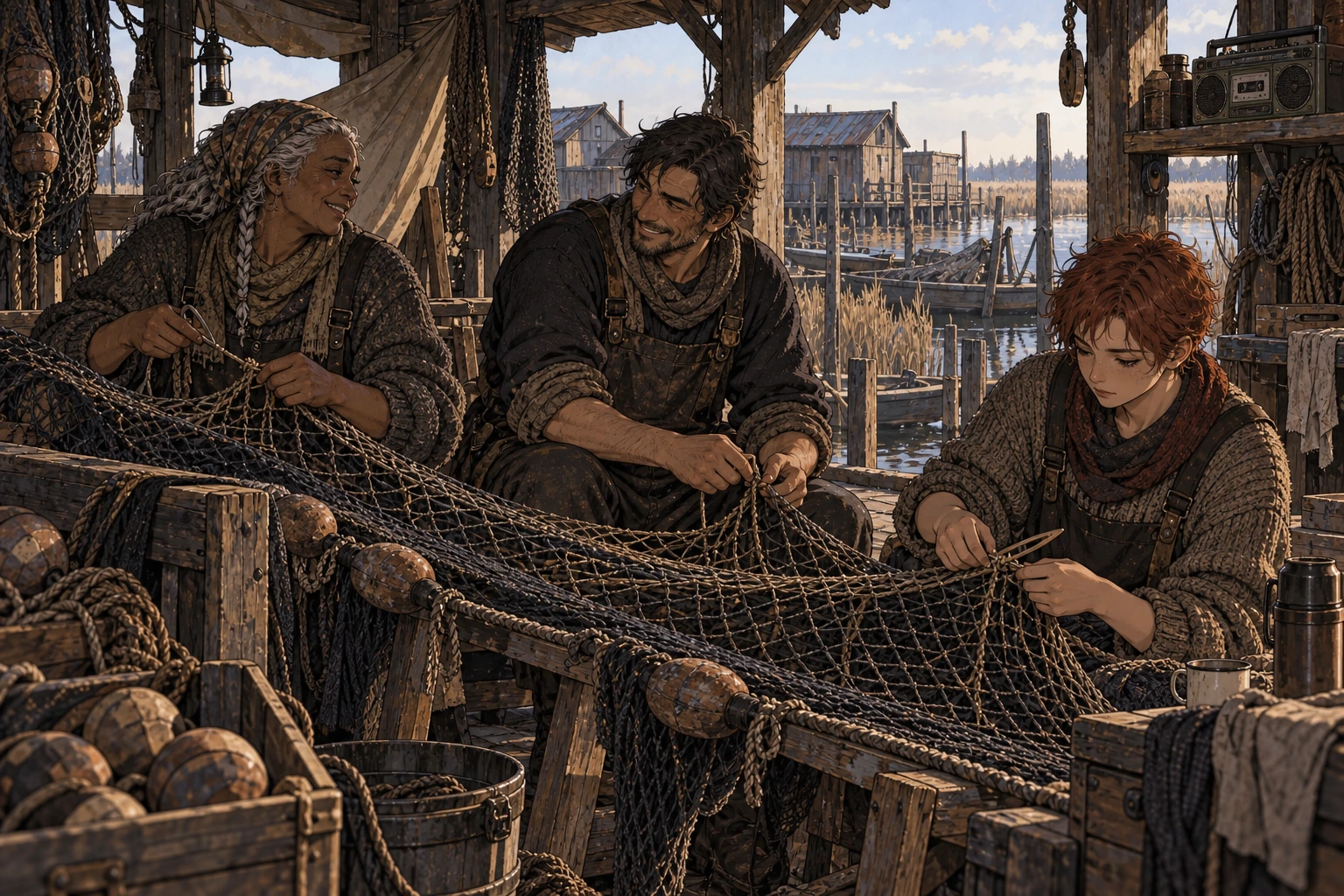
Patched clothing and practised hands hold an ordinary moment of affection among people who share difficult work.
Open full-size illustration ↗People in this picture · 3
Nadia Rellin
left, holding the net edge · Goes by Nadia
Residence: Hollenmere. Nadia is a net-maker who checks a repair under tension before calling it finished. She enjoys teaching when nobody pretends it saves time immediately. Jarek and Rina are her children.
Jarek Rellin
centre, mending and talking · Goes by Jarek
Residence: Hollenmere. Jarek works on a small fishing crew and repairs its gear between trips. He is better at telling a story than keeping the net still while doing it. Nadia is his mother and Rina his younger sister.
Rina Rellin
right, concentrating on the net · Goes by Rin
Residence: Hollenmere. Rin is a school pupil with no paid job. She is learning household net-mending and would rather finish a difficult knot than join the joke. Nadia is her mother and Jarek her brother.
Connections worth following
| Journey | What normally moves | Relationship under pressure |
|---|---|---|
| Tarnfeld → Roven Ferry → Stavenbruck | Discs, roots, eggs, passengers and repairs | Farm prices versus city procurement deductions |
| Brackenzell ↔ Stavenbruck | Castings, tools, apprentices and medical referrals | Industrial dependence without equal bargaining power |
| Hollenmere ↔ Tarnfeld | Fish, reed packing, grain and pump labour | Water management benefits one field while flooding another |
| Vesk Halt ↔ the other settlements | Freight, recorded dispatches, seasonal workers | A scheduling change can enrich a depot and bypass a town |
An argument over a new freight stop can sustain a story involving pilots, schoolchildren, shareholders and a medical referral without ever involving the prison. Regional development begins with such overlapping interests, not a compulsory conspiracy behind every shipment.
Protected cultivation
Growing food is dangerous because of the glowing rain. Gardens must be fully enclosed overhead and on all sides in transparent polyurethane or plastic greenhouses that keep the rain off the plants. This includes food and flower gardens. .