Stavenbruck uses municipal and contractor wages, household ration entitlements, cash markets, barter and debt. Currency remains generically described; no central bank or global monetary system is needed.
People enter formal work through hiring, apprenticeships and labour-office placement. Essential-service workers face emergency transfer restrictions. Others can change employment, although shortages and sponsorship constrain them. Informal vendors and repairers coexist with formal jobs. Workplace mutual-aid committees and apprenticeship circles exist locally without implying a powerful citywide union.
Injury and caregiving can interrupt wages without automatically cancelling basic ration registration. Clinic certificates and household arrangements mediate imperfect relief. Losing wages can threaten rent and heating even while food claims persist: employment, residence and ration access are connected but distinct.
A trade has an ordinary day
The city does not consist only of guards, engineers and anonymous labourers. Boiler attendants monitor familiar equipment and call qualified repair crews when observations exceed their role. Launderers sort, clean, dry and mend under constraints of water, heat and collection times. Container makers cut, join and repair the crates that food accounts depend on. Counter clerks reconcile people and forms. Instrument fitters work between precision parts, users' complaints and drawings that may describe an older version of a machine. Alterations workers, porters, drivers, cooks, teachers and carers have expertise that is not interchangeable merely because a superior wants another pair of hands.
The Labour Rooms near Freight Ward post vacancies, accept employer notices and maintain placement records. A resident might find a formal job there, enter a family workshop, hear of a vacancy through a kitchen neighbour or make money informally. Sponsorship matters because an employer wants some evidence of reliability; it also excludes capable people without recognised contacts. Hiring an unknown person can be a commercial judgement, generosity or a means of obtaining someone with little bargaining power.

Precision parts, old drawings and a user’s complaint call for a fitter’s particular expertise. Practical skill is not interchangeable labour.
Open full-size illustration ↗People in this picture · 2
Klara Hem
left, indicating the opened mechanism · Goes by Klara
Residence: Pump Ward, Stavenbruck. Klara is a machine operator who has brought a fault to the instrument bench. She describes when it occurs before offering a theory. Naren is the precision fitter examining her equipment.
Naren Loth
right, holding the gauge · Goes by Naren
Residence: Pump Ward, Stavenbruck. Naren is a precision fitter who compares a user’s account with the old drawing and the part itself. Klara operates the machine that depends on the gauge he is examining.
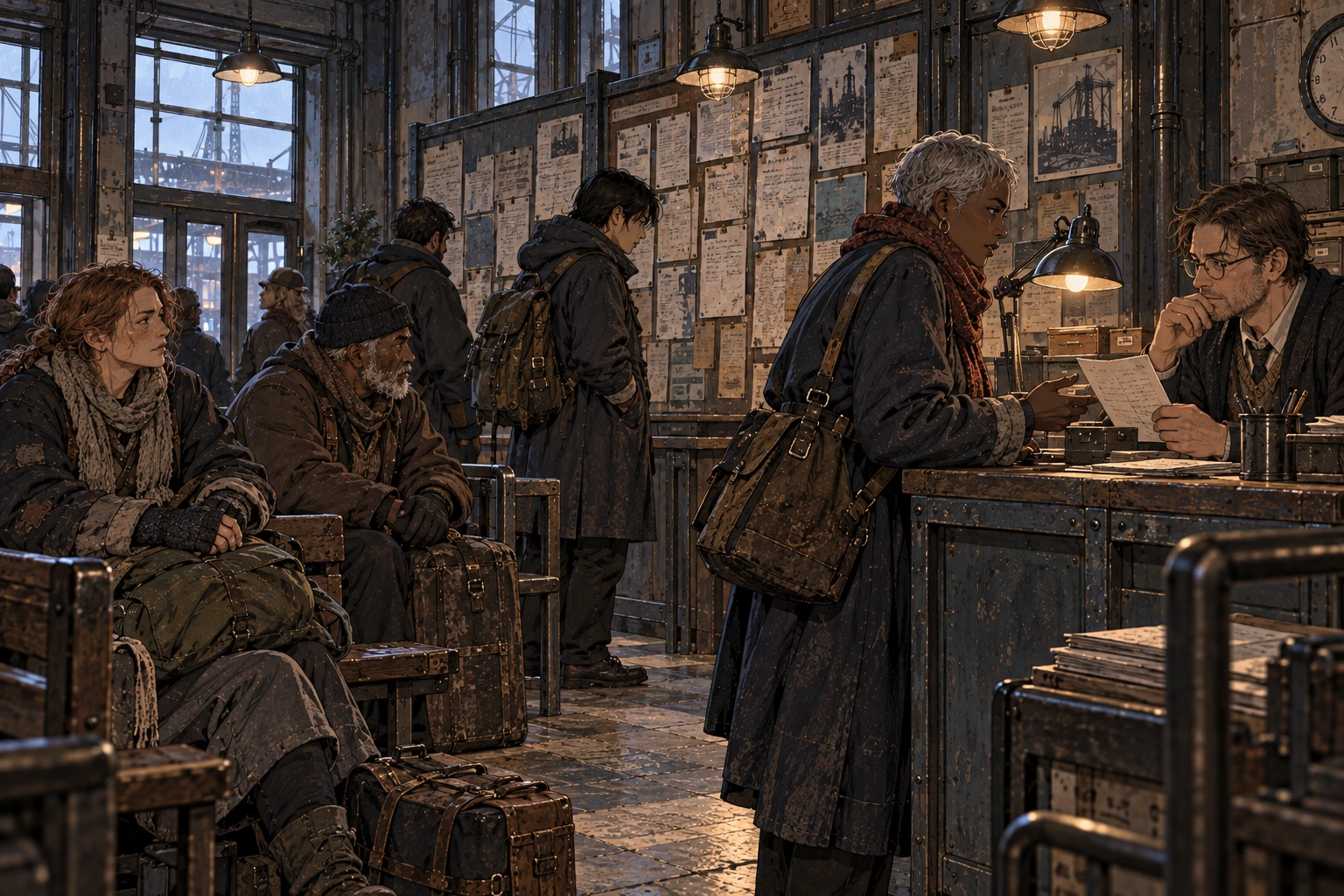
Applicants study vacancies and wait for placement at the labour office. Sponsorship can open a door while excluding another capable worker.
Open full-size illustration ↗People in this picture · 2
Zora Pelnik
centre-right, presenting her paper at the counter · Goes by Zora
Residence: Northbank, Stavenbruck. Zora is an experienced packing worker currently seeking paid employment. She wants the placement office to record her existing skills. Elias is the Labour Rooms clerk hearing her application.
Elias Krov
right, behind the Labour Rooms counter · Goes by Eli
Residence: Old Exchange, Stavenbruck. Eli is a labour-placement clerk who compares applicants’ records with current vacancies. He cannot turn an expired opening into a real job. Zora is an applicant, not a worker under his supervision.
Recognition and opportunity
A good apprentice learns why a job is done in a particular order, how to recognise a defect and when to ask for another judgement. They also learn where spare tools are kept and whose promise can be trusted. A qualified rural worker may need a demonstration or probation period to obtain city recognition. The useful compromise is not always “paperwork bad, experience good”: a credible practical assessment can protect both the worker and the people relying on their work.
Workplace committees have concrete demands: washing access after a dirty shift, notices early enough to arrange care, payment during required training, or replacement equipment without a humiliating argument. People who oppose a stoppage can still support those demands. A committee member might worry that shutdown will cut heat to their own building. Industry's connection to domestic infrastructure makes solidarity complicated and capable of serious thought, not automatically impossible. Pursuing a complaint adds another burden: shift records may be incomplete, witnesses may fear losing preferred work, and attending a hearing can consume unpaid time. Committees have limited money to support members through delays. Collective records and practical bargaining can nevertheless obtain paid training, replacement equipment or a dependable schedule; a won improvement is not automatically withdrawn by the next scene.

A rural worker demonstrates a practical skill for recognition. Experience and a credible assessment can protect both workers and those relying on their work.
Open full-size illustration ↗People in this picture · 2
Ibrahim Sarn
left, demonstrating the coupling · Goes by Ibra
Residence: Tarnfeld. Ibra repairs rural pump equipment and is seeking formal recognition of that experience. He wants the assessment to include what he can demonstrate. Mira is the assessor recording his work.
Mira Vesel
right, holding the assessment board · Goes by Mira
Residence: Pump Ward, Stavenbruck. Mira is a practical-skills assessor who notes the method as well as the finished result. She asks why an applicant chose a tool. Ibra is the worker being assessed; they have no family connection.

A workplace committee gathers evidence and bargains over equipment, paid training and workable schedules. Limited resources make the effort difficult without making success impossible.
Open full-size illustration ↗People in this picture · 4
Hugo Beren
left, listening over the records · Goes by Hugo
Residence: Pump Ward, Stavenbruck. Hugo is a workshop accounts clerk who brings the wage and shift records to committee meetings. He checks totals before discussing a promise. The other three are his workplace colleagues.
Zina Talvek
centre-left, checking the wristwatch · Goes by Zina
Residence: Pump Ward, Stavenbruck. Zina is an assembly worker fitting this meeting between paid work and care duties. She wants the discussion to produce a practical next step. Hugo, Alek and Lara are colleagues on the workplace committee.
Alek Ron
centre-right, holding the training book · Goes by Alek
Residence: Pump Ward, Stavenbruck. Alek is a shop-floor trainer seeking paid instruction time and usable equipment. He dislikes training plans that borrow unpaid hours from beginners. The other committee members work in the same establishment.
Lara Meln
right, indicating the shift papers · Goes by Lara
Residence: Pump Ward, Stavenbruck. Lara is a machine operator who has kept copies of the rota changes. She wants the proposed improvement tested against a real working week. Hugo, Zina and Alek are her colleagues, with different constraints on their time.
A life outside the trade
An experienced fitter may be a novice musician. A clerk may tend a productive garden inside a fully enclosed transparent polyurethane or plastic greenhouse. An intimidating shop owner may be the person who brings a careful meal to a sick neighbour. Work affects identity without exhausting it. Characters can pursue a better contract, a new technique or a change of profession because they want more time, more recognition, a different place to live or the pleasure of making something well.
Detailed cash examples are in the economy entry; teaching arrangements are in education; actual machine ownership is in infrastructure. Read together, those subjects explain why a skilled person might stay with a difficult employer or leave a secure post for a risky small workshop. Neither choice must reveal a secret motive beyond the one the person actually has.
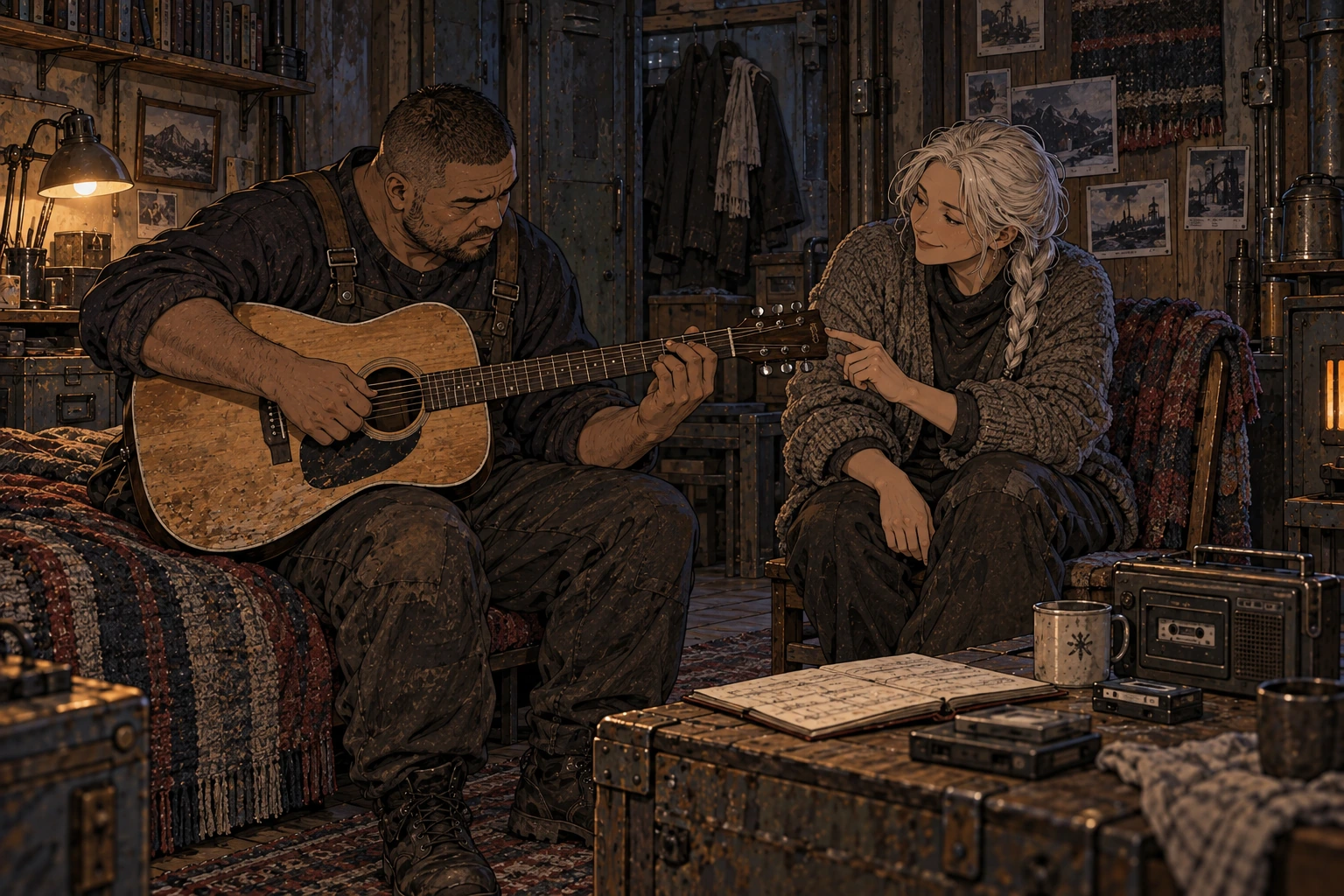
An experienced worker becomes a beginner with an instrument after the shift. Work shapes a life without exhausting its interests.
Open full-size illustration ↗People in this picture · 2
Olaf Shev
left, practising the guitar · Goes by Olaf
Residence: Pump Ward, Stavenbruck. Olaf is a heavy-machine fitter and a beginner guitarist. He is discovering that competence in one job does not spare him slow practice elsewhere. Nera is a friend teaching him after work.
Nera Kal
right, indicating the fretboard · Goes by Nera
Residence: Northbank, Stavenbruck. Nera is a paid linen mender who also plays at small gatherings. She likes teaching without turning an evening’s pleasure into another production target. Olaf is her friend and pupil; they live separately.
Protected cultivation
Growing food is dangerous because of the glowing rain. Gardens must be fully enclosed overhead and on all sides in transparent polyurethane or plastic greenhouses that keep the rain off the plants. This includes food and flower gardens. .
Illustrated scenes
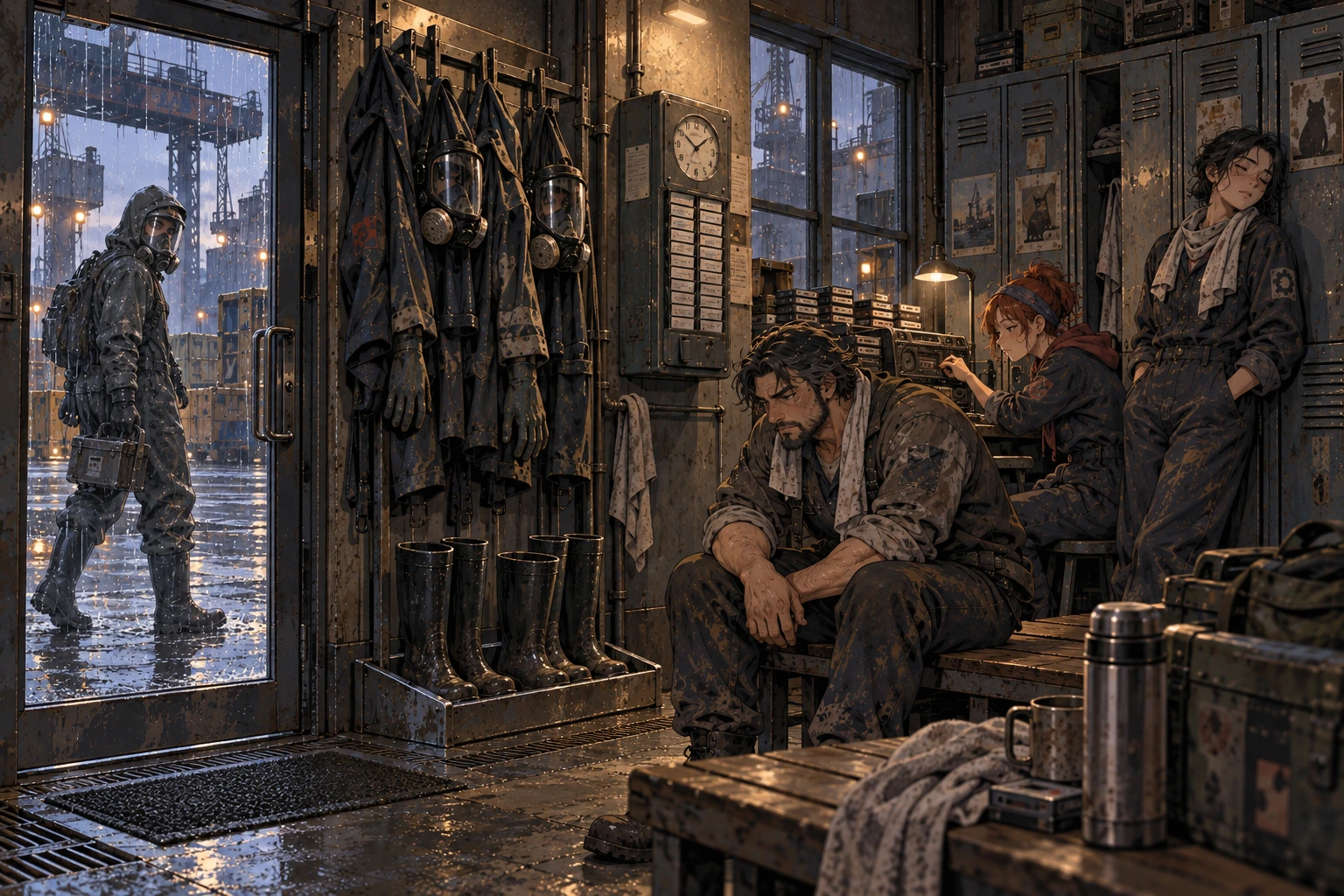
People in this picture · 3
Viktor Orelik
centre foreground, resting with head lowered · Goes by Vik
Residence: Pump Ward, Stavenbruck. Vik is a furnace-cleaning worker finishing a punishing shift. He wants a few quiet minutes before the journey home. Marta and Hana are shift colleagues resting in the same changing room.
Marta Rellov
behind Viktor, red-haired worker on the bench · Goes by Mart
Residence: Pump Ward, Stavenbruck. Mart works on the plant’s instrument cleaning crew and records minor faults before they are forgotten. She is off duty now. Vik and Hana share her shift; she is not the waterworks technician Marta Velska.
Hana Vorvik
right, leaning against the lockers · Goes by Hana
Residence: Pump Ward, Stavenbruck. Hana is a plant maintenance assistant who saves energy for the walk home. Her next job tonight is getting dry equipment ready for tomorrow. Vik and Mart are coworkers; the protected figure outside is incidental to this room’s focus.